Introduction
The acronym CFD appears across multiple professional domains with completely different meanings, leading to frequent confusion among professionals and learners alike. Whether you encountered CFD in a financial news article, an engineering journal, or a corporate job posting, understanding the correct definition is essential. This guide clarifies both primary meanings of CFD, explains how each works in practice, and provides context to help you identify which CFD is being discussed in any given situation.
CFD in Finance: Contracts for Difference
In the financial world, a Contract for Difference (CFD) is a derivative trading instrument that allows investors to speculate on the price movement of an underlying asset without actually owning it. CFDs have become increasingly popular among retail traders since the 1990s, particularly in markets outside the United States where they remain largely prohibited.
How CFDs Work in Trading
A CFD is an agreement between a trader and a broker to exchange the difference in an asset’s value between the contract’s opening and closing positions. The broker acts as the counterparty to your trade, which makes selecting a reputable, well-regulated platform essential for protecting your capital and ensuring fair execution.
Choosing a reputable broker is critical for CFD trading success. See our comprehensive guide to the best forex brokers in 2026 to compare platforms, fees, and regulatory protections before you begin trading.
Here’s the fundamental process of how CFD trading works:
- Opening a Position: The trader enters a CFD contract based on whether they believe an asset’s price will rise (going “long”) or fall (going “short”)
- Leverage Application: Brokers typically offer leverage ratios from 5:1 to 30:1, meaning traders can control positions much larger than their initial capital
- Price Movement: As the underlying asset’s market price changes, the CFD position gains or loses value accordingly
- Settlement: When closing the position, the trader receives profit or incurs loss based on the price difference, minus fees and overnight financing charges
Real-world example: If you open a long CFD position on 100 shares of a company trading at $50 with 10:1 leverage, you’d need only $500 in margin. If the price rises to $55, you profit $500 (minus fees). However, if it drops to $45, you lose $500, potentially exceeding your initial investment when leverage amplifies losses.
Key Features of Financial CFDs
FeatureDescriptionImplication
| No Asset Ownership | Trader never owns the underlying stock, commodity, or currency | No voting rights, dividends paid as adjustments, purely speculative |
| Leverage | Control large positions with small capital deposits | Amplifies both profits and losses significantly |
| Two-Way Trading | Profit from rising or falling markets | Flexibility to trade in bear markets, but requires market timing skill |
| Overnight Fees | Holding positions beyond one day incurs financing charges | Long-term positions become expensive, favors short-term trading |
| No Expiration | Unlike options or futures, most CFDs have no set expiry date | Trader controls timing but pays daily fees for open positions |
Advantages and Risks of CFD Trading
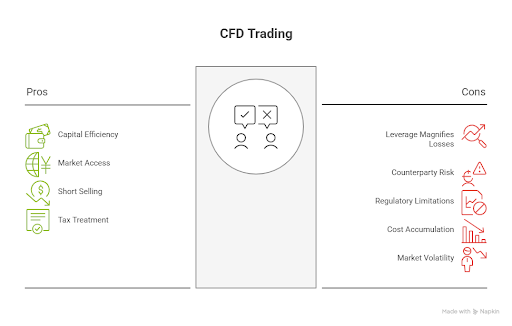
Advantages experienced by traders:
- Capital Efficiency: Leverage allows controlling substantial positions with limited capital, potentially generating higher percentage returns
- Market Access: Single accounts can trade stocks, indices, commodities, forex, and cryptocurrencies across global markets
- Short Selling Simplified: Going short on CFDs is as straightforward as going long, without borrowing requirements
- Tax Treatment: In some jurisdictions, CFDs receive favorable tax treatment compared to traditional securities (consult local tax professionals)
Critical risks to understand:
- Leverage Magnifies Losses: Just as leverage amplifies gains, it exponentially increases potential losses, sometimes exceeding initial deposits
- Counterparty Risk: CFDs are OTC (over-the-counter) contracts with brokers; if the broker fails, your position is at risk
- Regulatory Limitations: CFDs are banned for retail traders in the United States and face increasing restrictions in other markets
- Cost Accumulation: Spread, commission, and overnight financing fees erode profitability, especially for longer-term positions
- Market Volatility: Rapid price movements can trigger margin calls, forcing position closures at unfavorable prices
Studies show that 70-80% of retail CFD traders lose money, primarily due to inadequate risk management and overuse of leverage.
CFD in Engineering: Computational Fluid Dynamics
Computational Fluid Dynamics (CFD) represents a branch of fluid mechanics that uses numerical analysis and algorithms to solve and analyze problems involving fluid flows. Engineers and researchers across industries rely on CFD to simulate how liquids and gases interact with surfaces, structures, and environments.
How Computational Fluid Dynamics Works
CFD transforms complex fluid dynamics equations—primarily the Navier-Stokes equations—into solvable mathematical models through these steps:
- Geometry Creation: The physical domain (vehicle, pipe, aircraft wing) is modeled in 3D CAD software
- Mesh Generation: The geometry is divided into millions of small computational cells forming a mesh or grid
- Physics Definition: Boundary conditions, fluid properties, turbulence models, and initial conditions are specified
- Numerical Solution: Specialized algorithms solve governing equations iteratively across each mesh cell
- Post-Processing: Results are visualized through velocity vectors, pressure contours, temperature distributions, and streamlines
Practical example: When designing a new car, automotive engineers use CFD to simulate airflow around the vehicle body at various speeds. The simulation reveals areas of high drag, turbulence behind mirrors, and cooling airflow to the engine bay—all without building physical prototypes, saving months and millions in development costs.
Applications of CFD in Industry
CFD has become indispensable across engineering disciplines:
Industry | Application | Business Impact |
Aerospace | Wing design, engine combustion, aircraft aerodynamics | Fuel efficiency improvements of 5-15%, reduced wind tunnel testing costs |
Automotive | Vehicle aerodynamics, HVAC systems, engine cooling | Drag reduction translating to better fuel economy and performance |
Energy | Turbine blade optimization, combustion analysis, reactor design | Enhanced energy conversion efficiency, safety validation |
Architecture | Building ventilation, wind loading, smoke dispersion | Occupant comfort, structural integrity, emergency planning |
Biomedical | Blood flow in arteries, drug delivery, respiratory systems | Improved medical device design, personalized treatment planning |
Manufacturing | Mixing processes, coating applications, HVAC design | Process optimization, product quality consistency |
Popular CFD Software and Tools
Professional CFD engineers work with specialized software platforms, each offering distinct capabilities:
Commercial Solutions:
- ANSYS Fluent: Industry-standard for complex physics, turbulence modeling, and multiphase flows
- ANSYS CFX: Preferred for turbomachinery applications like pumps, compressors, and turbines
- Siemens Star-CCM+: Known for automated meshing and integrated CAD-to-simulation workflows
- COMSOL Multiphysics: Excels at coupling CFD with structural, electromagnetic, and chemical simulations
- Autodesk CFD: Accessible option for product designers requiring thermal and fluid analysis
Open-Source Alternatives:
- OpenFOAM: Powerful, highly customizable, used extensively in academic research and by companies with in-house development capabilities
- SU2: Specialized in aerodynamic shape optimization and adjoint-based design
The learning curve for CFD is substantial. Competent CFD analysts typically need graduate-level fluid mechanics knowledge, understanding of numerical methods, and months of software-specific training to produce reliable results.
Other Common Meanings of CFD
While finance and engineering dominate CFD usage, the acronym appears in additional contexts:
- Chief Financial Disclosure (government and compliance)
- Continuous Function Deployment (software development)
- Community Food Distribution (nonprofit sector)
- Computational Forensic Dynamics (legal and forensic science)
- Conceptual Framework Document (project management)
These specialized uses remain context-specific to particular industries or organizations and rarely cause confusion within their domains.
How to Determine Which CFD is Being Referenced
Identifying the correct CFD meaning requires examining contextual clues:
Financial CFD indicators:
- Discussion includes terms like leverage, margin, broker, spread, long/short positions
- Mentions of forex, stocks, indices, commodities as underlying assets
- References to trading platforms, regulations like ESMA, or retail trading
- Content appears in financial news, investment forums, or brokerage materials
Engineering CFD indicators:
- Technical terminology like mesh, turbulence models, Navier-Stokes, Reynolds number
- Discussion of simulation, fluid flow, heat transfer, or aerodynamics
- References to software packages like ANSYS, OpenFOAM, or Star-CCM+
- Content in engineering journals, technical specifications, or research papers
When in doubt, the surrounding subject matter almost always clarifies which CFD is relevant. A discussion about investment risks clearly points to Contracts for Difference, while talk of grid refinement and convergence indicates Computational Fluid Dynamics.
CFD Comparison: Finance vs Engineering
Aspect | Contract for Difference | Computational Fluid Dynamics |
Primary Field | Finance and trading | Engineering and physics |
Purpose | Speculative investment instrument | Simulation and analysis tool |
Users | Retail traders, institutional investors | Engineers, researchers, designers |
Risk Type | Financial loss through market exposure | Simulation error leading to design flaws |
Learning Curve | Moderate—trading platforms are accessible | Steep—requires advanced mathematics and physics |
Regulation | Heavily regulated, banned in some regions | Industry standards and validation requirements |
Cost to Entry | Low initial capital with leverage | Expensive software licenses, high-performance computing |
Time Horizon | Minutes to months (trading positions) | Days to weeks (simulation projects) |
Conclusion
Understanding what CFD stands for depends entirely on your professional context. In finance, Contracts for Difference offer leveraged exposure to market movements with significant profit potential and equally substantial risk. In engineering, Computational Fluid Dynamics provides powerful simulation capabilities that optimize designs and reduce development costs across industries.
Both CFD types demand respect for their complexity and potential consequences. Financial CFDs require rigorous risk management and market understanding, while engineering CFDs demand technical expertise and careful validation. Whichever CFD you encounter, commit to thorough education and professional guidance before application.
Ready to learn more? If you’re exploring CFD trading, start with demo accounts and comprehensive risk education. For engineering CFD, consider formal coursework in fluid mechanics and seek mentorship from experienced simulation engineers. The investment in proper training pays dividends regardless of which CFD path you pursue.
Frequently Asked Questions
Is CFD trading legal?
CFD trading legality varies by jurisdiction. It's prohibited for retail investors in the United States but legal and regulated in the UK, EU, Australia, and many other countries. Always verify local regulations before trading.
Do I need special qualifications to use CFD software?
While no formal certification is required to use CFD software, effective application demands strong fundamentals in fluid mechanics, thermodynamics, and numerical methods—typically requiring at least undergraduate engineering education.
Can I make money consistently with CFD trading?
Statistical evidence shows most retail CFD traders (70-80%) lose money. Success requires disciplined risk management, market knowledge, and emotional control. CFD trading should never involve funds you cannot afford to lose.
How accurate are CFD simulations?
CFD accuracy depends on mesh quality, turbulence model selection, boundary conditions, and solver settings. Properly validated simulations achieve 90-95% accuracy for many engineering applications, but results require verification against experimental data.
What's the minimum investment for CFD trading?
Many brokers allow CFD accounts with deposits as low as $100-$500, though professional traders recommend substantially more capital to manage risk appropriately and withstand normal market volatility.
How long does a CFD simulation take?
Simulation runtime varies dramatically based on complexity—from hours for simple 2D analyses to weeks for detailed 3D transient simulations requiring supercomputing resources.