TopBrokers360

Forex Trading for Beginners: Start & Profit Guide

What Is Forex Trading?

Forex — short for foreign exchange — is the global marketplace for trading national currencies against one another. Every time a business converts euros to dollars for an overseas transaction, or a traveler exchanges pounds for yen at an airport, they’re participating in the forex market. Retail traders like you can access this market to speculate on whether one currency will strengthen or weaken against another.

According to the Bank for International Settlements’ 2022 Triennial Survey (the most comprehensive data source for FX market activity), daily forex trading volume exceeds $7.5 trillion. This dwarfs global stock markets by a factor of roughly 25. That liquidity means tighter spreads and easier order execution — advantages that matter enormously when you’re starting out.

“The forex market is not a level playing field — institutions have information advantages. But retail traders who understand price action, manage risk tightly, and stay patient can carve out a real edge.”

— Common principle among consistently profitable independent traders

What makes forex accessible to beginners is the low barrier to entry: many regulated brokers allow you to open an account with as little as $100–$500, offer free demo accounts with virtual money, and provide educational resources. What makes it difficult is that leverage amplifies both gains and losses, and emotional decision-making destroys more accounts than any bad strategy.

How the Forex Market Works

Unlike stock exchanges such as the NYSE or London Stock Exchange, forex has no central exchange or clearing house. It operates as an over-the-counter (OTC) market — a decentralized global network of banks, institutions, brokers, and individual traders. Prices are quoted by market makers and aggregated through electronic communications networks (ECNs).

Currency Pairs Explained

All forex trades involve simultaneously buying one currency and selling another. These are always quoted as pairs, written as BASE/QUOTE. For example, EUR/USD 1.0850 means one euro buys 1.0850 US dollars.

CategoryPairsCharacteristicsBest For
MajorsEUR/USD, GBP/USD, USD/JPY, USD/CHFHighest liquidity, tightest spreads, most news coverageBeginners
Minors (Crosses)EUR/GBP, AUD/JPY, EUR/CHFModerate liquidity, slightly wider spreadsIntermediate
ExoticsUSD/TRY, EUR/ZAR, USD/MXNLow liquidity, wide spreads, high volatilityExperienced Only

Beginners should focus almost exclusively on major pairs, particularly EUR/USD. It has the highest global trading volume, the most technical analysis reliability (large sample sizes mean patterns repeat more consistently), and the lowest transaction costs.

The Four Trading Sessions

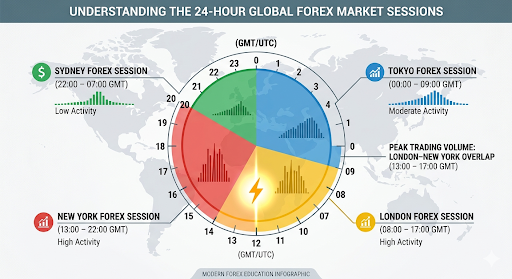
Because forex is global, it effectively trades 24 hours a day Monday through Friday. Activity is concentrated around four major sessions, each dominated by regional institutions:

Session

GMT Hours

Key Currencies

Volatility Level

Sydney

22:00 – 07:00

AUD, NZD

Low

Tokyo

00:00 – 09:00

JPY, AUD, NZD

Moderate

London

08:00 – 17:00

EUR, GBP, CHF

High

New York

13:00 – 22:00

USD, CAD

High

The London–New York overlap (13:00–17:00 GMT) is the highest-volume window of the day. For most strategies, this is where the best trade setups appear. Many experienced traders only trade during these four hours.

Essential Forex Terminology

Before placing a single trade, you need a working command of core forex terminology. These aren’t academic definitions — they have direct financial consequences on every trade you take.

Term

Definition

Practical Impact

Pip

The smallest standard price movement. For most pairs, 1 pip = 0.0001.

EUR/USD moving from 1.0850 to 1.0870 = 20 pips. On a standard lot, each pip = $10 profit/loss.

Spread

The difference between the buy (ask) and sell (bid) price.

Your trade starts at a small loss equal to the spread. Tight spreads reduce this cost.

Leverage

Borrowed capital that multiplies your market exposure. Common ratios: 50:1, 100:1, 500:1.

$1,000 with 100:1 leverage controls $100,000. A 1% move = $1,000 gain or loss — your full capital.

Margin

The deposit held by your broker as collateral for a leveraged position.

At 100:1 leverage, $1,000 opens a $100,000 position. That $1,000 is your margin.

Lot Size

Standard lot = 100,000 units. Mini lot = 10,000. Micro lot = 1,000.

Beginners should use micro or mini lots to limit per-pip dollar risk.

Stop-Loss

A pre-set order that closes your trade automatically at a defined loss level.

The single most important risk management tool. Never trade without one.

Take Profit

A pre-set order that closes your trade automatically at a defined profit level.

Removes emotional decision-making about when to exit a winning trade.

Going Long / Short

Long = buying, expecting price to rise. Short = selling, expecting price to fall.

Unlike stocks, you can profit in both rising and falling markets.

Leverage Warning

High leverage is the single biggest cause of account blow-ups among beginners. A 100:1 leverage ratio means a 1% adverse price movement wipes out your entire deposit. Most professional retail traders use leverage no higher than 10:1 or 20:1, even when brokers offer far more.

How to Start Trading Forex: Step-by-Step

Starting forex trading correctly means building your foundation before risking real money. The following sequence is how experienced traders recommend beginners approach their first 3–6 months.

  • Educate yourself on the fundamentals
  • Spend 2–4 weeks reading about how forex works, what moves currency prices (interest rates, economic data, geopolitics), and how to read candlestick charts. This guide is your starting point, but go deeper with free resources from brokers like IG, OANDA, and Babypips.com.
  • Choose a regulated broker
  • Only use brokers regulated by Tier 1 regulators: FCA (UK), ASIC (Australia), CySEC (EU), or NFA/CFTC (USA). Regulatory oversight ensures your funds are protected and the broker operates within legal standards.
  • Open and practice on a demo account
  • A demo account gives you real market conditions with virtual money. Practice here until you can execute your strategy profitably across at least 50–100 trades. Don’t rush this phase — it’s free tuition.
  • Develop and backtest a trading strategy
  • Choose one strategy (see below) and backtest it manually on historical charts. Document every setup: what the entry signal was, where you set your stop-loss, what the outcome was. This creates a statistical edge you can trust.
  • Start live trading with a micro account
  • When your demo results are consistently profitable, open a live account with a small deposit ($200–$500). Use micro lots (1,000 units) initially. Live trading has psychological pressures that demo accounts don’t replicate — starting small lets you adapt without catastrophic losses.
  • Track every trade in a journal
  • Record entry price, stop-loss, take-profit, lot size, the reason for the trade, and the outcome. Reviewing your journal monthly reveals patterns in your decision-making that are invisible without data.

How to Choose a Forex Broker

Your broker is your access point to the market, and a poor choice can cost you money in hidden fees, poor execution, or outright fraud. Evaluate brokers on these criteria:

Criterion

What to Look For

Red Flag

Regulation

FCA, ASIC, CySEC, NFA/CFTC license

Offshore license only (e.g., Vanuatu, Seychelles)

Spreads

EUR/USD spread below 1.0 pip (ECN brokers)

Fixed spreads above 2 pips on majors

Platform

MetaTrader 4/5, cTrader, or proprietary with charting tools

Browser-only platform with no charting

Execution

Low slippage, fast fills, no dealing desk (NDD)

Frequent requotes, unusual price gaps

Deposit/Withdrawal

Multiple methods, withdrawals processed within 3 business days

Withdrawal delays, excessive verification requirements post-deposit

Education

Free educational resources, webinars, or analysis

Pushy account managers incentivizing higher deposits

Making the Most of a Demo Account

Most beginners treat demo accounts like a video game — consequence-free and therefore emotionally meaningless. To make demo trading useful, impose the same constraints you’ll face live: set a virtual starting balance equal to what you’ll actually deposit, use position sizes that match your planned live risk, and treat every loss as if it were real money. The psychological habits you build in demo carry into live trading.

💡 Pro Tip

Demo accounts typically have better execution and sometimes tighter spreads than live accounts. Add 0.5–1 pip to every simulated spread in your results to get a more realistic picture of your live performance potential.

Reading Forex Charts

Price charts are the primary tool of technical analysis — the method most retail forex traders use to find entries and exits. While fundamental analysis (analyzing economic data and central bank policy) drives long-term currency trends, chart analysis helps pinpoint timing.

The Three Main Chart Types

The candlestick chart is the industry standard for a reason. Each candle shows four data points for a given time period: the opening price, the closing price, the high, and the low. A green (or white) candle means price closed higher than it opened. A red (or black) candle means it closed lower. The “wicks” above and below the body show the extremes reached.

Line charts (connecting closing prices only) give a clean view of trend direction but strip out intraday information. They’re useful for getting a quick directional read on higher timeframes. Bar charts show the same four data points as candlesticks but in a less visual format — rarely used by retail traders today.

Support, Resistance, and Trend Lines

Support is a price level where buying pressure historically overcomes selling, causing price to bounce upward. Resistance is the opposite — a ceiling where selling overcomes buying. These levels aren’t exact prices but zones, and their significance increases each time price respects them.

A trend line connects a series of higher lows (in an uptrend) or lower highs (in a downtrend). A break of a trend line doesn’t automatically signal a reversal, but it does signal potential change — worth monitoring closely.

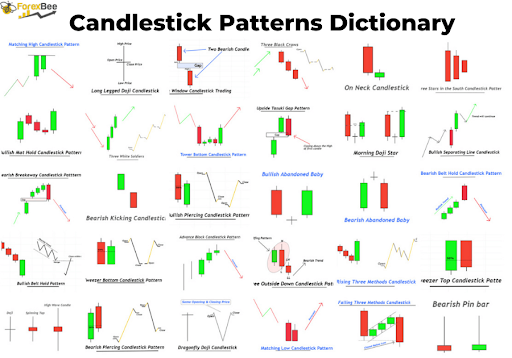
Key Candlestick Patterns for Beginners

Pattern

What It Looks Like

Signal

Reliability

Hammer

Small body, long lower wick, little upper wick

Bullish reversal at support

Moderate-High

Shooting Star

Small body, long upper wick, little lower wick

Bearish reversal at resistance

Moderate-High

Engulfing (Bullish)

Large green candle fully covers preceding red candle

Strong bullish reversal

High

Engulfing (Bearish)

Large red candle fully covers preceding green candle

Strong bearish reversal

High

Doji

Tiny body, equal wicks — open = close

Indecision; watch for follow-through

Low alone, context-dependent

Pin Bar

Long wick in one direction, small body at opposite end

Reversal from key level (high reliability in context)

High in context

📌 Important Context Rule

No candlestick pattern has meaning in isolation. A hammer at a random point in the middle of a trend is unreliable. The same hammer forming at a major support level, after an extended downtrend, on the daily timeframe — that’s a high-probability signal. Context is everything.

Beginner Forex Trading Strategies

The best strategy for a beginner is not the most profitable one you can find — it’s the simplest one you can execute consistently. Complexity is the enemy of discipline. Here are three approaches well-suited to new traders:

1. Trend Following with Moving Averages

Moving averages smooth out price data to reveal the underlying trend direction. The most common combination for beginners: the 50-period EMA (exponential moving average) and the 200-period EMA. When the 50 EMA is above the 200 EMA, the trend is bullish — only look for long trades. When below, bearish — only look for shorts.

Entry: Price pulls back to touch the 50 EMA during an established trend, then shows a reversal candlestick (e.g., a pin bar or engulfing candle). Stop-loss: Just below the swing low that formed at the pullback. Target: Previous swing high (in a bullish trend).

2. Support and Resistance Trading

This is among the most used approaches in professional trading rooms. Mark key horizontal support and resistance zones on the daily or 4-hour chart. Wait for price to reach one of these zones and show a rejection signal. Enter on confirmation, stop just beyond the zone, target the next major level.

The logic is simple: the same institutional levels that caused price to reverse historically often do so again because institutions set orders at round numbers and previous highs/lows.

3. Breakout Trading

Markets often consolidate — moving sideways in a range — before making a significant directional move. A breakout strategy identifies these ranges, waits for price to break convincingly through the boundary (not just touch it), and enters in the direction of the break. Caution: false breakouts are common; many traders wait for a candle to close outside the range and then retest the broken level before entering.

⚠ Strategy Note

No strategy wins every trade. A good strategy wins 40–60% of the time with a reward-to-risk ratio of at least 2:1. That combination is mathematically profitable over a large sample of trades even though more than half are losses. This is why risk management matters more than win rate.

Risk Management: The Foundation of Longevity

Most forex beginners spend 90% of their time looking for better entry signals and 10% on risk management. Experienced traders reverse that ratio. The reason is straightforward: a bad entry with excellent risk management is recoverable. An excellent entry with no risk management can still destroy your account.

The 1–2% Rule

Risk no more than 1–2% of your total account balance on any single trade. If you have a $2,000 account, maximum risk per trade is $20–$40. This isn’t cautious — it’s mathematically sound. At 1% risk, you could lose 20 consecutive trades and still have 82% of your capital remaining. At 10% risk, 10 consecutive losses wipe you out — and losing streaks of 10+ are not unusual even for profitable strategies.

Position Sizing Formula

Once you’ve defined your maximum dollar risk and your stop-loss in pips, your lot size follows from a formula:

Position Size Calculation — Worked Example

Account Balance$2,000

Max Risk Per Trade (1%)$20

Stop-Loss Distance20 pips

Pip Value (Micro Lot, EUR/USD)$0.10 per pip

Required Lot Size$20 ÷ (20 pips × $0.10) = 10 micro lots

Maximum Tolerable Loss$20 (1% of account)

The Risk-to-Reward Ratio

Every trade should have a minimum reward-to-risk ratio (RRR) of 2:1, ideally 3:1. This means if your stop-loss is 20 pips away, your take-profit target should be at least 40 pips (preferably 60 pips). Here’s why this is critical over time:

Win Rate

RRR 1:1

RRR 2:1

RRR 3:1

40%

−20% (losing)

+20% (profitable)

+44% (profitable)

50%

0% (breakeven)

+50% (profitable)

+100% (profitable)

60%

+20% (profitable)

+80% (profitable)

+156% (profitable)

The table above assumes 100 trades with consistent position sizing and a 1% risk per trade. It demonstrates that with a 2:1 RRR, even a trader who wins only 40% of the time is profitable — a counterintuitive and liberating realization for beginners who fixate on win rate.

Common Beginner Mistakes (and How to Avoid Them)

The mistakes that end most beginner trading journeys are predictable. Learning them in advance won’t make you immune — emotions are powerful — but awareness reduces their frequency.

Mistake

Why It Happens

The Fix

Overleveraging

Wanting to make large profits quickly; treating forex like gambling

Cap leverage at 10:1 max. Calculate your lot size from risk first, not from “how much could I win.”

No stop-loss

Belief that price will “come back” — and sometimes it does, which reinforces the habit

Set a stop-loss before clicking the buy or sell button, without exception.

Revenge trading

After a loss, doubling down to “win it back” — emotional decision-making

After two consecutive losses, stop trading for the day. Review the trades; resume tomorrow.

Overtrading

Confusing activity with productivity; feeling compelled to always be in a trade

Only trade when your pre-defined setup appears. No setup = no trade. Patience is a skill.

Jumping strategies

After a losing streak, abandoning a strategy before it has a sufficient sample size

Commit to one strategy for 100+ trades before evaluating it. Short-run variance is not failure.

Ignoring economic news

Placing trades before high-impact data releases (NFP, CPI, central bank decisions)

Check an economic calendar (like Forex Factory) every morning. Avoid open trades during red-flag events.

Trading too many pairs

More pairs = more opportunities (false logic)

Master 1–2 pairs first. EUR/USD and GBP/USD are sufficient for a full career of trading.

🚨 Scam Warning

Be highly skeptical of anyone on social media promising guaranteed forex returns, “copy trading” signals with fabricated track records, or “mentors” selling courses that promise five-figure monthly profits. Legitimate traders do not need to sell courses. Verify any signal service against verified, audited results — not screenshots of MetaTrader accounts.

Can Beginners Actually Profit from Forex Trading?

This question deserves a direct, honest answer: yes, but not quickly, and not most beginners. Regulatory disclosure data from EU-regulated brokers shows that between 70–80% of retail CFD/forex trading accounts lose money. That is a sobering statistic — and it doesn’t mean you should walk away from forex, but it does mean you should walk in clear-eyed.

The traders in the 20–30% who are profitable share common characteristics: they treated learning like a professional undertaking, spent months on demo accounts before going live, implemented strict risk management, and accepted that losing trades are part of any positive-expectancy strategy. None of them got there in three months.

Realistic Timeline and Expectations

Phase

Timeframe

Goals

Common Pitfall

Learning

Month 1–2

Understand all core concepts, open demo account

Skipping demo and going straight to live

Demo Mastery

Month 2–5

Develop and backtest a strategy; execute 50–100 demo trades

Not treating demo as serious

Live (Micro)

Month 5–10

Apply your strategy with real money at micro lot sizes; manage psychology

Increasing position sizes too quickly

Consistent Profitability

Month 10–18+

Achieve 3+ consecutive profitable months; refine strategy with journal data

Confusing a lucky run with expertise

Scaling

Year 2+

Increase position sizes with a proven statistical edge; possible account growth

Emotional drift as stakes increase

The traders who succeed are not the smartest or the most informed. They are the most disciplined. Forex rewards patience and penalizes impulsiveness consistently and without mercy. Treat it accordingly.

Final Thoughts: Your Forex Trading Starting Point

Forex trading for beginners doesn’t have to be the confusing, loss-ridden experience it is for most new participants. The difference between those who wash out and those who build sustainable trading practices comes down to a few consistent principles:

  • Learn the fundamentals before you risk any real capital — there’s no shortcut here.
  • Start on a demo account and treat it with the same discipline you’d apply to real money.
  • Choose a regulated broker with tight spreads and transparent practices.
  • Risk no more than 1–2% per trade and always trade with a stop-loss in place.
  • Master one or two currency pairs and one strategy before expanding your scope.
  • Journal every trade and review monthly — your own data is the best teacher.

The market will be there when you’re ready. The only trader who has no chance is the one who enters without preparation. Take your time, build your foundation, and let the compounding of disciplined trades do the work.

Dive deeper and discover what CFD really means—whether in trading or engineering. Don’t miss the full breakdown, real-world examples, and key risks. Read the full article now and get clarity before you act.

Author

Reach the new peaks of trading with FXNovus

Online broker of a new generation. Creating a new trading reality

Scroll to Top