Understanding how the forex market works is essential if you’re considering trading currencies or simply want to grasp how global money flows operate. Forex (foreign exchange) is not just for banks or large institutions—it’s accessible to individual traders worldwide.
In this comprehensive beginner guide, you’ll learn the mechanics behind forex trading, what influences currency prices, how trades are executed, and what separates successful traders from those who struggle. This is not theory alone—it’s grounded in how the market actually behaves in real conditions.
What Is the Forex Market?
The foreign exchange market (forex or FX) is a decentralized global network where currencies are traded electronically. Unlike stock markets, forex has no central exchange—transactions occur between participants via banks and brokers.
Operates 24 hours a day, 5 days a week
Involves global financial centers (London, New York, Tokyo)
Daily trading volume exceeds $7 trillion, making it the most liquid market
Real-World Context
Every time a business imports goods, travels internationally, or invests abroad, forex transactions occur. Trading is simply a speculative extension of these real-world currency exchanges.
How Forex Trading Works
Currency Pairs Explained
Currencies are quoted in pairs because you’re always comparing one currency to another.
Pair
Meaning
Example Interpretation
EUR/USD
Euro vs US Dollar
EUR strengthening vs USD
GBP/JPY
British Pound vs Japanese Yen
GBP rising vs JPY
USD/CHF
US Dollar vs Swiss Franc
USD gaining vs CHF
👉 Buying a pair = expecting the base currency to rise 👉 Selling a pair = expecting it to fall
Understanding Exchange Rates
An exchange rate shows how much of the quote currency is needed to buy one unit of the base currency.
Example:
EUR/USD = 1.10 → 1 Euro = 1.10 USD
If it rises to 1.12, the euro has strengthened.
Bid, Ask, and Spread
Term
Meaning
Bid
Price buyers are willing to pay
Ask
Price sellers demand
Spread
Difference between bid and ask
Practical Insight (Experience-Based)
In real trading conditions, spreads widen during major news events or low liquidity periods. This means entering trades at the wrong time can cost more than expected—something many beginners only learn after losses.
Pips and Lot Sizes
What is a Pip?
A pip is the smallest price movement in most currency pairs.
EUR/USD moves from 1.1000 → 1.1001 = 1 pip
Lot Sizes Explained
Lot Type
Units
Typical Pip Value
Standard
100,000
$10 per pip
Mini
10,000
$1 per pip
Micro
1,000
$0.10 per pip
👉 Understanding this is critical for managing risk.
Who Participates in the Forex Market
The forex ecosystem is layered:
Participant Type
Role
Central Banks
Control monetary policy
Commercial Banks
Facilitate global transactions
Hedge Funds
Speculate with large capital
Corporations
Exchange currencies for operations
Retail Traders
Individual speculators
Key Insight
Retail traders follow the market—but institutions often move it. Understanding this helps explain sudden volatility.
What Moves the Forex Market
Macroeconomic Factors
Currencies reflect a country’s economic health.Key indicators:
GDP growth
Inflation (CPI)
Employment data (e.g., Non-Farm Payrolls)
Central Banks and Monetary Policy
Central banks influence currencies through:
Interest rate changes
Quantitative easing
Policy guidance
Example
When the European Central Bank signals tightening policy, the euro often strengthens due to increased investor confidence.
Market Sentiment and Speculation
Markets often move on expectations rather than facts.
Example:
If traders expect inflation to rise → currency may move before data is released.
Forex Trading Sessions and Market Hour
Session
Major Centers
Characteristics
Asian
Tokyo
Lower volatility
European
London
High liquidity
US
New York
Strong trends
Overlap Advantage
The London–New York overlap produces the highest trading volume and clearer price movements.
Leverage, Margin, and Risk Management
Leverage Explained
Leverage allows you to control larger positions than your capital.
Example:
1:100 leverage → $100 controls $10,000
Margin Explained
Margin is the amount required to open a trade.
Risk Management Principles
Risk 1–2% per trade
Use stop-loss orders
Avoid over-leveraging
Real Trader Insight
Many beginners focus on winning trades. Experienced traders focus on losing less when wrong.
Order Types in Forex Trading
Order Type
Description
Market Order
Instant execution
Limit Order
Executes at specific price
Stop-Loss
Limits losses
Take-Profit
Locks in gains
Common Forex Trading Strategies
1. Day Trading
Fast-paced, requires constant monitoring
2. Swing Trading
Holds trades for days/weeks—ideal for beginners.
3. Scalping
Very short-term trades; high skill required.
4. Position Trading
Long-term approach based on macro trends.
Technical vs Fundamental Analysis
Type
Focus
Tools
Technical
Price patterns
Charts, indicators
Fundamental
Economic data
News, reports
Best Practice
Most successful traders combine both approaches rather than relying on one.
Risks of Forex Trading
Forex trading involves real financial risk.
Major Risks
Market volatility
Emotional decisions
Over-leverage
Lack of strategy
Transparent Reality
Statistics from brokers consistently show a large percentage of retail traders lose money. This is not due to the market being unfair—but due to lack of preparation and discipline.
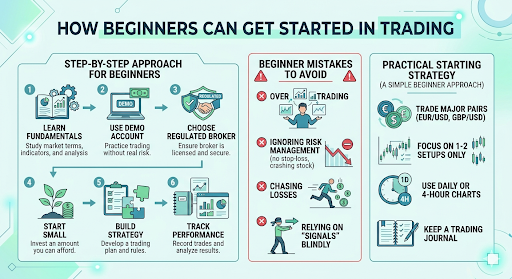
How Beginners Can Get Started
Step-by-Step Approach
Step
Action
1
Learn fundamentals
2
Use demo account
3
Choose regulated broker
4
Start small
5
Build strategy
6
Track performance
Beginner Mistakes to Avoid
Overtrading
Ignoring risk management
Chasing losses
Relying on “signals” blindly
Practical Starting Strategy
A simple beginner approach:
Trade major pairs (EUR/USD, GBP/USD)
Focus on 1–2 setups only
Use daily or 4-hour charts
Keep a trading journal
Conclusion
The forex market might seem complex at first, but at its core, it’s simply about how currencies interact and change in value based on real-world economic forces. Once you understand the basics—like currency pairs, market drivers, and risk—you start to see how everything connects.
What often separates beginners from consistent traders isn’t just knowledge, but how they apply it. Taking time to practice, staying patient, and managing risk carefully tends to matter far more than trying to chase quick profits.
If you’re just starting out, focus on building a solid foundation and getting comfortable with how the market moves. Over time, with the right approach and mindset, you’ll be in a much better position to make informed trading decisions.
Before you start trading, it’s crucial to understand the rules and protections in place. Learn more about how forex regulation works and why it matters here: