IC Markets and Tickmill are two of the most respected low-cost brokers in retail forex, and both are built around the same idea: raw interbank-style spreads plus a small transparent commission. Choosing between them is genuinely difficult, because they compete on the exact same ground.
IC Markets is the better overall choice for most active traders. It offers deeper liquidity, tighter average raw spreads, a much larger product range of 3,500+ instruments, cTrader alongside MetaTrader, and one of the fastest execution environments in retail trading. It was named the number one MetaTrader broker in ForexBrokers.com’s 2026 Annual Awards.
Tickmill is the better choice for cost-conscious traders with smaller accounts and for UK traders. Its $100 minimum deposit is half of IC Markets’ $200, its Raw account commission of $6 round turn matches IC Markets’ cheapest tier, it holds an FCA license that IC Markets lacks, and its UK entity even offers real exchange-traded futures and options, something almost no CFD-focused rival provides.
On pure trading costs the two finish within fractions of a pip of each other, with all-in EUR/USD costs of roughly 0.7 to 0.8 pips on both brokers’ raw accounts. Your decision should hinge on regulation, product range, platform preference and account size rather than headline spreads. The rest of this comparison breaks down exactly where each broker pulls ahead.
Comparison Table
| Feature | IC Markets | Tickmill |
|---|---|---|
| Founded | 2007 | 2014 |
| Headquarters | Sydney, Australia | London/Cyprus (group entities) |
| Regulation | ASIC, CySEC, FSA Seychelles | FCA, CySEC, FSA Seychelles, plus further entities |
| Publicly Listed | No (private company) | No (private company) |
| Minimum Deposit | $200 | $100 |
| Trading Platforms | MT4, MT5, cTrader, TradingView | MT4, MT5, TradingView, Tickmill Trader |
| Tradable Assets | 3,500+ instruments | Around 637 instruments, plus futures and options (UK) |
| Maximum Leverage | 1:30 (ASIC/CySEC retail), up to 1:500 offshore | 1:30 (FCA/CySEC retail), up to 1:1000 offshore |
| Spreads | Raw from 0.0 pips (approx. 0.1 avg EUR/USD) | Raw from 0.0 pips (approx. 0.1 avg EUR/USD) |
| Commissions | $3.50/side MT; $3.00/side cTrader | $3.00/side Raw; $3.50/side TradingView Raw |
| Inactivity Fee | None | None published |
| Account Types | Standard, Raw Spread, cTrader Raw | Classic, Raw, TradingView Raw, VIP, Futures (UK) |
| Demo Account | Yes, unlimited | Yes |
| Islamic Account | Yes | Yes |
| Copy Trading | Yes (IC Social, Signal Start, cTrader Copy) | Limited (via MT signals/third parties) |
| Social Trading | Yes | Limited |
| Mobile Trading | Yes (platform apps) | Yes (Tickmill app plus platform apps) |
| Desktop Platform | MT4, MT5, cTrader desktop | MT4, MT5 desktop |
| Web Platform | MT/cTrader web, TradingView | Tickmill Trader web, MT web, TradingView |
| Educational Resources | Basic tutorials, Web TV | CPD-accredited courses with LSE partnership |
| Research Tools | Third-party plugins, market blog | In-house analysis; Autochartist removed in 2026 |
| Customer Support | 24/7 | 24/5, multilingual |
| Deposit Methods | Cards, wire, PayPal, Skrill, Neteller, more | Cards, wire, Skrill, Neteller, crypto, regional methods |
| Withdrawal Methods | Same as deposits, no broker fees | Same as deposits, no broker fees |
| Processing Time | Often same day for e-wallets | Typically within 24 hours on business days |
| Investor Protection | Segregated funds; ICF for CySEC clients | Segregated funds; FSCS (UK) and ICF (EU) coverage |
Conditions change frequently and vary by entity. Confirm current figures on the official IC Markets and Tickmill websites before opening an account.
Company Overview
IC Markets
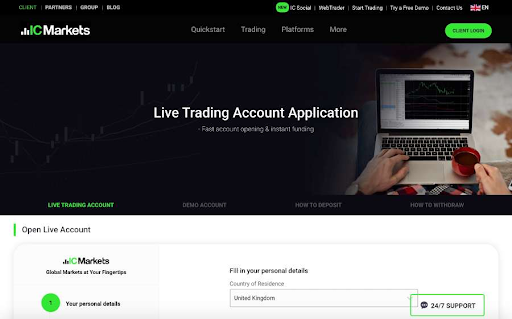
Founded in Sydney in 2007, IC Markets (International Capital Markets) has grown into one of the largest forex brokers in the world by trading volume, processing billions of dollars in trades daily for a client base of over 200,000 active traders. The company built its reputation on a simple pitch: true ECN-style pricing aggregated from up to 25 institutional liquidity sources, with servers co-located in the Equinix NY4 data center in New York to keep execution latency below roughly 35 to 40 milliseconds.
Opening an account is quick, and in day-to-day use the broker feels engineered for serious traders rather than beginners. There is no proprietary platform; instead you pick from MetaTrader 4, MetaTrader 5, cTrader or TradingView, and the infrastructure underneath does the heavy lifting. Scalping, hedging and expert advisors are all unrestricted. The group has also been expanding: it launched a prop trading arm, IC Funded, in 2026, runs IC Shares for Australian equities, and offers the IC Social copy trading app powered by Pelican Exchange along with the newly added Signal Start platform.
Independent recognition backs up the marketing. IC Markets holds a Trustpilot rating of 4.8 from more than 52,000 reviews as of early 2026 and won ForexBrokers.com’s 2026 Annual Award for number one MetaTrader broker, alongside Best in Class honors for trading fees.
Tickmill
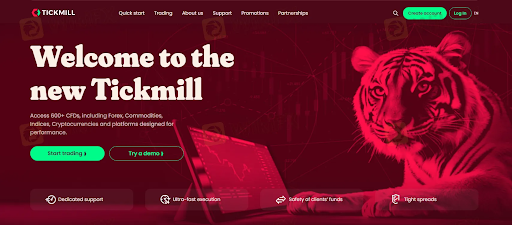
Tickmill launched in 2014 and has built a client base of more than 490,000 traders across 180+ countries, positioning itself as a lean, cost-focused ECN/STP broker. The group operates through several regulated entities, with Tickmill UK Ltd authorized by the FCA and Tickmill Europe Ltd by CySEC, alongside a Seychelles FSA entity for international clients.
Tickmill’s identity is all about pricing discipline. Its Raw account combines spreads from 0.0 pips with a $6 round-turn commission, producing all-in EUR/USD costs around 0.7 pips, which keeps it consistently near the top of independent cost rankings. One change worth knowing: in 2026 the Raw account replaced the old Pro account and the commission rose from $2 to $3 per side, a meaningful bump for long-time clients even though pricing remains competitive. The same year, Tickmill removed the third-party Autochartist and Capitalise.ai tools, trimming its research stack.
Where Tickmill genuinely differentiates is product structure. Beyond CFDs, its UK entity offers real exchange-traded futures and options, a rarity in this broker tier, and its education is anchored by CPD-accredited courses developed with the London Stock Exchange Group and Knightsbridge Trading Academy, totaling 28 hours and free with a live account.
Regulation & Safety
Both brokers are multi-regulated with clean track records, but the licensing maps differ in ways that matter depending on where you live.
IC Markets operates three main entities: the Australian parent regulated by ASIC (AFSL 335692, licensed since 2009), a Cypriot entity regulated by CySEC (license 362/18) and a Seychelles FSA entity (SD018) that onboards most international clients. There is no FCA UK entity, so British traders are served through Cyprus or Seychelles. Client funds are segregated at top-tier banks across all entities, negative balance protection applies, and CySEC clients benefit from the Investor Compensation Fund (ICF) covering up to EUR 20,000.
Tickmill holds the FCA license IC Markets lacks, alongside CySEC and Seychelles FSA authorizations and further regional registrations. UK clients get Financial Services Compensation Scheme (FSCS) protection up to GBP 85,000, EU clients get ICF coverage, and the group supplements this with negative balance protection and an Excess of Loss insurance policy. Funds are segregated across all entities.
Two honest caveats apply to both. First, most non-EU, non-Australian and non-UK clients at either broker will be onboarded under a Seychelles entity, where there is no statutory compensation scheme, only fund segregation and internal policies. Check which entity your account sits under before depositing. Second, neither company is publicly listed, so financial transparency depends on regulatory filings rather than public accounts.
Trust verdict: Tickmill edges it for UK and EU residents thanks to FCA coverage and FSCS protection. For Australians, IC Markets’ long ASIC history wins. Offshore, the two are broadly equivalent.
Trading Products
This is one of the clearest gaps in the comparison.
IC Markets offers more than 3,500 instruments: around 61 forex pairs, 25+ equity indices, energies, metals and soft commodities, bonds, futures-based CFDs, a broad cryptocurrency CFD range and over 2,000 share CFDs across US, UK, European and Australian markets, with real Australian equities available separately through IC Shares.
Tickmill offers a focused lineup of roughly 637 instruments: 62 forex pairs (slightly more than IC Markets), major indices, commodities, bonds and 15 cryptocurrency CFDs, which are not available to UK retail clients. Stock CFD coverage is far thinner than IC Markets’. Its trump card is different: through the UK entity, eligible clients can trade real exchange-traded futures and options on global exchanges, which appeals to traders who want listed derivatives rather than OTC contracts, though a higher minimum deposit (around $1,000) applies to futures accounts in some regions.
Verdict: IC Markets wins comfortably on breadth for CFD traders. Tickmill wins narrowly for currency-pair count and decisively for anyone who specifically wants listed futures and options from the same broker.
Trading Platforms
Neither broker locks you into proprietary software, which is exactly what experienced traders want.
IC Markets supports MetaTrader 4, MetaTrader 5, cTrader and TradingView. Its cTrader implementation is one of the best available, with Level II depth of market, sub-40ms average execution from Equinix NY4 co-location, and a slightly cheaper commission than the MetaTrader raw accounts. The MetaTrader suite comes with a 20-tool Advanced Trading Tools package, and algorithmic traders get unrestricted EA usage, VPS options and genuinely deep liquidity, which is why it keeps winning MetaTrader awards. The trade-off is the absence of any in-house platform, so the overall interface experience depends on third-party software that can feel dated.
Tickmill supports MetaTrader 4, MetaTrader 5, TradingView and its own Tickmill Trader platform, a modern proprietary front end with TradingView-powered charting, 97 indicators and cross-device syncing. The dedicated TradingView Raw account lets you execute directly from TradingView charts for a slightly higher commission. Execution measured in independent testing averaged around 59 milliseconds with minimal slippage, and free VPS hosting is available for accounts holding $500+ with qualifying monthly volume.
Verdict: IC Markets for cTrader devotees, depth-of-market traders and high-frequency algos; Tickmill for traders who want a polished proprietary app on top of MetaTrader, or native TradingView execution at a lower entry cost.
Trading Costs
Both brokers live or die on pricing, so we compared them line by line.
Raw account pricing. IC Markets’ Raw Spread account offers spreads from 0.0 pips with average EUR/USD spreads around 0.1 pips (independent monthly tracking has measured even tighter at times), plus a commission of $3.50 per lot per side ($7 round turn) on MT4/MT5, or $3.00 per side ($6 round turn) on cTrader. Tickmill’s Raw account also averages about 0.1 pips on EUR/USD with a commission of $3.00 per side ($6 round turn), rising to $3.50 per side on the TradingView Raw account. All-in, both brokers land at roughly 0.7 to 0.8 effective pips on EUR/USD, which puts them among the cheapest regulated brokers in the world. Tickmill’s VIP tier drops commissions further for accounts maintaining a $50,000 balance.
Standard/Classic accounts. IC Markets’ Standard account adds a fixed markup, with EUR/USD spreads from around 0.6 to 0.8 pips and no commission, which is unusually tight for a commission-free account. Tickmill’s Classic account starts from 1.6 pips with independent testing averaging about 1.7 pips on EUR/USD, noticeably wider. Casual traders who refuse commissions will pay less at IC Markets.
Non-trading fees. Both are clean. Neither broker charges deposit or withdrawal fees on standard methods, and neither charges inactivity fees. Swap rates at IC Markets have been noted in independent reviews as slightly above some rivals, so overnight position holders should compare rates on their specific pairs; Tickmill’s swap-free Islamic accounts apply a fixed handling fee after a grace period.
| Cost Item | IC Markets | Tickmill |
|---|---|---|
| Raw EUR/USD avg spread | Approx. 0.1 pips | Approx. 0.1 pips |
| Raw commission (round turn) | $7 MT / $6 cTrader | $6 Raw / $7 TradingView Raw |
| All-in raw cost (EUR/USD) | Approx. 0.7 to 0.8 pips | Approx. 0.7 pips |
| Commission-free account spread | From 0.6 to 0.8 pips | From 1.6 pips (approx. 1.7 avg) |
| Deposit fees | None | None |
| Withdrawal fees | None | None |
| Inactivity fee | None | None published |
| VIP/volume pricing | Rebates via programs | VIP tier at $50,000 balance |
Cost verdict: effectively a tie on raw accounts, a clear IC Markets win on commission-free accounts, and a slight Tickmill edge for very large accounts using VIP pricing.
Account Types
IC Markets keeps the menu tight, all with a $200 minimum deposit:
- Standard: commission-free, markup built into the spread, best for occasional traders.
- Raw Spread (MT4/MT5): 0.0 pip pricing plus $3.50 per side, the flagship account.
- cTrader Raw: same raw pricing with a $3.00 per side commission and Level II depth.
- Islamic: swap-free versions available on request.
- Demo: free, unlimited duration, multiple accounts allowed.
Active clients commonly run several accounts in parallel under one login with free instant internal transfers.
Tickmill offers more variety, mostly from a $100 minimum:
- Classic: commission-free with spreads from 1.6 pips.
- Raw: 0.0 pip spreads plus $3.00 per side, the successor to the old Pro account.
- TradingView Raw: raw pricing with execution inside TradingView, $3.50 per side.
- VIP: for balances of $50,000+, with the group’s lowest commissions.
- Futures and Options (UK): real exchange-traded derivatives, higher minimums apply.
- Islamic: swap-free variants of Classic and Raw with a handling fee after a grace period.
- Demo: free, plus a $30 no-deposit Welcome Account under the Seychelles entity.
| Account Feature | IC Markets | Tickmill |
|---|---|---|
| Minimum deposit | $200 | $100 |
| Cheapest raw commission | $6 RT (cTrader) | $6 RT (Raw) |
| Premium tier | Volume rebate programs | VIP ($50,000 balance) |
| Islamic option | Yes | Yes |
| Listed futures/options | No (CFDs only) | Yes, UK entity |
| Demo | Unlimited | Yes, plus $30 Welcome Account |
Both brokers live or die on pricing, so we compared them line by line.
Raw account pricing. IC Markets’ Raw Spread account offers spreads from 0.0 pips with average EUR/USD spreads around 0.1 pips (independent monthly tracking has measured even tighter at times), plus a commission of $3.50 per lot per side ($7 round turn) on MT4/MT5, or $3.00 per side ($6 round turn) on cTrader. Tickmill’s Raw account also averages about 0.1 pips on EUR/USD with a commission of $3.00 per side ($6 round turn), rising to $3.50 per side on the TradingView Raw account. All-in, both brokers land at roughly 0.7 to 0.8 effective pips on EUR/USD, which puts them among the cheapest regulated brokers in the world. Tickmill’s VIP tier drops commissions further for accounts maintaining a $50,000 balance.
Standard/Classic accounts. IC Markets’ Standard account adds a fixed markup, with EUR/USD spreads from around 0.6 to 0.8 pips and no commission, which is unusually tight for a commission-free account. Tickmill’s Classic account starts from 1.6 pips with independent testing averaging about 1.7 pips on EUR/USD, noticeably wider. Casual traders who refuse commissions will pay less at IC Markets.
Non-trading fees. Both are clean. Neither broker charges deposit or withdrawal fees on standard methods, and neither charges inactivity fees. Swap rates at IC Markets have been noted in independent reviews as slightly above some rivals, so overnight position holders should compare rates on their specific pairs; Tickmill’s swap-free Islamic accounts apply a fixed handling fee after a grace period.
| Cost Item | IC Markets | Tickmill |
|---|---|---|
| Raw EUR/USD avg spread | Approx. 0.1 pips | Approx. 0.1 pips |
| Raw commission (round turn) | $7 MT / $6 cTrader | $6 Raw / $7 TradingView Raw |
| All-in raw cost (EUR/USD) | Approx. 0.7 to 0.8 pips | Approx. 0.7 pips |
| Commission-free account spread | From 0.6 to 0.8 pips | From 1.6 pips (approx. 1.7 avg) |
| Deposit fees | None | None |
| Withdrawal fees | None | None |
| Inactivity fee | None | None published |
| VIP/volume pricing | Rebates via programs | VIP tier at $50,000 balance |
Cost verdict: effectively a tie on raw accounts, a clear IC Markets win on commission-free accounts, and a slight Tickmill edge for very large accounts using VIP pricing.
Deposits & Withdrawals
Both brokers are excellent here, with no internal fees and wide method coverage.
IC Markets supports one of the broadest funding menus in the industry: cards, bank wire, PayPal, Skrill, Neteller, and various regional methods. Deposits are typically instant for cards and e-wallets, and withdrawal requests submitted before the daily cutoff are usually processed the same business day, with no fees charged by the broker.
Tickmill supports cards, bank wire, Skrill, Neteller, cryptocurrency transfers and an unusually long list of regional options (FasaPay, Perfect Money, UnionPay, M-Pesa and more). Withdrawals are processed within 24 hours on business days, the minimum withdrawal is just $10, and the broker charges nothing on either direction.
| Funding Feature | IC Markets | Tickmill |
|---|---|---|
| Cards | Yes | Yes |
| Bank wire | Yes | Yes |
| PayPal | Yes | No |
| Skrill / Neteller | Yes | Yes |
| Crypto funding | Varies by entity | Yes |
| Broker fees | None | None |
| Typical withdrawal processing | Same business day | Within 24 hours |
One practical note from community feedback: larger manual bank wire withdrawals at either broker can take several business days once bank processing is included, so plan around that for significant sums.
Research & Education
Honestly, neither broker treats research as its main event, and both trail full-service rivals like IG here.
IC Markets provides a market blog, Web TV video updates, an economic calendar and a package of third-party MetaTrader plugins, but its educational content is thin and unstructured. The assumption is that IC Markets clients already know how to trade.
Tickmill counters with the strongest single educational asset in this matchup: three CPD-accredited courses built with the London Stock Exchange Group and Knightsbridge Trading Academy, totaling 28 hours, free for live account holders. Its in-house analysis and webinars are decent, but the 2026 removal of Autochartist pattern recognition and the Capitalise.ai automation tool was a genuine downgrade that pushed some signal-driven traders elsewhere.
Verdict: Tickmill for structured learning, IC Markets for plugin-driven power tools. Traders who want deep proprietary research should look beyond both.
Customer Support
IC Markets runs genuine 24/7 support via live chat, email and phone, matching its round-the-clock crypto trading hours. Responses in our testing were fast and competent, and the help center is thorough.
Tickmill offers 24/5 multilingual support across live chat, email and phone, closing on weekends. Response quality is well reviewed, though community feedback occasionally mentions slower resolution of compliance-related account reviews and large wire withdrawals.
| Support Channel | IC Markets | Tickmill |
|---|---|---|
| Live chat | Yes, 24/7 | Yes, 24/5 |
| Phone | Yes | Yes |
| Yes | Yes | |
| Multilingual | Yes | Yes |
| Weekend coverage | Yes | No |
Mobile Trading Experience
IC Markets relies on the MT4, MT5 and cTrader mobile apps rather than a proprietary trading app (the IC Social app covers copy trading specifically). The cTrader mobile app is arguably the best third-party trading app in the industry, with full depth of market, advanced order types and clean charting. The downside is a fragmented experience: account management happens in the secure client portal, trading in a separate app.
Tickmill offers its own Tickmill mobile app alongside the MetaTrader apps, giving a more unified experience: TradingView-powered charts, account management, funding and trading in one place. For traders who want a single modern app, Tickmill’s is the more cohesive product; for traders who live inside cTrader or MetaTrader mobile anyway, the difference disappears.
Pros & Cons
IC Markets
Pros
- Among the tightest raw spreads in retail forex, roughly 0.1 pips average on EUR/USD
- 3,500+ instruments, the widest range in this matchup
- MT4, MT5, cTrader and TradingView all supported
- Sub-40ms execution from Equinix NY4 co-location, ideal for scalpers and EAs
- 24/7 support and same-day withdrawal processing
- Copy trading via IC Social, Signal Start and cTrader Copy
- 4.8 Trustpilot rating from 52,000+ reviews
Cons
- No FCA UK entity; UK clients route via CySEC or Seychelles
- $200 minimum deposit, double Tickmill’s
- Weak structured education and thin in-house research
- No proprietary trading platform
- Swap rates slightly above some competitors
Tickmill
Pros
- $100 minimum deposit across CFD account types
- Raw account all-in costs around 0.7 pips on EUR/USD, with $6 round-turn commission
- FCA regulation with FSCS protection for UK clients
- Real exchange-traded futures and options via the UK entity
- Proprietary Tickmill Trader app plus MT4, MT5 and TradingView
- CPD-accredited education with the LSE Group
- Withdrawals processed within 24 hours, minimum withdrawal $10
Cons
- Much narrower CFD range, around 637 instruments and thin stock coverage
- Raw commission rose from $2 to $3 per side in 2026
- Autochartist and Capitalise.ai removed in 2026
- Classic account spreads (from 1.6 pips) are wide versus IC Markets’ Standard
- No weekend support; crypto CFDs unavailable to UK retail clients
Who Should Choose IC Markets?
Choose IC Markets if execution quality and market range top your list. Scalpers, high-frequency traders and EA operators get institutional-grade infrastructure: deep aggregated liquidity, sub-40ms fills, unrestricted strategies and the best cTrader deployment in the business. Multi-asset CFD traders get 3,500+ instruments, including a share CFD range Tickmill cannot approach, and copy traders get several supported platforms. If you trade more than a handful of lots per month and can comfortably fund $200+, IC Markets is the more complete high-performance broker, provided you are comfortable that UK-style FCA protection is not part of the package.
Who Should Choose Tickmill?
Choose Tickmill if you want elite pricing with a lower barrier to entry and stronger regulatory cover in Europe. The $100 minimum and $6 round-turn Raw commission make it arguably the cheapest properly regulated entry point into ECN-style trading. UK residents gain FCA oversight and FSCS protection, and ambitious traders can graduate into real futures and options without changing broker. Beginners also get more here: structured, accredited coursework and a simpler two-account choice. If your trading is forex-centric and you value FCA regulation or listed derivatives over CFD breadth, Tickmill is the smarter pick.
Final Verdict
This is a matchup between two brokers doing the same job at nearly the same price, so the verdict comes down to profile.
IC Markets wins for the majority of active CFD traders. Tighter commission-free pricing, a vastly larger instrument range, cTrader with depth of market, 24/7 support and top-tier execution make it the stronger all-round trading machine, which is why it keeps collecting industry awards in 2026.
Tickmill wins for UK-regulated safety, small accounts and futures ambitions. FCA plus FSCS protection, a $100 entry point, accredited education and access to listed futures and options give it advantages IC Markets structurally cannot match.
On raw account costs, treat them as equals: roughly 0.7 to 0.8 all-in pips on EUR/USD at both. Whichever you choose, confirm which regulatory entity will hold your account, and remember that leveraged CFD trading carries a high risk of rapid losses; a majority of retail accounts lose money.
Frequently Asked Questions
Is IC Markets or Tickmill cheaper for forex trading?
On raw accounts they are nearly identical, both landing around 0.7 to 0.8 all-in pips on EUR/USD. IC Markets’ cTrader Raw and Tickmill’s Raw account both charge $6 round turn. For commission-free trading, IC Markets’ Standard account (spreads from about 0.6 to 0.8 pips) beats Tickmill’s Classic account (from 1.6 pips).
Which broker is better regulated?
It depends on your location. Tickmill holds an FCA license with FSCS protection for UK clients, which IC Markets does not offer. IC Markets counters with a long-standing ASIC license dating to 2009. Both hold CySEC and Seychelles FSA authorizations, and both segregate client funds with negative balance protection.
What are the minimum deposits at IC Markets and Tickmill?
IC Markets requires $200 for all account types. Tickmill requires $100 for its Classic, Raw and TradingView Raw accounts, with higher minimums for futures accounts in some regions and a $50,000 balance for VIP pricing.
Which broker is better for scalping and EAs?
Both allow scalping, hedging and expert advisors without restriction. IC Markets has a slight edge thanks to Equinix NY4 co-location, sub-40ms average execution, deeper aggregated liquidity and cTrader’s Level II pricing. Tickmill remains excellent, with independent execution testing around 59 milliseconds and free VPS for qualifying accounts.
Does either broker offer cTrader?
Only IC Markets offers cTrader, with a reduced $3.00 per side commission on its cTrader Raw account. Tickmill instead offers its proprietary Tickmill Trader platform and direct TradingView execution.
Can I trade stocks at IC Markets or Tickmill?
IC Markets offers over 2,000 share CFDs globally plus real Australian equities via IC Shares. Tickmill’s stock CFD range is minimal, but its UK entity offers real exchange-traded futures and options, which IC Markets does not.
Do IC Markets and Tickmill charge inactivity fees?
No. Neither broker charges inactivity fees, and neither charges deposit or withdrawal fees on standard funding methods.
Which broker has faster withdrawals?
Both are quick. IC Markets typically processes withdrawal requests the same business day if submitted before the cutoff; Tickmill processes within 24 hours on business days with a $10 minimum withdrawal. Bank processing can add days for international wires at either broker.
Do these brokers offer Islamic accounts?
Yes, both. IC Markets provides swap-free versions of its accounts on request. Tickmill offers Islamic variants of both Classic and Raw accounts, charging a fixed handling fee on some instruments after a grace period instead of swaps.
Which broker is better for beginners?
Tickmill, on balance. The lower $100 minimum, simpler account menu and CPD-accredited course library with the LSE Group make the learning curve gentler. IC Markets assumes more existing knowledge and provides comparatively thin education.
Is copy trading available?
IC Markets has the stronger copy trading setup, with the IC Social app, Signal Start and cTrader Copy. Tickmill’s copy options are more limited and rely mainly on MetaTrader signal services and third-party bridges.
Did Tickmill raise its commissions?
Yes. In 2026 Tickmill replaced its Pro account with the Raw account and increased the commission from $2 to $3 per side ($4 to $6 round turn). Pricing remains competitive, but older reviews citing $4 round-turn costs are out of date.