Introduction
eToro and Darwinex both let money follow talent, but they attack the idea from opposite ends of the market, which makes this one of the most lopsided-by-audience comparisons we cover. Very few traders are genuinely torn between the two once they understand what each actually is.
eToro is the better choice for everyday investors and beginners. It is a NASDAQ-listed, multi-regulated consumer platform with more than 30 million registered users, real commission-light stock and ETF investing, 100+ cryptocurrencies, and the famous CopyTrader system that replicates other users’ portfolios from a $200 minimum. It is polished, simple and social, and its 2025 stock market listing added a level of financial transparency few brokers can match.
Darwinex is the better choice for serious traders who want to manage other people’s money. The FCA and CNMV regulated firm converts trader strategies into risk-managed investable indices called DARWINs. Skilled traders earn 15% performance fees on capital allocated by investors and by Darwinex’s own DarwinIA program (allocations up to EUR 500,000, with external investor capital uncapped beyond that), while investors get a hedge-fund-style marketplace of vetted, risk-normalized strategies rather than a social feed.
Put bluntly: eToro helps you copy traders; Darwinex helps you become the trader worth copying, and get paid properly for it. Costs, platforms, regulation and products all follow from that split, as the rest of this comparison shows.
Comparison Table
| Feature | eToro | Darwinex |
|---|---|---|
| Founded | 2007, Tel Aviv | 2012, London (Tradeslide Trading Tech Ltd) |
| Headquarters | Israel/global offices | London (Canary Wharf), UK |
| Regulation | FCA, CySEC, ASIC, SEC/FINRA (US), FinCEN | FCA (FRN 586466), CNMV (Spain) |
| Publicly Listed | Yes, NASDAQ: ETOR (since May 2025) | No (private company) |
| Minimum Deposit | From $50 (varies by country) | $500/€500/£500 |
| Trading Platforms | Proprietary web and mobile only | MT4, MT5, FIX API, IBKR TWS integration |
| Tradable Assets | 3,000+ stocks, 250+ ETFs, 100+ cryptos, forex/index/commodity CFDs | 44 FX pairs, 950+ CFDs, US stocks/ETFs, futures via IBKR |
| Maximum Leverage | 1:30 retail (CFDs) | 1:30 retail; higher for professionals |
| Spreads | Forex from 1 pip; crypto ~0.75%+ | Forex from 0.0 pips plus commission |
| Commissions | $0 US stocks/ETFs; $1-2 per stock trade in some countries; 1% crypto | Approx. $2.50 per side per FX lot; asset-based schedule |
| Inactivity Fee | $10/month after 12 months | None comparable published |
| Withdrawal Fee | $5 flat (free in GBP/EUR cases) | None standard; small-deposit bank fees apply |
| Account Types | Retail, Professional, Islamic, Demo | Trader, Investor, Professional, Darwinex Zero |
| Demo Account | Yes, $100,000 virtual, unlimited | Yes (demo/virtual via platforms and Zero) |
| Islamic Account | Yes | No |
| Copy Trading | Yes, CopyTrader ($200 minimum, up to 100 traders) | Not copy trading; DARWIN investing from ~$200 |
| Social Trading | Yes, full social feed | Community, but performance-driven |
| Funded/Allocation Program | Popular Investor payments | DarwinIA up to EUR 500k; Darwinex Zero (EUR 38/month) |
| Mobile Trading | Yes, flagship app | Yes, via platform apps |
| Desktop Platform | Web-based | MT4/MT5 desktop, TWS |
| Educational Resources | Extensive, beginner-focused | Limited, professional-focused |
| Research Tools | Market news, analyst views, insights | Risk analytics, execution and strategy diagnostics |
| Customer Support | Tickets/chat; faster for Club tiers | Email-led, limited hours |
| Deposit Methods | Cards, bank transfer, PayPal, e-wallets | Bank transfer, cards, Skrill |
| Withdrawal Methods | Same as deposits | Same as deposits |
| Processing Time | Typically 1 to 3 business days | Typically 1 to 3 business days |
| Investor Protection | FSCS (UK), ICF (EU), SIPC (US), plus Club insurance | FSCS (UK) plus supplementary private insurance, FOGAIN (Spain) |
Conditions vary by entity and country and change often. Confirm current figures on the official eToro and Darwinex websites before opening an account.
Company Overview
eToro
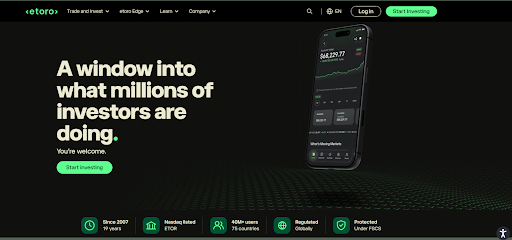
Founded in Tel Aviv in 2007 by Yoni Assia, Ronen Assia and David Ring, eToro effectively invented retail social trading and has ridden that idea to more than 30 million registered users across 100+ countries. In May 2025 the company went public on NASDAQ under the ticker ETOR, a milestone that brought quarterly disclosures and institutional scrutiny; its pre-listing financials showed $931 million in revenue and $192 million in net income for 2024, the profile of a mature, profitable business rather than a growth story burning cash.
The product is a single, unified proprietary platform (web and mobile) covering real stock and ETF investing, cryptocurrencies, and CFD trading on forex, indices and commodities. Its signature features remain CopyTrader, which mirrors other users’ trades automatically from a $200 minimum (up to 100 traders at once), and Smart Portfolios, thematic bundles built around ideas like renewable energy or crypto. Popular Investors, the traders being copied, are paid by eToro based on assets copying them, a lighter-touch cousin of what Darwinex does. Recent additions include interest on idle cash balances (up to roughly 3.5 to 4% depending on Club tier) and, since July 2025, a transparent 1% commission on crypto trades charged separately from the spread.
Having used the platform, the onboarding and everyday experience are genuinely best-in-class for beginners; the flip side is that advanced traders will quickly miss things like MetaTrader support, an API and granular order tooling.
Darwinex
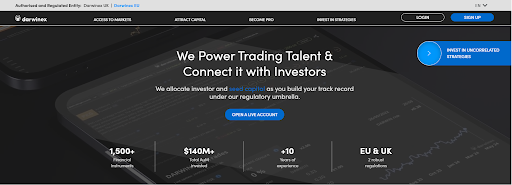
Darwinex, legally Tradeslide Trading Tech Ltd, was founded in London in 2012 and has been FCA-regulated since 2014 (FRN 586466), with a Spanish entity supervised by the CNMV. It is small by eToro standards, with assets under management reported above $140 million, but it occupies a niche no mass-market platform touches: converting individual traders into investable products.
The mechanism is the DARWIN. A trader runs a strategy on a live (or, via Darwinex Zero, virtual) account; Darwinex’s risk engine wraps it in an independent risk-management layer that normalizes every DARWIN to a target risk level, and the result is listed on the DARWIN exchange, where investors can allocate from around $200 per strategy. Traders earn 15% performance fees on investor profits, calculated on a high-water-mark basis exactly as hedge funds do. Darwinex accelerates the flywheel with DarwinIA, a monthly allocation program that awards the platform’s best risk-adjusted strategies notional allocations up to EUR 500,000, and with Darwinex Zero, a EUR 38 per month subscription (launched as a bridge product) that lets anyone, including US residents who cannot use the live brokerage, build a certified DARWIN track record on virtual capital with no profit targets, no daily loss limits and no strategy bans.
On the brokerage side, Darwinex offers ECN-style pricing through MT4, MT5 and a FIX API, plus an Interactive Brokers integration that opens real US stocks, ETFs and futures through the TWS platform. It is an ecosystem built for professionals and aspiring fund managers, and it makes no apology for that.
Regulation & Safety
Both firms are properly regulated, but their protection profiles differ in shape.
eToro operates through a stack of entities: eToro (UK) Ltd under the FCA (FRN 583263), eToro (Europe) Ltd under CySEC (license 109/10), eToro AUS under ASIC (AFSL 491139), and in the United States, eToro USA Securities Inc., a FINRA member with SIPC protection, alongside FinCEN registration for crypto. Depending on jurisdiction, clients are covered by the FSCS up to GBP 85,000, the EU Investor Compensation Fund up to EUR 20,000, or SIPC up to $500,000 for securities. Club members at Platinum+ and above receive an additional EUR 1 million in private insurance. The NASDAQ listing adds a transparency layer: audited public accounts every quarter. Two honest caveats: crypto assets sit outside all statutory compensation schemes everywhere, and the majority of eToro’s CFD clients lose money (its own disclosure cites 61% of retail accounts).
Darwinex holds FCA and CNMV authorizations, segregates client funds at major banks, provides negative balance protection, and participates in the FSCS (GBP 85,000) with supplementary private insurance on top for eligible clients; Spanish-entity clients fall under FOGAIN coverage. It publishes audited financials and discloses liquidity sources, unusual candor for a firm its size. The caveats run the other way: it is a small private company without eToro’s scale or public-market oversight, community feedback includes complaints about withdrawal processing speed and thin support, and regulators have flagged clone firms impersonating it, so verifying the genuine domain matters. US and Canadian residents cannot use the live brokerage at all, only Darwinex Zero.
Trust verdict: both are legitimate and well-regulated. eToro offers broader statutory coverage across more jurisdictions plus public-company transparency; Darwinex offers focused tier-1 regulation that is genuinely rare in the strategy-marketplace and funded-trading space, where most competitors are unregulated offshore entities.
Trading Products
eToro covers the retail waterfront: over 3,000 real stocks from 17 exchanges, 250+ ETFs, more than 100 cryptocurrencies (one of the widest ranges at any regulated multi-asset broker), and CFDs on forex, indices and commodities for non-US clients. US clients get stocks, ETFs, options (commission-free) and crypto, but no CFDs, which are banned in the US. The notable trap for newcomers: leveraged or short positions are always CFDs even on stock tickers, so checking the order ticket matters if you intend to own the underlying share. Bonds, futures and mutual funds are absent.
Darwinex offers roughly 44 currency pairs and 950+ CFDs spanning indices, commodities, metals, energies and US equities, plus, through its Interactive Brokers integration, 500+ real exchange-traded assets and futures on the TWS platform. There is no cryptocurrency trading on the live brokerage, no spread betting and no Islamic accounts. And then there is the product category eToro does not have at all: DARWINs themselves, an investable universe of hundreds of risk-normalized trading strategies that investors can allocate to like funds.
Verdict: eToro for breadth of conventional assets and crypto; Darwinex for professional derivatives access, futures via IBKR, and the unique DARWIN asset class.
Trading Platforms
eToro is a walled garden, and deliberately so. Its proprietary web platform and mobile app are consistently rated among the most intuitive in the industry: clean watchlists, one-tap copying, social feeds on every instrument, and an unlimited $100,000 demo account. What you cannot do is plug in MetaTrader, TradingView execution, EAs or an API. Charting is adequate rather than advanced, and complex order types are limited.
Darwinex is the inverse: no beginner-friendly proprietary front end, but full MT4 and MT5 support with ECN execution, a FIX API for institutional-grade automation, Zorro and algorithmic tooling compatibility, and Interactive Brokers’ Trader Workstation for the exchange-traded side. Its own web platform centers on the DARWIN exchange and deep risk analytics: VaR tracking, divergence, capacity and a dozen other diagnostics on every strategy. Automated strategies, news trading, hedging and weekend holding are all unrestricted, including inside Darwinex Zero.
Verdict: a category mismatch. eToro wins for usability and social experience; Darwinex wins for professional tooling, automation and transparency. Neither would satisfy the other’s core user.
Trading Costs
The pricing philosophies differ as much as the platforms.
eToro. Real US stocks and ETFs trade commission-free (regulatory micro-fees aside), while several countries (including Australia, Spain, the Netherlands and the Nordics) now pay a flat $1 to $2 per stock trade; ETFs remain commission-free. Crypto costs 1% per side plus spread, expensive next to dedicated exchanges but bundled with regulated custody. Forex CFD spreads start around 1 pip on EUR/USD, roughly triple what raw-pricing brokers charge. Non-trading fees are the platform’s known weak spot: a $5 withdrawal fee ($30 minimum withdrawal), a $10 monthly inactivity fee after 12 months, and currency conversion charges on every non-USD deposit and withdrawal since accounts are USD-denominated (Club tiers discount this). Overnight CFD fees apply, tripled over weekends. Copying itself costs nothing beyond the spreads of copied positions.
Darwinex. The brokerage runs an ECN model: spreads from 0.0 pips with commissions of roughly $2.50 per side per standard FX lot (about $5 round turn), index commissions around 2.75 per contract currency, and a percentage-based commodity schedule, competitive mid-tier pricing, cheaper than eToro’s CFDs but a shade above the cheapest raw brokers. On the investment side, DARWIN investors pay a 1.2% annual management fee on invested equity plus the 15% performance fee that goes to the strategy’s trader; there are no entry loads. Non-trading costs are minor but fiddly: EUR 5 on bank deposits under EUR 500, 0.5% on Skrill, triple swaps on Wednesdays. Darwinex Zero costs EUR 38 per month regardless of trading.
| Cost Item | eToro | Darwinex |
|---|---|---|
| US stocks/ETFs | $0 commission (real assets) | Via IBKR integration, exchange terms |
| Stock commission (some countries) | $1 to $2 flat per trade | Not applicable in same form |
| Forex pricing | Spread-only, from about 1 pip | From 0.0 pips + approx. $5 round turn |
| Crypto | 1% per side plus spread | Not offered |
| Copy/strategy investing | Free to copy (spread costs) | 1.2% p.a. management + 15% performance fee |
| Withdrawal fee | $5 flat | None standard |
| Inactivity fee | $10/month after 12 months | None comparable |
| Currency conversion | Yes, USD-based accounts | Multi-currency accounts (USD, EUR, GBP) |
Cost verdict: for buy-and-hold stock investors, eToro is cheaper. For active forex and CFD trading, Darwinex is meaningfully cheaper. For putting money behind other people’s skill, the models differ: eToro’s copying is free but unmanaged; Darwinex charges fund-style fees but wraps every strategy in an independent risk engine.
Account Types
eToro
- Retail account: the standard multi-asset account, minimum deposit from $50 depending on country.
- Professional account: higher leverage, fewer protections, for qualifying clients outside the US.
- Islamic account: swap-free version available.
- eToro Club: tiered benefits (Silver to Diamond) based on equity, including conversion-fee discounts, insurance and better cash interest.
- Demo: $100,000 virtual portfolio, free forever.
Darwinex
- Trader account: live ECN brokerage on MT4/MT5, $500 minimum, becomes an investable DARWIN.
- Investor account: allocate to DARWINs from around $200 per strategy (minimum funding from $500).
- Professional account: higher leverage and rebates for qualifying clients.
- IBKR-linked accounts: DARWIN IBKR and Classic IBKR structures for exchange-traded assets.
- Darwinex Zero: EUR 38/month virtual account building a certified DARWIN track record, with DarwinIA seed allocations from EUR 30,000 up to EUR 500,000 and uncapped external investor capital beyond; performance fees paid at 15% with a high-water mark. No cent accounts, no Islamic accounts.
| Account Feature | eToro | Darwinex |
|---|---|---|
| Entry minimum | From $50 | $500 (live); EUR 38/month (Zero) |
| Copy/invest minimum | $200 per copied trader | Approx. $200 per DARWIN |
| Get paid for your trading | Popular Investor program | 15% performance fees + DarwinIA |
| Islamic option | Yes | No |
| US residents | Yes (stocks, ETFs, options, crypto) | Darwinex Zero only |
| Demo | Unlimited $100k | Yes |
Deposits & Withdrawals
eToro accepts cards, bank transfer, PayPal and regional e-wallets (iDEAL and others), with minimum deposits from $50 by country. Withdrawals carry a flat $5 fee with a $30 minimum and typically land in 1 to 3 business days; because accounts are USD-denominated, deposits and withdrawals in other currencies incur conversion fees, the platform’s most cited hidden cost.
Darwinex accepts bank transfer, cards and Skrill across USD, EUR and GBP base currencies, which sidesteps forced conversion for most European clients. Standard withdrawals are free; small bank deposits (under EUR 500) attract a EUR 5 fee and Skrill costs 0.5%. Community reports mention occasional slow withdrawal processing, so allow a few business days.
| Funding Feature | eToro | Darwinex |
|---|---|---|
| Cards / bank transfer | Yes | Yes |
| PayPal | Yes | No |
| Skrill | Yes (region dependent) | Yes (0.5% fee) |
| Base currencies | USD only | USD, EUR, GBP |
| Withdrawal fee | $5 flat | None standard |
| Minimum withdrawal | $30 | EUR 100 (Zero payouts) |
Research & Education
eToro is built for learning by osmosis: an academy of beginner courses, in-platform news and analyst sentiment, social feeds where every ticker doubles as a discussion board, and Smart Portfolio explanations that teach thematic investing. It is arguably the best broker in the world at making markets feel approachable, though depth-seeking analysts will find the tooling shallow.
Darwinex publishes some of the most intellectually serious content in retail trading, on risk management, strategy capacity, VaR and portfolio construction, mostly via its blog and YouTube seminars, but offers little structured beginner education and no conventional market research desk. Its analytics are aimed at diagnosing your own strategy, not telling you what to trade.
Verdict: eToro for beginners and casual investors, Darwinex for quantitatively minded traders. No overlap to speak of.
Customer Support
eToro provides support via help center tickets and live chat, with priority service for higher Club tiers. At 30 million users, service quality varies: independent reviews and user feedback cite slow responses and automated replies as recurring complaints, though most routine issues resolve without drama.
Darwinex runs a lean, email-led support desk with limited hours, competent on technical questions but thin by mass-market standards, and user feedback echoes that. Neither firm offers the 24/7 human coverage some execution brokers provide.
| Support Channel | eToro | Darwinex |
|---|---|---|
| Live chat | Yes (tiered priority) | Limited |
| Email/tickets | Yes | Yes |
| Phone | Limited | Limited |
| Coverage | Business hours, tier dependent | Business hours |
Mobile Trading Experience
eToro’s app is the company’s crown jewel: the full platform, social feed, copying, portfolio analytics and funding in one polished package that consistently ranks among the highest-rated finance apps. For its audience it is close to flawless.
Darwinex relies on the MT4/MT5 mobile apps for trading and its own app and mobile web experience for monitoring DARWINs and allocations. Functional, but managing serious strategy work from a phone is not the intended workflow, and the firm does not pretend otherwise.
Verdict: eToro, comfortably, for anyone who trades or invests primarily from a phone.
Pros & Cons
eToro
Pros
- Best-in-class usability and the largest social trading community in the world
- NASDAQ-listed with audited public financials and multi-jurisdiction regulation (FCA, CySEC, ASIC, SEC/FINRA)
- Real stocks and ETFs with $0 commission in major markets; 100+ cryptocurrencies
- CopyTrader and Smart Portfolios from a $200 minimum
- Interest paid on idle cash; unlimited $100k demo
- Available to US residents
Cons
- $5 withdrawal fee, $10/month inactivity fee, USD-only accounts with conversion charges
- Forex/CFD spreads roughly triple those of ECN brokers
- 1% crypto commission each way is expensive for active traders
- No MetaTrader, API or advanced order tooling
- Easy to buy a CFD when you meant to buy the share
Darwinex
Pros
- Unique DARWIN model: earn 15% performance fees on investor capital, hedge-fund style with a high-water mark
- DarwinIA allocations up to EUR 500,000 plus uncapped external investor scaling
- FCA and CNMV regulation with FSCS plus supplementary insurance, a rarity in the funded/strategy space
- ECN pricing from 0.0 pips, MT4/MT5, FIX API and IBKR integration for real assets and futures
- No strategy restrictions: EAs, news trading, weekends and hedging all allowed
- Darwinex Zero (EUR 38/month) opens the ecosystem to anyone, including US residents
Cons
- $500 minimum and a professional-grade learning curve
- No crypto, no Islamic accounts, no beginner accounts
- Small company with lean support and reported withdrawal processing delays
- 15% trader profit share is far below prop-firm marketing splits (though on real, scalable capital)
- Sparse structured education and conventional research
Who Should Choose eToro?
Choose eToro if you are investing rather than operating. First-time stock buyers get commission-light real shares in an interface that explains itself; passive investors get CopyTrader and Smart Portfolios to outsource decision-making from $200; crypto-curious users get 100+ coins inside a regulated, insured platform rather than an offshore exchange; and US residents get one of the few social-investing platforms legally open to them. The trade-offs, higher CFD spreads, non-trading fees and limited pro tooling, simply do not bite the buy-and-hold, copy-and-forget audience eToro is built for.
Who Should Choose Darwinex?
Choose Darwinex if trading is your craft and scaling it is the goal. Consistent traders can turn a EUR 38 subscription or a $500 live account into a certified public track record, win DarwinIA allocations up to half a million euros, and build toward genuinely uncapped investor capital, all inside FCA regulation while competitors sell demo-account challenges from offshore jurisdictions. Algorithmic traders get MT4/MT5, FIX API and zero strategy restrictions; sophisticated investors get a marketplace of risk-normalized strategies that behaves more like a liquid fund platform than a social feed. If words like VaR, capacity and high-water mark excite rather than intimidate you, this is your side of the comparison.
Final Verdict
This is less a contest than a fork in the road.
eToro wins for 95% of retail users: simpler, broader, cheaper for investing, available in more countries including the US, and backed by public-company transparency. It is the definitive consumer social-investing platform in 2026.
Darwinex wins for the professional minority: cheaper for active trading, vastly more capable technically, and the only FCA-regulated route in its class for converting trading skill into managed capital and performance fees.
If you want to put money behind other people’s decisions, start at eToro. If you want other people’s money behind your decisions, start at Darwinex. In both cases the standard warning applies with force: most retail CFD accounts lose money (eToro discloses 61% for its own clients), copied and DARWIN performance is never guaranteed by past results, and you should commit only capital you can afford to lose.
Frequently Asked Questions
Are eToro and Darwinex the same kind of platform?
No. eToro is a mass-market social investing platform where users copy each other’s portfolios. Darwinex is a professional brokerage and asset-management ecosystem where trader strategies become investable, risk-managed indices (DARWINs) and traders earn performance fees from investors. They serve almost entirely different audiences.
Which platform is better regulated?
Both are well regulated. eToro spans more jurisdictions (FCA, CySEC, ASIC, SEC/FINRA, FinCEN) and is publicly listed on NASDAQ. Darwinex holds FCA and CNMV licenses with FSCS protection plus supplementary insurance, which is exceptional for the strategy-marketplace and funded-trading niche it operates in.
What are the minimum deposits?
eToro starts from $50 depending on country, with a $200 minimum to copy a trader. Darwinex requires $500 (or EUR/GBP equivalent) for a live account, while Darwinex Zero costs EUR 38 per month with no live deposit at all.
Can I earn money from my own trading skill on these platforms?
Yes, on both, but differently. eToro’s Popular Investor program pays traders based on the assets copying them. Darwinex pays 15% performance fees on profits generated for investors and DarwinIA allocations, calculated with a high-water mark, and allocations can reach EUR 500,000 through DarwinIA with uncapped external capital beyond that.
Is Darwinex Zero a prop firm challenge?
Not in the usual sense. There are no profit targets, daily loss limits, time pressure or strategy bans. You pay EUR 38 per month, trade a virtual account freely, and your risk-adjusted performance competes for real capital allocations. It is a track-record builder run by an FCA-regulated broker, not a pass/fail exam.
Which platform supports MetaTrader?
Only Darwinex, which offers MT4, MT5, a FIX API and an Interactive Brokers TWS integration. eToro is exclusively proprietary, with no MetaTrader, API or third-party platform support.
Can I trade crypto on both?
Only on eToro, which offers 100+ cryptocurrencies with a 1% commission per side plus spread, and a 2% fee for transfers to its external wallet. Darwinex does not offer cryptocurrency trading on its live brokerage.
Can US residents use these platforms?
eToro, yes: US clients get stocks, ETFs, commission-free options and crypto through its FINRA-member US entity (CFDs are banned in the US). Darwinex’s live brokerage is unavailable to US and Canadian residents, but Darwinex Zero is open to them.
Which is cheaper for forex trading?
Darwinex, clearly. Its ECN accounts price from 0.0 pips plus roughly $5 round turn per lot, versus eToro’s spread-only model starting around 1 pip on EUR/USD. eToro is not designed for cost-sensitive active forex trading.
What non-trading fees should I watch?
At eToro: the $5 withdrawal fee, $10 monthly inactivity fee after a year, and USD conversion charges. At Darwinex: EUR 5 on bank deposits under EUR 500, 0.5% on Skrill funding, and the EUR 38 monthly Zero subscription. Neither charges platform fees for standard trading.
How does DARWIN investing differ from copy trading?
Copy trading replicates a trader’s positions one-to-one into your account, with your risk equal to theirs. A DARWIN is an independent product: Darwinex’s risk engine normalizes every strategy to a controlled risk target before investor money tracks it, so a reckless underlying trader cannot expose investors beyond the engine’s limits. It is closer to investing in a systematic fund than to mirroring a person.
Which platform is better for beginners?
eToro, without hesitation. Its interface, education, demo account and copy features are all designed for first-timers. Darwinex assumes you already know how to trade and want infrastructure to prove and scale it.