Introduction
FXCM and XTB started in the same business, retail forex and CFDs, but a quarter-century later they have evolved into very different animals, which makes this comparison unusually decisive once you know what you need.
XTB is the better broker for the vast majority of traders and investors. The Warsaw Stock Exchange-listed firm serves over 1.3 million clients under seven regulators including the FCA, KNF and CySEC, offers 6,000+ real stocks and 1,400+ real ETFs at 0% commission up to EUR 100,000 in monthly turnover alongside its full CFD range, requires no minimum deposit, pays interest on uninvested cash, and runs xStation 5, the platform that swept ForexBrokers.com’s 2026 Best in Class awards for Overall, Ease of Use and Beginners.
FXCM is the better broker for a specific tribe: algorithmic and professional traders. Now wholly owned by US investment bank Jefferies Financial Group, it pairs its veteran Trading Station platform with TradingView integration, MT4, Capitalise.ai automation, free APIs and an app marketplace, a stack strong enough to win 2026 Best in Class honors for Trading Platforms, Professional Trading and Algo Trading. Its history demands mention: the 2017 exit from the US market after a CFTC action, and a December 2025 ASIC order halting new CFD business at its Australian entity, sit alongside its otherwise solid FCA-led regulation.
If you want one modern account for investing and trading, choose XTB. If you build, automate and scale trading systems, FXCM earns its place. The full breakdown follows.
Comparison Table
| Feature | FXCM | XTB |
|---|---|---|
| Founded | 1999 | 2002 |
| Headquarters | London, UK (Stratos Group) | Warsaw, Poland (offices in 13 countries) |
| Regulation | FCA, CySEC, FSCA, ISA; ASIC (restricted Dec 2025); SVG entity for internationals | KNF, FCA, CySEC, DFSA, IFSC and more (7 licenses) |
| Publicly Listed | No (owned by NYSE-listed Jefferies) | Yes, Warsaw Stock Exchange (XTB) |
| Minimum Deposit | $50 | None |
| Trading Platforms | Trading Station, MT4, TradingView, Capitalise.ai, APIs | xStation 5 (web, desktop, mobile) |
| Tradable Assets | Approx. 300+ CFDs, 39 to 43 FX pairs | 10,000+ incl. 6,000+ real stocks, 1,400+ real ETFs |
| Maximum Leverage | 1:30 UK/EU; up to 1:400+ offshore | 1:30 retail (ESMA); higher professional |
| Spreads | EUR/USD approx. 0.9 to 1.3 avg (entity dependent) | EUR/USD from approx. 0.5 to 0.8 |
| Commissions | None standard; approx. $5/lot RT on commission accounts | None on CFDs; 0% real stocks to EUR 100k/month |
| Inactivity Fee | Yes (after prolonged dormancy) | EUR 10/month after 12 months |
| Account Types | Standard, Active Trader, Professional, Spread Betting (UK), Islamic | Standard, Pro (regions), Islamic (regions), ISA (UK) |
| Demo Account | Yes, $20,000 virtual | Yes (time limits vary by region) |
| Islamic Account | Yes | Availability varies by entity |
| Copy Trading | Via ZuluTrade integration | No native copy trading |
| Social Trading | Limited, third party | No |
| Interest on Cash | No | Yes (EUR, USD, GBP balances) |
| Mobile Trading | Trading Station mobile, MT4 | xStation mobile, top rated |
| Desktop Platform | Trading Station desktop, MT4 | xStation 5 desktop |
| Web Platform | Trading Station web, TradingView | xStation 5 web |
| Educational Resources | Good, trader-focused | Extensive, beginner-friendly |
| Research Tools | FXCM Plus, signals, market scanner | News, sentiment, stock screener, analytics |
| Customer Support | 24/5, multilingual | 24/5, multilingual |
| Deposit Methods | Cards, bank, Skrill, Neteller, Google Pay | Bank, cards, PayPal, e-wallets |
| Withdrawal Methods | Same, no broker fees | Bank transfer; free above small thresholds |
| Processing Time | Up to 24h e-wallets; 3 to 5 days wires | Often same day if before 1pm; 1 to 2 days |
| Investor Protection | FSCS (UK entity), ICF (EU); none via SVG | FSCS (UK), ICF (EU), KNF regime (Poland) |
Conditions vary by entity and change often. Confirm current figures on the official FXCM and XTB websites before opening an account.
Company Overview
FXCM
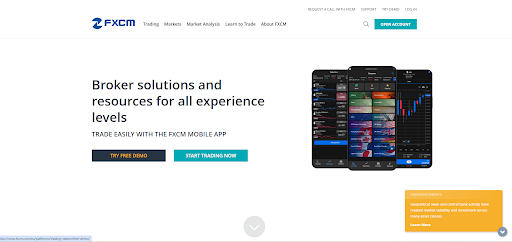
FXCM launched in 1999 and was for years one of the largest retail forex brokers on earth. Its modern history has two defining chapters. The first is corporate: after the 2015 Swiss franc crisis and a 2017 CFTC enforcement action over undisclosed conflicts of interest that ended its US retail business, the firm was absorbed into Leucadia, now Jefferies Financial Group (NYSE: JEF), which today owns FXCM outright, giving it investment-bank-grade financial backing few retail brokers can claim. The second is structural: the group’s entities now operate under the Stratos name, with Stratos Markets Ltd holding the FCA license (217689), Stratos Europe under CySEC (392/20), an FSCA entity in South Africa, an ISA license in Israel, and Stratos Global LLC in St Vincent and the Grenadines onboarding most international clients without comparable oversight. In December 2025, ASIC ordered the Australian entity to stop issuing CFDs and opening new accounts over deficiencies in its target market determination, a live regulatory blemish this comparison cannot omit.
What has never wavered is FXCM’s identity as a trader’s technology shop. Trading Station remains a genuinely powerful proprietary platform; MT4, direct TradingView integration, Capitalise.ai natural-language automation, NinjaTrader and ZuluTrade connectivity, free REST and Java APIs and an app marketplace round out one of the deepest automation stacks in retail trading, recognized with 2026 Best in Class awards for Trading Platforms, Professional Trading and Algo Trading. The catch is the shelf behind the tools: roughly 300 CFDs and about 39 to 43 currency pairs, with its exchange-traded securities offering recently discontinued. Its Trustpilot score stands at a healthy 4.6, and its UK/EU sister brand Tradu offers a tighter-spread, TradingView-first alternative within the same group.
XTB
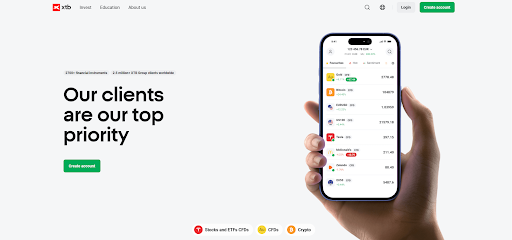
XTB was founded in Poland in 2002, listed on the Warsaw Stock Exchange in 2016, and has grown into one of Europe’s largest listed retail brokers: over 1.3 million clients, offices in 13 countries, seven regulatory licenses (KNF in Poland, FCA in the UK under FRN 522157, CySEC, Dubai’s DFSA, Belize’s FSC and more) and the quarterly audited disclosures that come with a public listing.
Its transformation is the story. Once a classic forex/CFD house, XTB has rebuilt itself into a universal investing app for Europe: 6,000+ real stocks from 16 exchanges and 1,400+ real ETFs at 0% commission up to EUR 100,000 of monthly turnover (0.2% with a EUR 10 minimum beyond), fractional investing from EUR 10, automated ETF Investment Plans, a UK stocks-and-shares ISA, interest paid on uninvested EUR, USD and GBP balances, and even a multi-currency card and eWallet, all wrapped around its continuing CFD business in forex, indices, commodities and roughly 50 crypto CFDs. Everything runs through xStation 5, the proprietary platform whose 2026 Best in Class sweep (Overall, Ease of Use, Beginners) reflects what users have said for years: it is the smoothest single-app experience in the CFD industry. MetaTrader is no longer offered to new clients, and there is no raw-spread account, which defines exactly who XTB is not for.
Regulation & Safety
XTB presents the cleaner, stronger file. Seven licenses headed by the FCA, KNF and CySEC; a Warsaw Stock Exchange listing with audited quarterly accounts; FSCS protection up to GBP 85,000 for UK clients and ICF coverage up to EUR 20,000 in the EU; segregated funds and negative balance protection for retail clients; and more than two decades without a defining enforcement scandal. Clients under the Belize entity accept lighter protections, the standard multi-entity caveat.
FXCM is more complicated, and honesty serves better than polish here. On the positive side: an FCA license since the early 2000s, CySEC and FSCA entities, segregated funds, negative balance protection in regulated jurisdictions, and 100% ownership by NYSE-listed Jefferies, whose balance sheet stands behind the group. On the other side: the 2017 CFTC action that banned it from the US market remains the industry’s cautionary tale about execution transparency; the December 2025 ASIC restriction on its Australian entity is recent and unresolved at the time of writing; and most international clients are onboarded by Stratos Global LLC in SVG, which is effectively unregulated, meaning no compensation scheme and contractual rather than statutory protections. UK and EU clients under the FCA and CySEC entities are as well protected as at any peer.
Trust verdict: XTB, clearly. FXCM is legitimate and financially robust, but its record and entity structure require the exact kind of scrutiny XTB’s listing exists to remove. At either broker, confirm which legal entity appears at signup before depositing.
Trading Products
The starkest gap in this comparison.
XTB offers more than 10,000 instruments across two worlds. The investing side: 6,000+ real stocks across 16 exchanges, 1,400+ real ETFs, fractional shares from EUR 10, Investment Plans for automated portfolio building, and the UK ISA wrapper. The trading side: CFDs on 70+ forex pairs, 40+ indices, commodities, stock and ETF CFDs, and around 50 cryptocurrency CFDs (restrictions apply to UK retail). Missing: bonds, mutual funds, listed options and futures (options are available to some Cyprus-entity clients).
FXCM offers roughly 300+ CFDs: 39 to 43 forex pairs, major indices, commodities, fractional share CFDs, crypto CFDs (not for UK retail) and index baskets, plus UK spread betting. Its brief venture into exchange-traded securities was discontinued, so nothing here is ownable, and the range trails not just XTB but most mid-tier rivals.
Verdict: XTB by a landslide for anyone who wants breadth or real ownership. FXCM’s counterargument is focus: for a forex-and-indices systems trader, 300 instruments cover the strategy universe that matters.
Trading Platforms
Both brokers won platform awards in 2026, for opposite reasons.
FXCM wins on stack depth. Trading Station (desktop, web, mobile) delivers advanced charting, real volume data, custom indicators and strategy backtesting; MT4 serves the EA ecosystem; direct TradingView integration puts execution behind the world’s favorite charts; Capitalise.ai turns plain-English rules into automated strategies at no cost; and free REST/Java APIs plus NinjaTrader and ZuluTrade connectivity complete a professional toolkit. This is why its 2026 honors came in Trading Platforms, Professional Trading and Algo Trading. Notably absent: MetaTrader 5.
XTB wins on single-platform excellence. xStation 5 unifies real investing and CFD trading in one interface with heatmaps, market sentiment, a stock screener, performance analytics of your own trading, integrated news and education, and identical polish across web, desktop and mobile. Its 2026 sweep of Overall, Ease of Use and Beginners categories is deserved; the deliberate trade-offs are the phase-out of MetaTrader for new clients, no cTrader or TradingView execution, and limited API access, which shuts out most algorithmic workflows.
Verdict: automated and multi-platform traders choose FXCM; everyone else will be happier inside xStation 5.
Trading Costs
Forex CFDs. XTB prices EUR/USD from roughly 0.5 to 0.8 pips on its standard spread-only account, with independent tests placing typical costs slightly under the industry average, and a Pro pricing tier with tighter spreads plus commission available in some regions. FXCM’s commission-free pricing averaged about 0.9 pips on EUR/USD in recent time-weighted data under its regulated entities, but runs wider (around 1.2 to 1.3 pips) under the commission-free-only SVG and South African entities; its commission-based structure offers spreads from 0.2 pips plus roughly $5 per lot round turn, and the Active Trader program discounts average around 60% for volume clients. Net: XTB is cheaper for the typical retail trader; a high-volume FXCM Active Trader can close the gap.
Stocks and indices. No contest where ownership matters: XTB’s 0% commission on real stocks and ETFs up to EUR 100,000 monthly turnover (then 0.2%, minimum EUR 10) against FXCM’s CFD-only share exposure. On index CFDs both are competitive (S&P 500 around 0.4 to 0.5 points at XTB; comparable headline pricing at FXCM). XTB applies a 0.5% currency conversion fee on real-stock trades outside your base currency, its most cited hidden cost, and deducts standard US withholding on dividends.
Non-trading fees. Neither charges deposit fees on standard methods (XTB card deposits can carry around 0.7% in some regions; PayPal is accepted). Withdrawals are free at FXCM on most methods, and free at XTB above small thresholds (roughly EUR/USD 50 to 100 by country, with about EUR 10 charged below). Both charge inactivity fees after roughly a year of dormancy (around EUR 10 per month at XTB; FXCM’s applies after prolonged inactivity). XTB uniquely pays interest on uninvested cash, which for funded-but-idle accounts flips the comparison entirely.
| Cost Item | FXCM | XTB |
|---|---|---|
| EUR/USD (commission-free) | Approx. 0.9 to 1.3 pips by entity | Approx. 0.5 to 0.8 pips |
| Commission pricing | From 0.2 pips + approx. $5 RT | Pro tier in select regions |
| Real stocks/ETFs | Not offered | 0% to EUR 100k/month, then 0.2% |
| Index CFDs | Competitive | S&P 500 approx. 0.4 to 0.5 pts |
| Interest on idle cash | No | Yes |
| Withdrawal fees | None (most methods) | Free above small thresholds |
| Inactivity fee | Yes, after dormancy | Approx. EUR 10/month after 12 months |
Cost verdict: XTB for most traders and all investors; FXCM competitive only via Active Trader volume discounts.
Account Types
FXCM:
- Standard: commission-free, $50 minimum, the default worldwide.
- Active Trader: tighter spreads, rebates and volume discounts for high-volume clients.
- Professional: higher leverage for eligible experienced traders.
- Spread betting: UK residents, tax-efficient under current rules.
- Islamic: swap-free on request.
- FXCM Pro: institutional pricing for high-balance clients.
- Demo: free, $20,000 virtual funds.
XTB:
- Standard: spread-only, no minimum deposit, covering CFDs and real investing in one account.
- Pro: commission-plus-raw-spread pricing in select regions.
- Swap-free: available under certain entities.
- UK ISA: tax-free wrapper for British investors.
- Investment Plans: automated recurring ETF portfolios.
- Demo: free, with time limits varying by region (commonly 30 days).
| Account Feature | FXCM | XTB |
|---|---|---|
| Minimum deposit | $50 | None |
| Volume/raw pricing | Active Trader | Pro (regions) |
| Real investing account | No | Yes (integrated) |
| ISA (UK) | No | Yes |
| Spread betting (UK) | Yes | No |
| Demo | $20,000, standard terms | Time-limited in most regions |
Deposits & Withdrawals
FXCM accepts cards, bank transfer, Skrill, Neteller and Google Pay depending on region, charges no deposit or withdrawal fees itself, and processes e-wallet and card movements within about 24 hours with wires taking three to five business days. Cards must be in the account holder’s name, and funds return to source under AML rules.
XTB accepts bank transfer (free), cards (small fee in some regions), PayPal and local e-wallets, with no minimum deposit. Withdrawals go by bank transfer, are free above modest thresholds, and requests before 1pm are typically processed the same day, among the fastest in the industry. Its eWallet and multi-currency card add spending flexibility no traditional CFD broker matches.
| Funding Feature | FXCM | XTB |
|---|---|---|
| Cards / bank / e-wallets | Yes | Yes |
| PayPal | No | Yes |
| Broker fees | None | Minor cases (small withdrawals, some card deposits) |
| Speed | E-wallets ~24h; wires 3 to 5 days | Often same day |
| Extras | None | eWallet, multi-currency card, cash interest |
Research & Education
FXCM provides FXCM Plus with trading signals and market scanners, technical and fundamental analysis, economic calendars and a solid education hub aimed at active traders, plus the quietly excellent resource of its free historical tick data for backtesters. Quality is good; volume trails category leaders.
XTB produces market news and analysis at scale, integrates sentiment data and a stock screener into xStation, and runs one of the friendlier education programs in the industry, from beginner courses to regular webinars, matching its beginner-award positioning. Deep fundamental research (analyst reports, ratings) remains a gap versus full-service brokers.
Verdict: XTB for learning and market coverage; FXCM for quant-relevant resources.
Customer Support
Both offer 24/5 multilingual support via live chat, phone and email. FXCM’s support earns solid marks, with over 30 supported languages and free international dial-ins; XTB’s is similarly rated, with fast chat responses and localized offices in 13 countries. Neither runs weekend coverage. On dispute records, XTB’s file is quieter; FXCM’s user feedback includes occasional friction around withdrawals during volatility, though its 4.6 Trustpilot suggests routine service is well regarded.
Mobile Trading Experience
XTB’s xStation mobile app is the best single-broker app in this matchup: full parity with desktop, real investing and CFDs side by side, screeners, sentiment, alerts and same-day withdrawal requests from your phone.
FXCM offers Trading Station Mobile and MT4 mobile, competent and stable, with full order management and charting, but designed as companions to desktop workflows rather than as the primary venue.
Verdict: XTB decisively for mobile-first users.
Pros & Cons
FXCM
Pros
- Elite automation stack: Trading Station, MT4, TradingView, Capitalise.ai, free APIs
- 2026 Best in Class: Trading Platforms, Professional Trading, Algo Trading
- 100% owned by NYSE-listed Jefferies Financial Group
- Active Trader program with deep volume discounts (~60% average on majors)
- UK spread betting, free historical tick data, 4.6 Trustpilot
- No deposit or withdrawal fees; $50 entry
Cons
- Narrow range: ~300 CFDs, ~40 forex pairs, exchange-traded securities discontinued
- 2017 CFTC action ended its US business; December 2025 ASIC restriction in Australia
- Most international clients onboarded via the unregulated SVG entity
- Standard spreads above average under commission-free-only entities
- No MT5, no real share ownership, no interest on cash
XTB
Pros
- 10,000+ instruments including 6,000+ real stocks and 1,400+ real ETFs at 0% commission (to EUR 100k/month)
- xStation 5: 2026 Best in Class Overall, Ease of Use and Beginners
- Warsaw-listed with seven licenses (FCA, KNF, CySEC, DFSA and more)
- No minimum deposit, fractional shares from EUR 10, Investment Plans, UK ISA
- Interest paid on uninvested cash; same-day withdrawals
- Tighter standard forex spreads than FXCM
Cons
- No MetaTrader for new clients, no TradingView execution, minimal API access
- No raw-spread account in most regions; scalpers look elsewhere
- 0.5% conversion fee on foreign-currency real-stock trades
- Demo time limits; EUR 10/month inactivity fee after a year
- No listed options, futures, bonds or copy trading
- Not available to US residents
Who Should Choose FXCM?
Choose FXCM if you build systems. Algorithmic traders get free APIs, historical tick data, Capitalise.ai and an app marketplace under a broker that just won the industry’s algo-trading award; discretionary chartists get native TradingView execution; and high-volume traders get an Active Trader program whose discounts genuinely change the math. UK residents gain spread betting, and everyone gains the comfort of Jefferies’ balance sheet behind the firm. Do it with discipline: sign up under the FCA or CySEC entity if you are eligible, understand exactly what the SVG entity does and does not protect if you are not, and go in aware of the 2017 history and the 2025 Australian restriction.
Who Should Choose XTB?
Choose XTB if you want one modern, safe account for your whole financial life in the markets. Investors get commission-free real stocks and ETFs with fractional access and automated plans; traders get sub-average CFD spreads inside the industry’s best-rated platform; savers get interest on idle cash; and UK clients get an ISA on top. Beginners get the gentlest on-ramp among serious brokers (no minimum, award-winning usability, strong education), while the publicly listed, seven-license structure removes most trust questions before they are asked. Only dedicated algo traders and raw-spread scalpers should look past it.
Final Verdict
XTB wins this comparison for most people, and it is not close. Broader products, real ownership, cheaper standard pricing, stronger and cleaner regulation, a listed parent, no minimum deposit and the best-reviewed platform of 2026 make it the more complete and more trustworthy broker.
FXCM survives on specialization. For automated, professional and TradingView-native traders, its technology stack is the superior tool and its Jefferies ownership a real reassurance, provided the entity question is handled with eyes open and its regulatory history is priced in.
Both brokers disclose that a large majority of retail clients lose money on CFDs (roughly 67% at FXCM’s UK entity and 72 to 74% at XTB), so whichever you choose, trade with risk capital only and verify every figure on the official sites before funding.
Frequently Asked Questions
Is FXCM or XTB safer?
XTB has the stronger trust profile: listed on the Warsaw Stock Exchange with audited accounts, seven licenses including the FCA, KNF and CySEC, and a clean record. FXCM holds solid FCA/CySEC/FSCA licenses and is owned by NYSE-listed Jefferies, but carries the 2017 CFTC action that ended its US business, a December 2025 ASIC restriction in Australia, and an unregulated SVG entity serving most international clients.
Which broker is cheaper for forex?
XTB for typical retail trading, with EUR/USD from roughly 0.5 to 0.8 pips versus FXCM’s 0.9 to 1.3 pips depending on entity. High-volume traders can narrow the gap at FXCM through Active Trader discounts and its commission-based pricing (from 0.2 pips plus about $5 per lot round turn).
Can I buy real stocks at FXCM or XTB?
Only at XTB, which offers 6,000+ real stocks and 1,400+ real ETFs at 0% commission up to EUR 100,000 monthly turnover, with fractional shares from EUR 10 and automated Investment Plans. FXCM offers share exposure via CFDs only, having discontinued its exchange-traded securities offering.
Which broker is better for algorithmic trading?
FXCM, decisively. It provides free REST and Java APIs, MT4 Expert Advisors, Capitalise.ai natural-language automation, NinjaTrader connectivity and free historical tick data, winning 2026 Best in Class for Algo Trading. XTB’s xStation offers minimal automation and no longer provides MetaTrader to new clients.
Do these brokers support TradingView or MetaTrader?
FXCM supports MT4 and direct TradingView integration (no MT5). XTB supports neither for new clients; everything runs through its proprietary xStation 5.
What are the minimum deposits?
XTB has no minimum deposit. FXCM requires $50.
What happened with FXCM in the US and Australia?
In 2017, a CFTC enforcement action over undisclosed conflicts of interest led FXCM to withdraw from the US retail market permanently. In December 2025, ASIC ordered FXCM’s Australian entity to stop issuing CFDs and opening new accounts over deficiencies in its target market determination. Its FCA, CySEC and FSCA entities continue operating normally.
Does either broker pay interest on cash?
Only XTB, which pays interest on uninvested EUR, USD and GBP balances, calculated daily and paid monthly at rates tracking central banks. FXCM pays no interest on idle funds.
Which broker has the better platform?
Depends on the yardstick. For a single all-purpose platform, XTB’s xStation 5 won 2026 Best in Class for Overall, Ease of Use and Beginners. For a professional multi-tool stack, FXCM’s Trading Station plus TradingView, MT4 and APIs won Best in Class for Trading Platforms and Professional Trading.
Are there inactivity fees?
Yes at both: roughly EUR 10 per month at XTB after 12 months without activity, and a dormancy fee at FXCM after prolonged inactivity. Any trade or open position typically resets the clock.
Can UK residents spread bet with these brokers?
Only with FXCM, which offers tax-efficient spread betting to UK residents alongside CFDs. XTB offers UK clients CFDs, real investing and a stocks-and-shares ISA instead.
Do FXCM or XTB accept US clients?
No. FXCM has been barred from the US retail market since 2017, and XTB does not serve US residents. US-based traders should consider CFTC-regulated alternatives.