Introduction
The foreign exchange market operates 24 hours daily across global trading centers, offering unprecedented liquidity and opportunity. Yet with opportunity comes complexity: how you approach forex trading—the timeframes you target, the frequency of trades you execute, and the risk exposure you maintain—fundamentally shapes your profitability, stress levels, and long-term sustainability as a trader.
This article examines three dominant forex strategies: scalping, swing trading, and day trading. These aren’t mutually exclusive; they represent different points on a spectrum of trading frequency and holding periods. Understanding each approach—its mechanics, advantages, pitfalls, and suitability to your situation—empowers you to select or blend strategies that align with your unique circumstances.
We’ll move beyond surface-level comparisons to explore how professional traders implement these strategies, the psychological demands each creates, and the technical and capital requirements needed for consistent execution.
What Are Forex Trading Strategies?
A forex trading strategy is a systematic approach to identifying, entering, and exiting currency trades. Each strategy defines:
- Timeframes (1-minute, hourly, daily, weekly)
- Holding periods (seconds to weeks)
- Entry signals (technical indicators, price action, economic events)
- Exit rules (profit targets, stop-losses, trailing stops)
- Position sizing (how much capital per trade)
- Risk parameters (maximum loss per trade, daily limits)
The three strategies covered here differ primarily in frequency (how often you trade), duration (how long you hold positions), and capital intensity (how much money you need to execute effectively).
Scalping in Forex: Quick Wins, High Frequency
How Scalping Works
Scalping is a high-frequency strategy where traders execute 10 to 100+ trades daily, each targeting micro-movements of 5-20 pips (price points). A scalper might hold a EUR/USD position for 30 seconds to 5 minutes, capturing small but consistent gains.
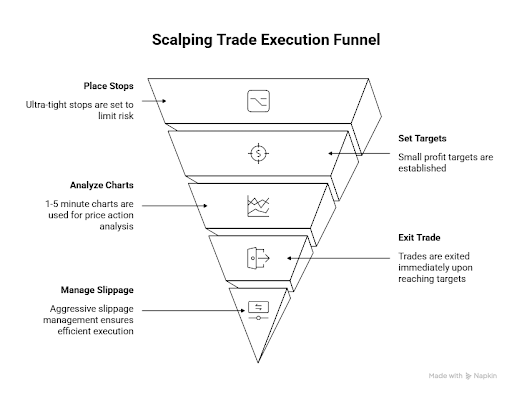
Mechanics of a scalping trade:
- Identify liquidity concentration — scalpers trade the most liquid pairs (EUR/USD, GBP/USD, USD/JPY) during peak liquidity hours (London and US session overlaps)
- Place ultra-tight stops — typically 3-5 pips below entry to limit downside
- Set small profit targets — usually 5-10 pips per trade
- Use 1-5 minute charts — reading price action, support/resistance, and order flow
- Exit immediately at target — capturing the win before momentum reverses
- Manage slippage aggressively — scalpers demand superior execution to beat transaction costs
Real-world example: A scalper buys EUR/USD at 1.0850 with a 5-pip stop-loss (1.0845) and 10-pip target (1.0860). If filled at 1.0860, they exit immediately for a 10-pip gain. Over 50 such trades daily at an average 8-pip win, they’d capture 400 pips—potentially $4,000 on a standard lot (assuming no losses).
Timeframes and Entry/Exit Rules
- Primary timeframes: 1-minute, 5-minute charts
- Trade duration: 30 seconds to 5 minutes
- Session preference: London open, New York open (highest volatility)
- Entry signals:
- Price action rejection from micro-support/resistance
- Order flow divergence (price makes a new high but volume declines)
- One-minute breakouts of the prior 5-minute range
- Momentum oscillators (RSI, Stochastic) extreme readings
- Exit rules:
- Hit profit target (fixed or trailing)
- Hit stop-loss
- No signal confirmation within 2-3 candles
- Market volatility dries up (spread widens)
Advantages of Scalping
- Small risk per trade — 3-5 pip stops mean minimal loss if wrong
- Frequent wins — hitting small targets multiple times daily provides psychological reinforcement
- Minimal overnight risk — all positions closed before day’s end; no gap exposure
- Leverages volatility spikes — scalpers thrive when 4-8 pip swings appear every minute
- Fast capital turnover — capital is deployed and returned quickly, allowing compounding
- Reduced macro risk — 5-minute trades are insulated from economic announcements or geopolitical shocks that impact longer-term trends
Disadvantages and Challenges
- Transaction costs eat profits — spreads, commissions, and slippage can consume 50%+ of small wins
- Example: If your broker charges 2-pip spread + 1-pip commission per trade, and you target 5-pip wins on 50 trades, transaction costs consume 150 pips of your 250-pip gross, leaving only 100 pips (40% net)
- Requires perfect execution — delays of 100 milliseconds can mean missing fills; you need:
- VPS (Virtual Private Server) for zero latency
- Direct broker connectivity or ECN access
- Minimal slippage agreements
- Emotionally exhausting — 50+ daily trades demand constant vigilance; fatigue leads to errors
- Requires substantial capital — while margin multiplies gains, it also multiplies losses
- $5,000 account with 50:1 leverage = $250,000 notional; a 20-pip loss = $200 (4% account risk per trade)
- High correlation with randomness — on noisy 1-minute charts, separating signal from noise is difficult
- Broker restrictions — many brokers restrict scalpers or impose wider spreads specifically to discourage the strategy
Profit potential limited — realistic scalping returns (after costs) are 1-3% monthly, not the 10%+ advertised in ads
Swing Trading in Forex: Capturing Intermediate Moves
How Swing Trading Works
Swing trading holds positions 3-14 days, targeting intermediate-term price swings of 50-200 pips. Swing traders let profitable trends run, capturing larger moves with fewer trades.
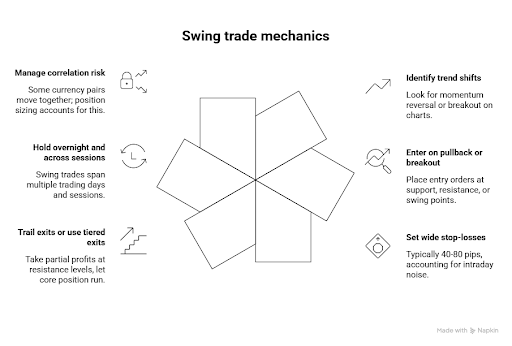
Mechanics of a swing trade
- Identify trend shifts on daily/4-hour charts — wait for momentum reversal or breakout from consolidation
- Enter on pullback or breakout — place entry orders at support, resistance, or swing points
- Set wide stop-losses — typically 40-80 pips, accounting for intraday noise
- Trail exits or use tiered exits — take partial profits at resistance levels, let core position run
- Hold overnight and across sessions — swing trades span multiple trading days and sessions
- Manage correlation risk — some currency pairs move together; position sizing accounts for this
Real-world example: A swing trader identifies USD/JPY consolidating at 150.00-152.00 range over 4 days. On day 5, price breaks above 152.00 with volume confirmation. They buy at 152.20 with a 100-pip stop (151.20) and target 155.50 (330 pips away). After 8 trading days, price reaches 155.40; they exit for a 320-pip gain. One such trade offsets multiple losing scalp trades.
Timeframes and Trade Duration
- Primary timeframes: 4-hour, daily, weekly charts
- Trade duration: 3-14 days (typically)
- Session preference: No specific session; trades span multiple sessions
- Entry signals:
- Daily chart support/resistance breakouts
- Trend line breaks with volume confirmation
- Moving average crossovers (50-day crosses 200-day)
- Weekly chart reversal patterns (head-and-shoulders, double bottoms)
- Risk/reward ratio > 1:2 (risking $200 to make $400+)
- Exit rules:
- Hit profit target at resistance level
- Hit stop-loss below support
- Trade deteriorates (closes below moving average; loses structural support)
- Economic event risk requires immediate exit
Advantages of Swing Trading
- Larger profit per trade — 100-300 pip targets = $1,000-$3,000 per standard lot per trade
- Lower trade frequency — 3-8 trades weekly instead of 50+ daily; less time spent monitoring
- Transaction costs negligible — fewer trades mean spread/commission impact is lower
- Allows part-time trading — check charts before work, after hours; don’t need constant screen time
- Follows structural trends — aligns with larger market directional moves
- Better sleep at night — overnight risk is known and managed; not constantly watching price tick
- Emotional stability — fewer trades = fewer emotional decisions; more time to analyze
- Suits full-time employment — swing trades don’t demand 8-hour daily commitment
Disadvantages and Challenges
- Overnight gap risk — economic announcements, geopolitical events, or bank interventions can gap price 50-200 pips overnight
- Example: GBP/USD at 1.2750; overnight Brexit news gaps it to 1.2600, triggering your 1.2680 stop-loss for a 70-pip loss, but you realize the move at 1.2600—a 150-pip move against you
- Longer time to profit — capital tied up for days/weeks; slower compounding than scalping
- Requires larger stops — 50-80 pip stops mean minimum account size; a 50-pip loss on a micro lot = $5, but on standard lots = $500
- Interest rate rollover costs — holding positions overnight incurs swap fees; on negative carry pairs (like USD/TRY), daily costs can be significant
- Weekend risk — markets close Friday; Monday opens can gap significantly
- Requires patience — sitting through intraday drawdowns without acting (most traders exit early)
- Whipsaw risk — price can reverse within your holding period, taking your stop before the intended trend resumes
Day Trading in Forex: Intraday Profit Taking
How Day Trading Works
Day traders open and close all positions within a single trading day, holding trades from 1 hour to 8 hours. This strategy captures intraday volatility while eliminating overnight risk.
Mechanics of a day trade
- Trade only during high-volatility hours — London open (2 AM-4 AM ET) or US open (8 AM-10 AM ET)
- Identify intraday trends — use 15-minute to hourly charts to spot directional bias
- Enter on momentum — buy breakouts or oversold bounces; sell reversals or overbought pullbacks
- Set moderate stops — 20-30 pips; account for intraday swings but avoid gap-level risk
- Exit before session close — flatten positions 1-2 hours before day end to eliminate overnight exposure
- Trade 2-4 hours daily — focus on peak volatility windows
Real-world example: A day trader trades EUR/USD on the New York open (1 PM GMT). EUR/USD opens at 1.0900 and shows bullish momentum. They buy at 1.0910 with a 25-pip stop (1.0885) and 60-pip target (1.0970). After 2.5 hours, price reaches 1.0970 and they exit for a 60-pip gain ($600 on one standard lot). They close all trades by 5 PM, avoiding any overnight risk. They execute 3-4 similar trades that day.
Timeframes and Holding Periods
- Primary timeframes: 15-minute, 1-hour charts
- Trade duration: 1-8 hours
- Session preference: London open, New York open (avoid slow Asian/overlap sessions)
- Entry signals:
- Hourly breakouts above prior 2-hour high/low
- Bullish/bearish divergences on 4-hour chart
- Support/resistance breaks on 1-hour chart with volume
- Moving average crossovers (5-minute trends early entries)
- Economic news surprises creating directional momentum
- Exit rules:
- Hit profit target
- Hit stop-loss
- Session time-based (close all 1-2 hours before market close)
- Trend reversal (close below hourly moving average)
Advantages of Day Trading
- Zero overnight risk — all positions flat by day’s end; no weekend, gap, or news-driven overnight losses
- Moderate profit potential — 40-80 pip targets per trade = 3-6 trades daily × $400-$600/trade = $1,200-$3,600 daily ($6,000-$18,000 weekly)
- Less capital required than scalping — 30-pip stops and fewer daily trades = smaller position sizes acceptable
- Active but bounded — 4-6 hours of trading per day is sustainable; not the exhaustion of 50+ trades
- Combines trend-following and timing — captures both intraday directional moves and mean reversion
- Psychological advantage — winners and losers are realized same-day; less stress of overnight uncertainty
- Feedback loop — daily close allows reflection and journaling; faster learning
Disadvantages and Challenges
- Requires daily focus — 4-8 hours every trading day; can’t skip sessions without losing rhythm
- Limited by trading hours — can’t trade during illiquid sessions (Asian, if trading from US); restricted to 2-3 peak hours
- Intraday volatility noise — 15-minute and hourly charts have more whipsaws; harder to distinguish signal from noise
- Requires active broker — need reliable platform, low spreads, and fast execution; retail brokers often inadequate
- Emotional demand — must execute same plan repeatedly; boredom, frustration, or overtrading risk
- Transaction costs material — 3-5 trades daily × 2-pip spread = 15+ pips in costs weekly
- No compounding benefit — positions held same-day don’t provide leverage advantage
- Requires consistent discipline — skipping a session for fatigue or missed your peak-time window means sitting out
- Profit margin thin — after costs and slippage, average trade must be 50+ pips to be profitable; 35-40 pip average trades don’t work
Head-to-Head Comparison: Scalping vs Swing vs Day Trading
| Factor | Scalping | Day Trading | Swing Trading |
| Trade Frequency | 50-100+ daily | 3-5 daily | 3-8 weekly |
| Holding Period | 30 sec – 5 min | 1-8 hours | 3-14 days |
| Average Pips per Trade | 5-15 | 40-80 | 100-300 |
| Daily Time Required | 6-8 hours continuous | 4-6 hours active | 30 min – 1 hour |
| Minimum Spread/Conditions | <1.5 pips essential | <2 pips preferred | 2-3 pips acceptable |
| Typical Monthly Return (realistic) | 1-3% | 2-5% | 3-8% |
| Overnight Risk | None | None | Significant |
| Capital Required (minimum) | $5,000-$10,000 | $2,000-$5,000 | $1,000-$2,000 |
| Leverage Used | 50:1 to 500:1 | 10:1 to 100:1 | 5:1 to 20:1 |
| Drawdown Tolerance | <2% per trade | 2-3% per trade | 3-5% per trade |
| Emotional Difficulty | Very High | High | Moderate |
| Learning Curve | Steepest | Moderate | Gentlest |
| Skill Cap | Execution, intuition | Pattern recognition | Patience, trend analysis |
| Slippage Impact | Critical | Material | Minor |
| Suitability for Beginners | Poor | Moderate | Good |
| Part-Time Viability | No | Difficult | Yes |
| Broker-Friendly | Low (many restrict) | Moderate | High |
Risk Management Across All Three Strategies
Position Sizing
The Kelly Criterion and fixed-percentage-risk approach prevent catastrophic losses:
Fixed-percentage method:
- Risk a fixed % of account per trade (e.g., 1-2%)
- Example: $10,000 account, 1% risk = max $100 loss per trade
- If stop-loss is 20 pips, position size = $100 ÷ 20 pips ÷ 10 pips per $1 (micro lot) = 0.5 standard lots
Calculation example:
Account: $10,000
Risk per trade: 1% = $100
Stop-loss distance: 25 pips
Lot size = $100 ÷ (25 pips × $10 per pip) = 0.4 standard lots
Daily and Weekly Limits
- Daily loss limit: Stop trading after 3 consecutive losses or 2% daily account loss
- Weekly loss limit: If down >5% for the week, take a break, review trades, adjust strategy
- Maximum open positions: Never risk >5% of account across all open trades combined
Trade-Specific Rules
- Risk-to-reward ratio ≥ 1:2 — never risk $100 to make $150; target $200+ on every trade
- Stop-loss placement:
- Scalping: 3-5 pips below entry or below recent swing low
- Day trading: 20-25 pips, below hourly support
- Swing trading: 40-80 pips, below daily support or weekly trend line
- Profit-taking discipline:
- Take partial profits at resistance (sell 50% at target, trail 50%)
- Don’t move stops to losses (a trade is a trade; exit if thesis breaks)
Psychological Risk Management
- Max consecutive losses: Exit after 3 losses in a row (system is broken or you’re not focused)
- Avoid revenge trading: After a loss, don’t immediately enter next trade; wait one complete market move
- Track everything: Keep a trading journal noting entry reason, exit reason, emotions, and what you’d do differently
- Monthly reviews: Evaluate win rate, average win vs. loss, largest drawdown; adjust position sizes if drawdown exceeds 20%
How to Choose Your Forex Strategy
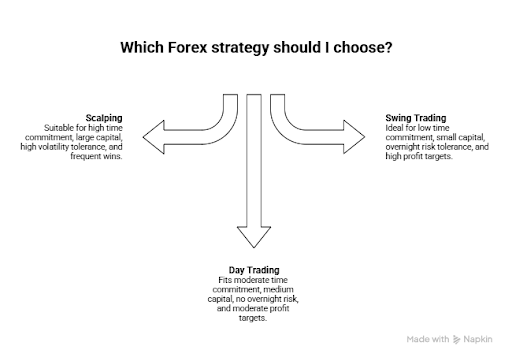
The “best” strategy is the one that matches your lifestyle, capital, and temperament.
Decision Matrix
Answer these questions:
- How much time can you dedicate daily?
- ≥6 hours continuously → Scalping is viable
- 3-6 hours active → Day trading fits
- <1 hour → Swing trading is right
- What is your account size?
- <$2,000 → Swing trading only; avoid scalping/day trading leverage risks
- $2,000-$5,000 → Day trading or conservative swing trading
- $5,000 → All three strategies viable
- How much volatility can you handle psychologically?
- Uncomfortable with any overnight risk → Day trading only
- Can sleep with open positions → Swing trading or day trading
- Need frequent wins for confidence → Scalping (if you have discipline)
- Do you have trading experience?
- <6 months experience → Start swing trading only
- 6-18 months → Add day trading once profitable
- 18 months + proven consistency → Consider scalping
- What is your realistic profit target?
- 1-3% monthly → Scalping (if execution perfect)
- 2-5% monthly → Day trading
- 5-10% monthly → Swing trading (if timing excellent)
Sample Decision Scenarios
Scenario A: Part-time trader, $3,000 account, works full-time, 1-2 hours daily → Swing trading only. Day trading incompatible with job; scalping needs more capital.
Scenario B: Full-time trader, $8,000 account, 8 hours available, high patience → Day trading primary + swing trading secondary. Day trading requires full-time but time aligns; swing trades can run longer.
Scenario C: Experienced trader, $15,000 account, 4-6 hours daily, impatient personality → Scalping or day trading mix. Capital sufficient; time matches; temperament favors quick feedback.
Real-World Implementation: Practical Tips
Setting Up for Scalping Success
- Broker: Use ECN broker (FxPro, FXCM Pro, Saxo Bank) with direct market access and <0.5 pip spreads
- Technology: Run VPS in nearest location to broker servers (latency <10 ms critical)
- Trading hours: Trade only London 2-4 AM ET or NY 8-10 AM ET (peak liquidity, tightest spreads)
- Pairs: Focus on EUR/USD, GBP/USD only (highest volume, most predictable)
- Entry example: Set alerts for price 5 pips above/below current hourly high/low; enter if breaks with volume confirmation
- Stop placement: Exactly 5 pips below entry; accept loss immediately if hit
- Profit target: 10 pips; hit target and exit, no trailing, no hope
Setting Up for Day Trading Success
- Broker: Standard retail broker acceptable (Oanda, IG, Forex.com); <2 pip spreads on majors
- Technology: Desktop platform (MetaTrader 4/5) with alerts for key levels
- Trading hours: Focus on London open (2-4 AM ET) and NY open (8-10 AM ET)
- Pairs: EUR/USD, GBP/USD, USD/JPY (avoid exotics; they gap erratically)
- Entry example: Wait for 1-hour breakout of prior 2-hour high/low; enter on break with 20-pip stop
- Time discipline: Close all positions 1-2 hours before market close (avoid Friday close altogether)
- Daily journal: Record 3-5 best trades; identify patterns in winning entries
Setting Up for Swing Trading Success
- Broker: Any regulated broker acceptable (OANDA, IG, TD Ameritrade, etc.)
- Technology: Weekly and daily charts; don’t stare at 5-minute moves
- Entry setup: Find daily support/resistance; place pending orders, then walk away
- Entry example: EUR/USD holds 1.0800 support for 3 days; place buy limit at 1.0800 + 5 pips with 70-pip stop at 1.0735, 200-pip target at 1.0900+
- Management: Once in trade, check once daily (morning before work)
- Exit: Use tiered exits (sell 25% at R1, 25% at R2, trail 50%) or simple profit target
- Hold time: Expect 5-10 trading days; don’t exit early due to intraday volatility
Common Mistakes Traders Make
Across All Strategies
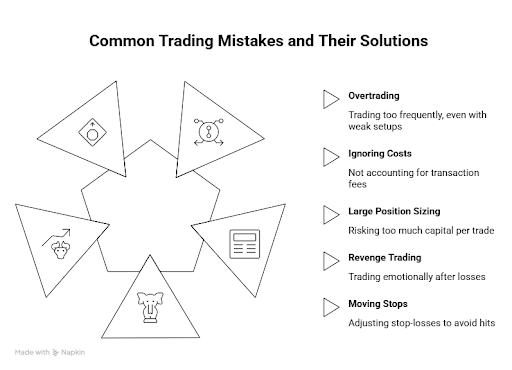
- Overtrading during low-confidence setups
- Mistake: Trade every possible setup, even weak ones
- Fix: Define high-confidence criteria in writing; skip 70% of setups
- Impact: 50% fewer trades with 30% better win rate = 65% more profit
- Ignoring transaction costs
- Mistake: Calculate P&L without accounting for spreads, commission, slippage
- Reality: Costs 15-20% of gross pips on shorter timeframes
- Fix: Always subtract 2-3 pips from target for realistic returns
- Position sizing too large
- Mistake: Risk 5-10% per trade due to account impatience
- Reality: Two 5% losses = 9.75% account loss; recovery requires 10.8% gain
- Fix: Risk 1-2% max; even 20 consecutive losses = 18% loss, recoverable
- Revenge trading after losses
- Mistake: Enter immediately after stop-loss hit with doubled size
- Reality: Emotional trading has 30% worse outcomes
- Fix: Mandatory 1-hour wait after loss; journal reason before next trade
- Moving stops to losses
- Mistake: Extend stop-loss after entry to avoid hit
- Reality: Turns small losses into account killers
- Fix: Set stop before entry; never move it wider
Scalping-Specific Mistakes
- Scalping during slow sessions
- Problem: Trade Asian hours with 4-6 pip spreads
- Solution: Trade only London/NY overlap when spreads are 0.5-1.5 pips
- Expecting >15 pips per trade
- Problem: Target too large; price reaches 12 pips, you hold for 15, miss exit
- Solution: Accept 5-10 pip targets; compound through volume
Day Trading-Specific Mistakes
- Not using time-based exits
- Problem: Hold trade into market close hoping for big move; gap overnight
- Solution: Mechanical rule: close all trades 90 minutes before close
- Trading outside peak volatility hours
- Problem: Trade slow afternoon hours; wider stops needed for same move
- Solution: Trade only first 3 hours after open (8-11 AM ET for NYSE)
Swing Trading-Specific Mistakes
- Exiting early due to intraday noise
- Problem: Price pulls back 30 pips intraday; panic exit, missing 150-pip move
- Solution: Weekly chart entries only; never check daily until morning (check once at day start)
- Holding through obvious reversals
- Problem: Hope for recovery; miss the trend-break signal
- Solution: Exit if price closes below entry 4-hour moving average or breaks daily support
Conclusion
The path forward:
- Self-assess honestly: Use the decision matrix above to identify which strategy aligns with your time, capital, and psychology
- Paper-trade first: Spend 2-4 weeks demo trading your chosen strategy without real money; track the same metrics you would with real capital
- Start with minimum scale: Fund your account with capital you can afford to lose entirely (not rent money); risk only 1% per trade
- Keep a detailed journal: Record every trade with entry reason, exit reason, and one lesson learned; review weekly
- Expect a 3-6 month learning curve: Profitability in forex typically requires 50-100 real trades before consistency emerges
- Adjust, don’t abandon: After 20-30 trades, review your results; refine entry/exit rules, position sizing, or trading hours—but don’t abandon the strategy after 2 weeks
- Find your community: Join trader forums, read market analysis, or work with a mentor; isolation breeds bad habits
The dirty truth about forex trading: Most retail traders fail not because strategies don’t work, but because they lack discipline, risk management, and emotional control. A simple swing-trading strategy executed perfectly beats a sophisticated scalping strategy executed emotionally.
Start with the strategy that fits your life. Master one before considering others. And remember: in forex, slow and steady compounds into wealth; fast and reckless compounds into losses.