Can You Really Learn Commodity Trading Fast?
The honest answer is: it depends entirely on what “fast” means to you — and what standard of readiness you are willing to accept before committing real capital.
You can acquire a solid working knowledge of commodity market mechanics, terminology, and fundamental analysis frameworks in two to four weeks of dedicated study. You can begin simulated trading within the first month and develop genuine pattern recognition over the following two to three months. Many committed beginners are trading live with a tested strategy and genuine competence within four to six months of starting from zero.
What you cannot do is shortcut the experiential component. Commodity markets are probabilistic, dynamic, and humbling. Reading about how crude oil reacts to OPEC production decisions is categorically different from watching it happen in real time with your attention fully engaged. The fastest learners are not those who consume the most content — they are those who get into active market observation and simulation as quickly as possible and build deliberate feedback loops into everything they do.
This guide is structured to compress your learning curve as aggressively as possible without sacrificing the steps that actually determine whether you succeed.
What You Need to Learn Before Your First Trade
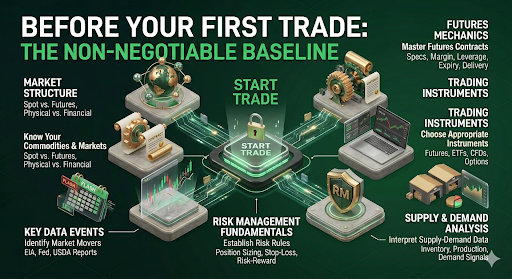
Before placing even a simulated trade, there is a non-negotiable baseline of knowledge every commodity trader must have. Attempting to trade without it is not “learning by doing” — it is operating blindly in a market where leverage can punish ignorance quickly.
The non-negotiable baseline:
- What commodities are and how markets are structured — spot vs. futures, physical vs. financial markets, exchange mechanics
- How futures contracts work — contract specifications, margin, leverage, expiry, and delivery
- The trading instruments available to you — futures, ETFs, CFDs, options — and which is appropriate for your capital and goals
- Basic supply-demand analysis — how to interpret inventory reports, production data, and demand signals for your chosen commodity
- Risk management fundamentals — position sizing, stop-loss placement, risk-reward ratios, daily loss limits
- How to read a commodity price chart — basic price action, support and resistance, trend identification
- The key data releases and events that move your market — for crude oil, the weekly EIA inventory report; for gold, Fed meeting decisions and real interest rate movements; for grains, USDA crop reports
This is not an exhaustive list — but covering these seven areas before your first trade gives you the scaffolding to learn from market observation rather than being bewildered by it.
The Fast-Track Learning Roadmap: Phase by Phase
Phase 1: Build Your Foundation (Weeks 1–2)
The objective of this phase is to acquire working knowledge of commodity market structure, instruments, and fundamentals — efficiently and without getting lost in unnecessary depth too early.
What to do:
- Read one comprehensive introductory resource cover-to-cover (see the resources section below)
- Study how futures contracts work in detail — margin, leverage, contract specs, expiry and rolling
- Learn the four main commodity sectors: energy, metals, agricultural, and livestock
- Understand the difference between spot markets and futures markets
- Open a free demo account on a trading platform (TradingView, CME’s demo platform, or your intended broker) and familiarize yourself with the interface — charts, order types, position management
- Follow daily price movements in two or three major commodities (crude oil, gold, wheat) and read the news explanations for why they moved
Learning goal by end of Phase 1: You can explain how a futures contract works, name the major exchanges and commodity sectors, and describe the basic instruments used to trade commodities without needing to reference notes.
Time commitment: 1.5–2 hours per day of focused study.
Phase 2: Choose Your Market and Go Deep (Weeks 3–4)
The single most accelerating decision a new commodity trader can make is to specialize in one market early. Trying to learn crude oil, gold, wheat, copper, and natural gas simultaneously fragments your attention and prevents deep pattern recognition from forming.
What to do:
- Select one commodity to focus on for your first six months (see the How to Choose Your First Commodity Market section below)
- Study the specific supply-demand framework for that commodity in depth — who produces it, who consumes it, what the key data releases are, what seasonal patterns exist, what geopolitical factors matter
- Identify the three to five variables that most consistently move your market
- Begin studying historical charts of your chosen commodity over the past 3–5 years — relate major price movements to fundamental events that caused them
- Study the contract specifications for your instrument of choice — margin requirements, tick size, contract value, trading hours
- Read analyst reports and market commentary from reputable sources in your sector daily
Learning goal by end of Phase 2: You can explain what drives the price of your chosen commodity, identify the key data releases and their typical market impact, and recognize the major price patterns that have occurred over the past few years.
Time commitment: 1–2 hours per day of study plus 30 minutes of daily market observation.
Phase 3: Paper Trade with Full Discipline (Weeks 5–10)
Paper trading — simulated trading using real market prices but no real money — is where theoretical knowledge begins transforming into practical skill. This phase is the most important and the most commonly undervalued by impatient beginners.
What to do:
- Open a paper trading account on your chosen platform (most major futures brokers offer this; TradingView has an excellent built-in paper trading feature)
- Write your trading plan before placing a single simulated trade — define your entry criteria, exit criteria, position sizing rules, and daily loss limits
- Execute every simulated trade as if real money is at stake — same position sizes (relative to a realistic starting capital), same stop-losses, same discipline
- Record every trade in a trading journal: entry, exit, P&L, rationale, emotional state, and post-trade review
- Review your journal weekly — look for patterns in what is working and what is not
- After at least 50 trades, calculate your win rate, average risk-reward ratio, and expectancy (average profit per trade)
The discipline standard: Paper trading only produces meaningful learning if you treat it with the same seriousness as real money. Skipping stop-losses “because it’s only simulated” produces false data and bad habits that cost you real money later.
Learning goal by end of Phase 3: A trading journal with at least 50 documented trades, clear understanding of where your strategy works and where it does not, and calculated metrics that demonstrate whether your approach has a positive expectancy.
Time commitment: Active trading session time plus 20–30 minutes of journaling per day.
Phase 4: Transition to Live Trading with Minimal Capital (Weeks 11–16)
The transition from paper trading to live trading is psychologically significant regardless of how prepared you are. Real money activates emotional responses that simulation cannot fully replicate — and those emotions will affect your decision-making.
What to do:
- Start with the smallest viable position size for your chosen instrument — for futures traders, this means Micro contracts (Micro E-mini, Micro Gold futures, etc.); for CFD traders, the minimum lot size
- Apply identical rules to your live account as your paper account — same plan, same position sizing, same daily loss limits
- Expect your live results to initially underperform your paper results — this is normal and temporary
- Keep journaling with the same rigor as during paper trading
- Do not increase position size until you have completed at least 30 live trades and your results are consistent with your paper trading metrics
What not to do: Do not start live trading because you are “ready” based on emotion or impatience. Start because your paper trading data demonstrates a positive expectancy over a meaningful sample size. This distinction is the difference between confidence grounded in evidence and confidence grounded in optimism.
Learning goal by end of Phase 4: 30+ live trades executed with full adherence to your trading plan, a live journal with honest review, and a clear picture of how your psychological response to real P&L affects your execution.
Phase 5: Review, Refine, and Scale (Ongoing)
Learning commodity trading does not end when you start trading live — it accelerates. The market is the best teacher available, and every session with a disciplined journal review produces insights that no course or book can replicate.
Ongoing practices:
- Weekly journal review: identify your best and worst trades, look for systematic patterns in your errors
- Monthly performance review: calculate key metrics — expectancy, profit factor, maximum drawdown, win rate — and compare to prior months
- Continuous fundamental study: commodity markets evolve; stay current with structural changes in your market (energy transition dynamics affecting oil and metals, climate impacts on agricultural commodities, etc.)
- Gradual position sizing increases: scale up only when both your metrics and your psychological composure support it
- Seek feedback: a trading mentor, peer accountability group, or community of traders working in the same market accelerates development dramatically
The Best Resources for Learning Commodity Trading
Books
For foundational market knowledge:
- Hot Commodities by Jim Rogers — accessible, experience-based introduction to why commodities matter from a legendary macro investor
- The Futures Game by Richard Teweles and Frank Jones — comprehensive academic treatment of futures markets, contract mechanics, and trading principles
- A Complete Guide to the Futures Market by Jack Schwager — technically rigorous coverage of futures analysis, written by the author of the Market Wizards series
For trading psychology and discipline:
- Trading in the Zone by Mark Douglas — the most widely recommended book on trading psychology; essential reading before live trading
- The Disciplined Trader by Mark Douglas — Douglas’s earlier work, equally valuable for building the psychological framework needed to follow rules consistently
For technical analysis applicable to commodities:
- Technical Analysis of the Financial Markets by John Murphy — the reference text for chart analysis; Murphy spent much of his career analyzing commodity markets specifically
Online Courses and Platforms
- CME Group Education (cmegroup.com/education) — The CME’s own educational portal covers futures mechanics, commodity fundamentals, and trading strategies with free courses directly from the world’s largest derivatives exchange. The quality and accuracy here is authoritative by definition.
- TradingView — While primarily a charting platform, TradingView’s community scripts, published ideas, and the ability to observe how experienced traders analyze specific commodity charts provides enormous practical learning value
- Investopedia Academy — Structured courses on futures trading and commodity markets with clear explanations suited to beginners
- Udemy commodity trading courses — Variable quality; read reviews carefully and prioritize instructors with verifiable professional trading backgrounds
Market Data and News Sources
| Source | Best For |
| CME Group Settlements | Daily futures settlement prices, volume, open interest |
| EIA (eia.gov) | US energy data: crude oil, natural gas, petroleum inventories |
| USDA (usda.gov) | Agricultural reports: WASDE, crop progress, export data |
| World Gold Council | Gold demand, supply, and investment flow data |
| Reuters / Bloomberg Commodities | Breaking news, analyst commentary, price feeds |
| Commitments of Traders (CFTC COT) | Weekly positioning data showing how large traders are positioned |
The CFTC’s Commitments of Traders (COT) report is a particularly powerful learning tool that many beginners overlook. Published every Friday, it shows the net long/short positioning of commercial hedgers, large speculators, and small speculators in every major futures market. Learning to read COT data provides genuine insight into market structure that pure price chart analysis cannot.
How to Choose Your First Commodity Market
The commodity you start with significantly affects the quality and pace of your learning. Here is a framework for making the decision:
| Commodity | Volatility | Liquidity | Complexity | Best For |
| Gold | Moderate | Very High | Moderate | Beginners — clear macro drivers, deep liquidity, extensive analysis available |
| Crude Oil (WTI/Brent) | High | Extremely High | High | Active traders comfortable with fast markets and event-driven moves |
| Natural Gas | Very High | High | High | Experienced beginners only — extreme seasonal volatility, difficult to hold overnight |
| Corn / Wheat / Soybeans | Moderate–High | High | High | Traders interested in fundamental/seasonal analysis; steep learning curve in crop reporting |
| Copper | Moderate | High | Moderate | Macro-oriented traders; excellent economic indicator, less media noise |
| Silver | High | High | Moderate | Similar to gold but amplified volatility; more speculative character |
Recommended starting market for most beginners: Gold (COMEX GC futures or GLD ETF)
Gold is an ideal first commodity for several reasons: it is the most extensively analyzed commodity in the world, meaning high-quality research and commentary is readily available; its primary price drivers (real interest rates, USD strength, risk sentiment, central bank demand) are macroeconomic and relatively transparent; it has deep liquidity with tight spreads; and Micro Gold futures (MGC) allow genuinely small initial position sizes suitable for learning with minimal capital at risk.
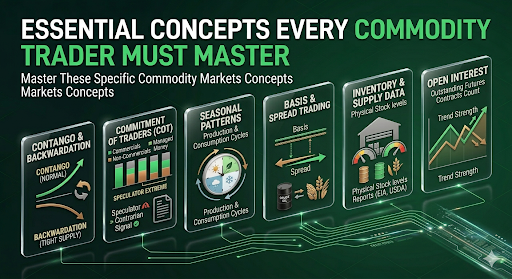
Essential Concepts Every Commodity Trader Must Master
Beyond basic market knowledge, these specific concepts separate traders who understand commodity markets from those who merely understand markets in general:
Contango and Backwardation These terms describe the relationship between current futures prices and expected future spot prices. In contango, futures prices are higher than the current spot price — the normal state for commodities where storage costs exist. In backwardation, futures trade below spot — typically signaling tight near-term physical supply. Understanding whether your market is in contango or backwardation affects roll costs for long positions and reveals important information about physical supply conditions.
The Commitment of Traders (COT) Report As mentioned above, this weekly CFTC publication shows how different categories of market participants are positioned. Extreme positioning by large speculators (the “managed money” category) often precedes reversals — when everyone is already long, who is left to buy? COT analysis is a genuinely useful contrarian signal when used alongside other analysis.
Seasonal Patterns Many commodities exhibit historically recurring price patterns tied to physical production and consumption cycles. Natural gas rises ahead of winter heating demand; agricultural commodities peak during planting uncertainty in spring; crude oil tends to find support as summer driving season approaches. Seasonal analysis is not deterministic — but ignoring it is leaving relevant information on the table.
Basis and Spread Trading The basis is the difference between the spot price and a futures price. Spread trading — the simultaneous purchase and sale of related futures contracts — is a cornerstone of professional commodity trading. Understanding basic spread relationships (calendar spreads, inter-commodity spreads like the crack spread or soybean crush) provides both analytical insight and actual trading opportunities.
Inventory and Supply Data Physical commodity markets respond acutely to inventory data. For crude oil, the weekly EIA report showing changes in US crude and product inventories is one of the most market-moving regular releases in global finance. For agricultural commodities, USDA reports on crop progress, ending stocks, and export sales drive price action. Learning to interpret these reports and understand their relationship to price is fundamental commodity analysis.
Open Interest Open interest — the total number of outstanding futures contracts — tells you whether money is flowing into or out of a market. Rising open interest alongside rising prices confirms a trend; rising open interest with falling prices confirms a downtrend. Declining open interest suggests positions are being closed and a trend may be weakening. Price action without open interest analysis gives you half the picture.
The Role of Paper Trading in Fast-Tracking Your Education
Paper trading is arguably the most undervalued accelerator available to beginners — and the most commonly dismissed. The objections are predictable: “it doesn’t feel real,” “I won’t learn emotional control,” “I’ll just start small with real money instead.” Each of these objections has merit but misses the larger point.
What paper trading does exceptionally well:
- Forces you to make real-time decisions and live with their outcomes — without financial consequence
- Reveals flaws in your strategy before they cost you real money
- Builds familiarity with platform execution, order types, and position management
- Creates the trade history needed to calculate genuine statistical metrics on your approach
- Exposes the gap between your theoretical plan and your actual behavior under market conditions
What paper trading cannot fully replicate:
- The emotional response to real financial loss and gain
- The sleep quality impact of holding a leveraged position overnight
- The temptation to deviate from rules when real money is involved
The solution is not to skip paper trading but to use it strategically: treat every paper trade with identical seriousness to a real trade, commit to minimum 50–100 trades before going live, and accept that the transition to live trading will still involve an adjustment period — just a much shorter and less costly one.
A practical tip: after completing your paper trading phase, keep a small paper trading account running in parallel with your live account indefinitely. Use it to test new setups or strategy variations without contaminating your live results.
Common Mistakes That Slow Down Your Learning
Avoiding these errors does not just reduce losses — it actively speeds up your development:
Starting with real money too early The most common and most damaging mistake. Early real-money trading before competence is established does not accelerate learning — it creates emotional trauma that interferes with learning. Significant early losses trigger defensive psychological responses (denial, revenge trading, strategy abandonment) that can set progress back by months.
Trying to learn too many markets simultaneously Spreading attention across crude oil, gold, soybeans, copper, and natural gas simultaneously guarantees surface-level knowledge of all and deep knowledge of none. Pattern recognition — the core skill that makes trading profitable — requires concentrated exposure to a single market over time. Specialists consistently outperform generalists in commodity trading.
Consuming content without active application Watching 50 hours of YouTube videos about commodity trading produces the illusion of knowledge without the substance. Learning that sticks requires active engagement: taking notes, summarizing concepts in your own words, applying them to real market examples, and testing them in paper trading. Passive consumption is the lowest ROI use of your learning time.
Skipping the fundamentals of your market Technical analysis without fundamental context produces traders who can read charts but cannot understand why the market is behaving the way it is. Commodity markets are fundamentally driven — supply and demand balances, inventory cycles, production disruptions, and demand shifts are the engine behind the price moves that chart patterns reflect.
Using leverage before understanding it Leverage is the feature that makes commodity futures uniquely powerful and uniquely dangerous. Many beginners discover its destructive potential through personal experience rather than education. Understand exactly how leverage works in your specific instrument — the relationship between margin, contract value, and P&L per price point — before placing your first trade.
Measuring performance by early results instead of process Profitability in the first 30–60 live trades is essentially random — far too small a sample size to indicate whether your approach works. Beginners who make money early often attribute it to skill and increase position sizes prematurely; those who lose early often abandon viable strategies prematurely. Evaluate yourself by process adherence, not early P&L.
How to Build a Learning Routine That Actually Works
The difference between traders who develop quickly and those who stagnate is not talent — it is the quality and consistency of their learning routine. Here is a practical daily structure that produces rapid skill development:
Morning (30–45 minutes before markets open):
- Review overnight price action in your commodity — what moved, and why?
- Check any relevant data releases or events scheduled for the day
- Review your open positions (if any) and confirm your plan for managing them
- Identify potential setups for the session based on your strategy
During market hours:
- Active observation and trading (paper or live) following your plan
- Note key price levels, reactions to news, and any behavioral patterns you observe
- Do not multitask — market observation requires attention to be educational
Post-session (20–30 minutes):
- Journal every trade taken: entry, exit, rationale, emotional state, result
- Review trades not taken: were there setups you missed? Why?
- One-line market summary: what was the dominant theme today? What drove price?
Weekly (60–90 minutes on weekends):
- Review the full week’s journal entries
- Calculate running performance metrics
- Study one new concept, report, or resource in depth
- Adjust your trading plan if patterns in your journal indicate a systematic issue
This routine requires roughly 90 minutes per day beyond active trading time. Executed consistently over 16 weeks, it produces more learning than most traders accumulate in two years of casual market participation.
How Long Does It Realistically Take?
Setting honest expectations prevents the frustration and impulsive decisions that come from underestimating the learning curve:
| Milestone | Realistic Timeframe |
| Understand market basics and futures mechanics | 2–3 weeks of focused study |
| Deep knowledge of one specific commodity market | 4–6 weeks |
| Completed paper trading phase with 50+ trades | 10–14 weeks |
| First live trades with full strategy adherence | 3–4 months from start |
| Consistent profitability with proven edge | 6–18 months (varies significantly) |
| Advanced strategy development and scaling | 18+ months |
The wide range on consistent profitability reflects the genuine variability in individual aptitude, market conditions, capital available, and crucially — the quality of the learning process. Traders who journal religiously, paper trade seriously, and specialize in one market reach competence at the faster end of this range. Those who skip steps reach it much later — or not at all.
It is also worth stating plainly: not every person who attempts commodity trading will become consistently profitable. The skills involved — analytical thinking, emotional regulation under financial stress, probabilistic reasoning, and sustained discipline — are genuinely demanding. The goal of learning fast is to find out as quickly as possible whether you have the aptitude and temperament for it — with minimal financial cost during that discovery process.
Conclusion
Learning commodity trading fast is a legitimate goal — but it requires redefining what “fast” means. Fast does not mean skipping fundamentals, paper trading, or risk management education. It means following a structured, sequential path without wasted detours, building knowledge and practical experience simultaneously, and compressing the timeline through consistency and deliberate practice rather than impatience.
The traders who learn fastest share a common set of behaviors: they specialize early, they journal obsessively, they treat paper trading with the same seriousness as live trading, and they measure themselves by process quality rather than short-term results. These habits are available to any beginner willing to adopt them.
The roadmap in this guide — foundation, specialization, paper trading, live trading, continuous review — has no guaranteed timeline. But followed with genuine commitment, it represents the most direct route from zero knowledge to genuine trading competence available. The commodity markets will always be there. The traders who prepare properly are the ones who stay long enough to benefit from them.
Your immediate next step: Before doing anything else, choose the one commodity you will specialize in for the next six months. Open a free TradingView account, pull up its chart, and spend 30 minutes studying its price history. That single action starts your clock — and starts your edge building from day one.
FAQs
Do I need a finance or economics degree to learn commodity trading?
No. While a relevant academic background can accelerate the learning of certain concepts, it is neither necessary nor sufficient. Many successful commodity traders come from engineering, agriculture, law, and military backgrounds. What matters is analytical thinking, intellectual curiosity about markets, and emotional discipline — none of which require a specific degree.
How much capital do I need to start learning commodity trading?
For the education and paper trading phases: zero. For initial live trading: it depends on your instrument. Micro futures contracts (Micro Gold, Micro Crude Oil, Micro E-mini indices) require as little as $500–$2,000 in margin. ETF-based commodity exposure can begin with any amount through a standard brokerage account. A practical starting live capital figure that allows meaningful but not reckless learning is $5,000–$10,000 for futures trading.
Is paper trading actually useful, or should I just start small with real money?
Both have value, but the sequence matters. Paper trading first, then small real money, is significantly better than small real money from the start. The reason is that paper trading allows you to make all your structural mistakes — wrong position sizing, unclear entry criteria, missing stop-losses — before real money is involved. The emotional gap between paper and real trading is real but manageable; the knowledge and habits built in paper trading are transferable.
What is the fastest way to learn technical analysis for commodities?
Focus on the fundamentals: support and resistance, trend identification, and volume/open interest analysis. These three concepts, applied consistently to your chosen commodity's chart, provide more practical trading value than mastering complex indicator systems. Study historical charts intensively — pick a period, cover the right side of the chart, make a trading decision, then reveal what actually happened. This deliberate practice method builds chart-reading skill faster than passive observation.
Can I learn commodity trading from YouTube alone?
YouTube can supplement your learning but is insufficient as a primary source. The platform's incentive structure rewards entertainment over accuracy, and the quality of commodity trading content varies enormously. Use YouTube for visual explanations of concepts you are already studying through more rigorous sources — never as your primary educational channel.
How do I know when I'm ready to trade live?
You are ready when: (1) you have a written trading plan with defined rules for every scenario, (2) you have completed at least 50 paper trades and calculated your statistical metrics, (3) those metrics show a positive expectancy, (4) you can explain every rule in your plan and why it exists, and (5) your emotional state during paper trading is calm and process-focused rather than results-focused. If you cannot meet all five criteria, you are not yet ready — regardless of how long you have been studying.