What Is a Prop Trading Firm?
A proprietary trading firm — commonly called a “prop firm” — is a company that provides its own capital to skilled traders to trade financial markets. In exchange for access to that capital, the trader shares a percentage of the profits they generate with the firm, while the firm absorbs the risk of real-money losses.
The modern retail prop trading model works in three stages:
- Evaluation (the Challenge): You pay a one-time fee to access a simulated trading account with a profit target and defined risk limits. Pass the challenge and prove your discipline.
- Funded Account: You receive a live (or simulated-live) funded account. Your trades are mirrored into the firm’s real capital operation.
- Profit Split: Profits are split between you and the firm, typically 80–90% in your favour, paid on a regular withdrawal cycle.
This model solves the biggest barrier in trading: capital. A skilled trader with a $1,000 personal account has limited earning potential. That same trader with a $200,000 funded account can generate meaningful income, while the firm participates in the upside.
Importantly, prop firms are not brokers. They do not hold client funds, are not required to register under standard broker-dealer frameworks in most jurisdictions, and the capital you trade is simulated at the evaluation stage — the firm’s real money enters the equation only once you are funded.
How Prop Firm Evaluations Work
Every prop firm uses some form of evaluation to filter for traders who demonstrate consistent profitability and disciplined risk management. Understanding the common evaluation mechanics is essential before choosing a firm.
The Standard 2-Step Challenge
- Phase 1 (Challenge): Hit a profit target (typically 8–10% of account balance) while staying within daily and maximum drawdown limits.
- Phase 2 (Verification): Hit a smaller target (typically 5%) under the same rules, confirming your Phase 1 result wasn’t luck.
- Funded Stage: Trade with the firm’s capital and receive your profit split on a set payout cycle.
1-Step Challenges
Increasingly popular, 1-step challenges require only a single evaluation phase — usually with a 10% profit target and tighter drawdown rules. They are faster but often have stricter daily loss limits or consistency requirements.
Instant Funding
Some firms offer instant funded accounts with no evaluation, for a higher upfront fee. These typically use stricter trailing drawdown rules and lower starting profit splits to compensate for the removal of the challenge filter.
Key Risk Rules to Understand
Before committing to any firm, understand these core mechanics:
- Daily Loss Limit: The maximum you can lose in a single trading day, typically 3–5% of the account balance. This is the most common reason traders fail evaluations.
- Maximum Drawdown (Static): A fixed floor — e.g., if your $100K account ever drops to $90K, you are disqualified. The floor never moves.
- Trailing Drawdown: The floor moves up with your equity peaks. If your account reaches $105K and the trailing drawdown is $5K, your floor rises to $100K — even if your balance drops back to $101K. This is significantly stricter than a static model and eliminates the majority of traders who use it at Apex.
- Consistency Rules: Some firms cap the proportion of your profit that can come from any single trading day (e.g., the FTMO 1-Step’s Best Day Rule), preventing traders from hitting targets with one outsized session.
The Prop Trading Industry in 2026
The prop trading sector has transformed from a niche corner of finance into a mainstream alternative for retail traders. In January 2020, the term “prop firm” generated approximately 880 monthly global searches. By mid-2025, that figure had reached nearly 50,000 — a 56-fold increase in five years.
The industry is now estimated to be worth $20 billion globally, with over 2,000 active firms and more than $1 billion paid out collectively to traders. Over 600% growth in search interest between 2020 and 2024 confirms that prop trading has entered the financial mainstream.
However, the statistics behind the growth tell a more sobering story. Only 5–10% of traders pass evaluations, and approximately 7% ever receive a payout. Around 70% of prop firm revenue comes from evaluation fees rather than actual trading profits — meaning the business model depends on trader failure at the challenge stage.
Between 80 and 100 firms exited the market in 2024 alone, following regulatory pressure, unsustainable business models, and the high-profile shutdown of My Forex Funds (which faced CFTC enforcement action). These collapses underscore why firm longevity, transparent ownership, and verified payout history must be central to any selection decision.
How We Evaluated These Firms
The TopBrokers360 team evaluated each firm across seven core criteria, assessing both published terms and real trader feedback from community sources:
- Track Record & Longevity: Years in operation, verified payout history, ownership transparency, and absence of regulatory sanctions.
- Evaluation Structure: Fairness and clarity of challenge rules, profit targets, time limits, and pass rates.
- Profit Split & Scaling: Starting split percentage, scalability to higher splits, and maximum fundable account size.
- Drawdown Rules: Whether drawdown is static or trailing, daily loss limits, and how consistently rules are enforced.
- Payout Reliability: Speed of payouts, minimum withdrawal thresholds, available payment methods, and community-reported payout issues.
- Platform & Asset Access: Supported trading platforms (MT4, MT5, cTrader, DXtrade), available instruments, and leverage limits.
- Value for Money: Challenge fee relative to account size, fee refund policy on first payout, and absence of hidden charges.
Best Prop Trading Firms in 2026 — Our Top Picks
Based on our evaluation, the following six firms represent the strongest options available to traders in 2026 across different trading styles, asset classes, and experience levels.
1. FTMO — Best Overall & Most Established
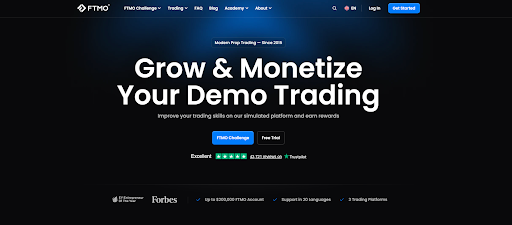
Founded: 2015 (Prague, Czech Republic)
Best for: Forex traders seeking the most reliable, proven prop firm in the industry
Max Funding: $200,000 per account | $2,000,000 via Scaling Plan
Profit Split: 80% (2-Step) | 90% (1-Step, from day one)
Challenge Fee: €89 ($10K) to €1,080 ($200K) — refunded on first payout
FTMO is the benchmark against which all other prop firms are measured. Operating since 2015, it has paid out over $500 million to more than 3.5 million customers worldwide, and its December 2025 acquisition of OANDA — one of the world’s most regulated forex brokers — adds an institutional layer of credibility that no competitor currently matches.
In 2026, FTMO offers two evaluation paths. The classic 2-Step Challenge requires a 10% profit target in Phase 1 and a 5% target in Phase 2, with a 5% daily loss limit and a 10% static maximum drawdown. The newer 1-Step Challenge condenses the process into a single 10% target with a tighter 3% daily loss and a trailing 10% maximum drawdown, rewarding decisive traders with a 90% profit split from their first withdrawal.
The challenge fee is fully refunded with the first profit split, making a successful evaluation effectively free. Payouts are processed on demand after 14 days, with support for bank wire and cryptocurrency. Supported platforms include MT4, MT5, cTrader, and DXtrade.
Pros
- Eleven years of unbroken operation with $500M+ in verified payouts
- OANDA acquisition adds regulated brokerage infrastructure across eight jurisdictions
- No time limit on evaluations — trade at your own pace
- Full challenge fee refunded on first successful payout
- Scaling Plan grows accounts to $2M with profit splits up to 90%
Cons
- News trading restricted within 2 minutes of high-impact events on Standard accounts
- $400,000 cap on individual funded accounts before Scaling Plan applies
- Recent community reports of stricter aggregated-risk enforcement
2. FundedNext — Best for Multi-Asset Traders
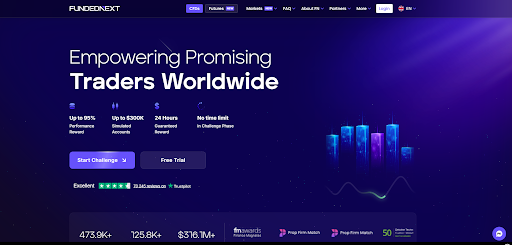
Founded: 2022
Best for: Traders who want one firm for forex, indices, crypto, and futures
Max Funding: $4,000,000 (through scaling)
Profit Split: 70–90% (varies by account type)
Challenge Fee: From $32.99 (Stellar Lite) to $1,099 (flagship accounts)
FundedNext is the most versatile prop firm in 2026, uniquely offering both CFD and Futures trading under a single brand. Its Stellar programme covers forex, indices, commodities, and crypto; its separately structured Rapid and Legacy programmes cover futures with real CME pricing. For multi-asset traders who previously needed accounts at two different firms, FundedNext consolidates everything in one place.
The firm offers seven distinct account types, from the entry-level Stellar Lite at $32.99 to full-scale Stellar 2-Step and 1-Step accounts. The Stellar 2-Step mirrors the industry standard (8% Phase 1, 5% Phase 2), while the Stellar Instant option skips evaluation entirely for traders willing to accept a trailing drawdown and a 70% starting split.
As of April 2026, FundedNext has distributed over $284 million to traders globally. Payouts are processed within 24 hours under its published terms, with a compensation payment offered if this window is missed.
Pros
- Only firm offering both CFD and Futures under one brand in 2026
- 7 account types from $32.99 — lowest entry cost among top-tier firms
- $4,000,000 maximum funding through scaling — highest in the industry
- 15% challenge profit reward on Stellar programmes
- 24-hour payout promise with compensation for delays
Cons
- 36 prohibited trading strategies create more friction than most competitors
- Payout fees of up to 3.5% reduce effective earnings
- 1:5 leverage cap on commodities and indices is lower than FTMO and The5ers
3. Apex Trader Funding — Best for Futures Traders
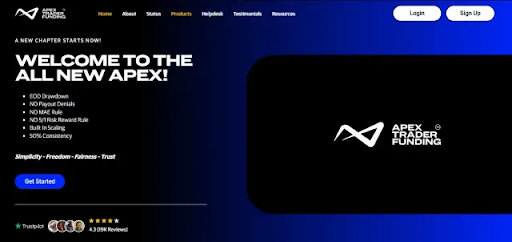
Founded: 2021 (Austin, Texas, USA)
Best for: Futures day traders, particularly those targeting US markets
Max Funding: $300,000 per account | up to 20 simultaneous accounts
Profit Split: 100% on first $25K per account, then 90%
Challenge Fee: Subscription model; frequent promotions reduce cost to under $20/month
Apex Trader Funding has become the go-to choice for futures traders through a combination of the most generous initial profit split in the industry (100% on the first $25,000 per account), a single-phase evaluation, and an unusually permissive rule set. The firm allows up to 20 simultaneous funded accounts, making it a favourite among traders who scale through account multiplication.
The evaluation is straightforward: reach the profit target while respecting a trailing drawdown and a minimum of 5 trading days. There are no consistency requirements, no time limits beyond the subscription month, and no restrictions on news trading during the evaluation phase.
The critical caveat is the trailing drawdown, which tracks your equity high in real time, tick by tick. If your account peaks and then pulls back — even while still in profit — the floor has already risen. This mechanism eliminates the majority of traders who do not factor it into their position sizing from day one.
Apex supports futures trading on major CME products through Rithmic and Tradovate platforms, with real exchange data from day one of the evaluation.
Pros
- 100% profit split on first $25K per account — highest initial retention in the industry
- Single-phase evaluation with no time limits and no consistency rules
- Up to 20 simultaneous funded accounts allows aggressive scaling
- Frequent flash sales reduce the monthly subscription cost to under $20
- Real CME data and execution from evaluation day one
Cons
- Trailing drawdown tracks equity in real time — the single most common reason traders fail
- Futures only — no forex, no CFDs
- Subscription model means recurring costs if evaluation takes more than one month
4. The5ers — Best for Forex Swing Traders

Founded: 2016 (Tel Aviv, Israel)
Best for: Serious forex traders with a swing or position trading approach
Max Funding: $4,000,000 (through scaling)
Profit Split: 50–90% (scales to 100% at higher tiers)
Challenge Fee: From $49 depending on programme
The5ers has operated since 2016 and has built its reputation as the most trader-centred firm in the industry. Its core differentiation is a genuine scaling model that grows funded accounts progressively as traders demonstrate consistent profitability — reaching $4,000,000 in maximum funding and 100% profit splits at the highest tiers.
The firm’s Hyper programme is its fastest-track option: a 10% profit target with a 4% daily loss and 8% maximum drawdown leads to a funded account with a 60% starting split. The Bootcamp programme is uniquely structured for developing traders, starting with smaller accounts and scaling continuously without requiring re-evaluation.
The5ers is particularly well-suited to swing and position traders. Overnight holding is permitted across all programmes, leverage is higher than most competitors for funded accounts, and the firm does not impose trading hour restrictions or news trading bans on Standard accounts.
Pros
- Scaling model reaches $4,000,000 and 100% profit splits — genuinely trader-aligned
- 10-year track record of consistent operations
- Overnight holding permitted on all programmes
- Higher funded leverage than most competitors
- Bootcamp programme designed specifically for developing traders
Cons
- Starting profit splits (50–60%) are lower than FTMO, Apex, and FundedNext
- Primarily forex-focused — limited for traders wanting index or commodity exposure
- Scaling milestones require sustained performance over multiple months
5. FundingPips — Best Payout Track Record
Founded: 2022
Best for: Traders prioritising payout reliability above all else
Max Funding: $300,000
Profit Split: Up to 100% in top performance tiers
Challenge Fee: Competitive; supports MT5, cTrader, and MatchTrader
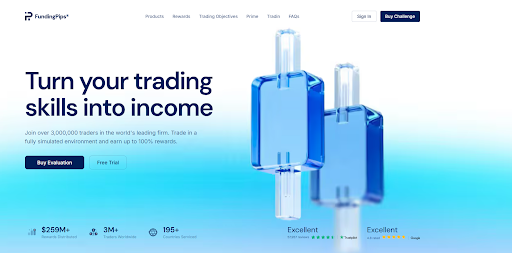
FundingPips has established itself in 2026 through one specific commitment that matters above all others in this industry: a verified zero-denial policy for profit withdrawals. The firm has distributed over $200 million globally, and its published no-denial stance — meaning legitimate withdrawals are processed regardless of trading style or profit size — addresses the single biggest concern traders have about prop firms.
FundingPips supports over 2 million traders and offers a range of evaluation models including 1-step and 2-step challenges. Platform support spans MT5, cTrader, and MatchTrader, providing flexibility for traders who have left the MetaTrader ecosystem.
The firm is particularly attractive to traders who have had payouts denied or accounts closed unfairly at other firms — a growing community concern given several high-profile prop firm collapses and payout disputes since 2023.
Pros
- Zero-denial payout policy — verified $200M+ distributed without payout denials
- Supports MT5, cTrader, and MatchTrader — broadest platform coverage
- 1-step and 2-step evaluation options
- Profit splits up to 100% at top tiers
Cons
- Newer firm (2022) with a shorter operational track record than FTMO or The5ers
- Lower maximum account size ($300K) compared to FundedNext ($4M) and The5ers ($4M)
6. Topstep — Best for US Futures Traders
Founded: 2012 (Chicago, Illinois, USA)
Best for: US-based futures traders seeking a regulated, established partner
Max Funding: $150,000
Profit Split: 100% on first $10K, then 90%
Challenge Fee: Monthly subscription model; starter plans from ~$49/month
Topstep is the oldest retail funded futures trading firm in the industry, operating since 2012 from Chicago — the heartland of futures trading. Its longevity, US-based operations, and consistent payout history make it the benchmark for US futures traders in the same way FTMO is for global forex traders.
The Trading Combine evaluation is a single-phase process: hit the profit target while staying within daily and overall loss limits. There is no time pressure beyond the subscription month. Topstep supports trading on the CME Group’s core futures products — equity indices, interest rates, metals, and energy — through platforms including NinjaTrader, Tradovate, Sierra Chart, and others.
Topstep’s 100% profit split on the first $10,000 earned is competitive with Apex, and its simpler rule structure (no trailing drawdown in the evaluation phase) makes it more approachable for traders new to futures prop trading.
Pros
- Longest-running retail futures prop firm in the industry — operational since 2012
- 100% profit split on first $10K earned per funded account
- Straightforward rules with no trailing drawdown during evaluation
- Broad platform support including NinjaTrader and Sierra Chart
- US-based and operationally transparent
Cons
- Maximum funding ($150K) is lower than Apex ($300K)
- Monthly subscription model; costs recur if evaluation takes time
- Primarily futures-focused; no forex or equity CFD trading
Prop Firm Comparison Table
| Firm | Founded | Max Funding | Profit Split | Challenge Fee | Asset Classes | Best For |
| FTMO | 2015 | $2,000,000 | 80–90% | €89–€1,080 | Forex, Indices, Commodities, Crypto, Stocks | Reliability & Forex |
| FundedNext | 2022 | $4,000,000 | 70–90% | From $32.99 | Forex, Indices, Crypto, Futures | Multi-Asset Traders |
| Apex Trader Funding | 2021 | $300,000 x20 | 100% / 90% | From ~$20/mo | Futures only | Futures Day Traders |
| The5ers | 2016 | $4,000,000 | 50–100% | From $49 | Forex, some Indices | Swing / Position Traders |
| FundingPips | 2022 | $300,000 | Up to 100% | Competitive | Forex, Indices, Metals | Payout Reliability |
| Topstep | 2012 | $150,000 | 100% / 90% | From ~$49/mo | Futures only | US Futures Traders |
How to Choose the Right Prop Firm for You
The most common mistake traders make is choosing a prop firm based on brand recognition or the biggest discount code, rather than whether the firm’s rules actually suit their trading style. Use this framework to narrow your decision:
Step 1: Define Your Asset Class
- Forex and CFDs: FTMO, FundedNext, The5ers, FundingPips
- Futures: Apex Trader Funding, Topstep, FundedNext Futures
- Multi-asset (forex + futures): FundedNext is the only firm offering both under one brand in 2026
Step 2: Match the Drawdown Rule to Your Trading Style
- Static drawdown: Best for swing traders and position traders who experience equity fluctuation. FTMO 2-Step and The5ers use static models.
- Trailing drawdown: Only suits traders with high win rates and steady equity curves. Apex uses a real-time trailing model — the most punishing in the industry.
- End-of-day trailing: FundedNext Futures calculates trailing drawdown at end of day rather than in real time — a meaningful difference for intraday traders.
Step 3: Assess the Profit Split and Scaling Model
If your goal is maximum earnings from a single large account, FTMO’s scaling to $2M at 90% is compelling. If you want maximum total funding across accounts, FundedNext’s $4M ceiling or Apex’s 20-account model give you more gross exposure. If you care most about keeping the highest percentage of early profits, Apex’s 100% on the first $25K per account is unmatched.
Step 4: Verify the Firm’s Payout History
Before paying any challenge fee, research community feedback on payout reliability. Check Trustpilot, Reddit’s r/Forex and r/PropFirms, and dedicated community forums. Look specifically for patterns in denied payouts, account closures after large withdrawals, or changes in rules after traders reached funded status. FundingPips’ zero-denial policy and FTMO’s decade-long track record are the industry’s current gold standards.
Risks Every Trader Must Understand
Prop trading offers genuine opportunity — but it also carries structural risks that are unique to this model and are frequently underrepresented in marketing materials.
- Most traders fail evaluations: Only 5–10% of traders pass challenges, and approximately 7% ever receive a payout. The majority of prop firm revenue comes from evaluation fees, not shared profits.
- Firms can close without warning: Between 80 and 100 prop firms exited the market in 2024 alone. My Forex Funds — which had processed hundreds of millions in trader payouts — was shut down following CFTC enforcement action in 2023. Diversifying across two or three established firms reduces concentration risk.
- Rule changes mid-challenge: Some firms have changed drawdown rules, added consistency requirements, or modified payout structures after traders purchased challenges. Always verify current rules directly on the firm’s website before purchasing — not from a third-party review.
- Leverage amplifies losses in funded accounts: Funded account leverage is real. Oversizing positions because you are trading “someone else’s money” is the fastest path to losing your funded account and needing to repurchase an evaluation.
- Tax obligations vary by jurisdiction: Profit split income from prop firms may be treated as trading income, self-employment income, or capital gains depending on your country. Consult a tax professional before scaling your prop trading activity significantly.
How to Pass a Prop Firm Challenge: Pro Tips
The traders who consistently pass challenges share a common set of habits that have nothing to do with having the best strategy — they are all about discipline and risk management.
- Risk no more than 0.5–1% per trade during the evaluation. Most traders fail by overleveraging after a few good early trades. Keep risk per trade at 0.5–1% and let compound consistency reach the target, not one large bet.
- Never trade on your first day. Log on, observe the platform, test order execution, and verify your drawdown calculations manually. Eliminate technical surprises before real money is on the line.
- Calculate your daily loss limit in real dollar terms, not percentages. On a $100,000 account with a 5% daily limit, you have $5,000 of room. Know that number before you place any trade.
- Stop trading for the day after a 2% drawdown, not 5%. Leave a buffer. Traders who use their full daily limit are one bad trade away from disqualification. Those who preserve a cushion can recover.
- Paper trade the firm’s rules before buying. Simulate the evaluation on your own demo account for 30–60 sessions before purchasing. Confirm that your strategy can hit the profit target without violating any drawdown rule across a realistic sample of trading days.
- Treat the funded account exactly like the challenge. The most common failure mode after reaching a funded account is position size inflation. The rules that got you funded are the rules that will keep you funded.
Conclusion
Prop trading has become one of the most accessible pathways in financial markets for skilled traders who lack personal capital — but the low pass rates, structural risks, and wide variation in firm quality mean that choosing the right firm is as important as choosing the right strategy.
The firms covered in this guide — FTMO, FundedNext, Apex Trader Funding, The5ers, FundingPips, and Topstep — represent the most reliable, well-tested options available in 2026 across forex, futures, and multi-asset trading. Each serves a different trader profile, and no single firm is the best choice for every style.
The core principle for success in this space is simple: match the firm’s rules to how you actually trade, not how you hope to trade. Verify payout history independently. Start with the smallest account available. And treat every challenge with the same discipline you would bring to trading real personal capital — because ultimately, the traders who succeed in prop firms are the ones who would have succeeded with their own money too.
For individual broker reviews, comparisons, and further trading guides, explore the full TopBrokers360 library at www.topbrokers360.com.
FAQs
Are prop trading firms legitimate?
The established, long-running firms — FTMO, The5ers, Topstep — are legitimate businesses with verified payout histories and transparent operations. However, the industry also contains low-quality or outright fraudulent firms, particularly among the hundreds that have launched since 2021. Verify a firm’s payout history, ownership structure, and community reputation before committing any capital.
How much money can I make with a prop firm?
Earnings depend entirely on your strategy’s profitability, your account size, and your profit split. A trader generating 5% per month on a $200,000 FTMO account with an 80% split earns $8,000/month. However, 5% monthly consistency is rare — treat published “earnings potential” numbers as maximums, not expectations.
Do I need trading experience to join a prop firm?
There are no formal experience requirements — anyone can purchase a challenge. But the pass rates (5–10%) reflect the reality that consistent trading discipline is rare. Attempting a prop firm challenge without at least 6–12 months of demo trading experience is likely to result in challenge failure and wasted fees.
What happens if a prop firm goes out of business?
If a prop firm closes, funded traders typically lose access to their accounts and any outstanding profit split balances. Unlike regulated brokers, there is no compensation scheme or client fund protection for prop trading participants. This is why diversifying across two or three established, long-running firms is recommended for traders who rely on prop trading income.
Is prop trading taxable?
Yes. Profit split payments from prop firms are taxable income in virtually every jurisdiction, though the specific treatment (trading income, self-employment, capital gains) varies by country. Consult a qualified tax advisor in your country before scaling your prop trading significantly.
Can I trade news events with a prop firm?
It depends on the firm and programme. FTMO Standard accounts restrict trading within two minutes of high-impact news events; FTMO Swing accounts do not. Apex Trader Funding permits news trading. Always check the specific programme rules before placing trades around scheduled economic releases.
What is the best prop firm for beginners?
For beginners, FundingPips or FundedNext’s Stellar Lite (’from $32.99) offer the lowest-cost entry into prop evaluation with clear rules and reliable payouts. Avoid firms with complex consistency requirements or real-time trailing drawdowns until you have a demonstrated track record of passing simulated evaluations.