What Is AI Trading, Really?
Artificial intelligence in trading refers to the application of machine learning models, natural language processing, and adaptive data analysis to financial markets. In its truest form, AI trading means a system that learns from market data, adapts to changing conditions, and improves its decision-making over time without explicit reprogramming.
In practice, the term is applied far more loosely. A trading platform that fires an alert when the RSI crosses 70 is not AI — it is a conditional rule. A strategy builder that lets you automate entry and exit conditions in plain English is not AI — it is a logic engine with a natural language interface. Genuine AI involves adaptive learning from data, not the execution of fixed instructions.
This distinction matters enormously for forex traders evaluating tools in 2026, because the marketing language does not distinguish between them. Understanding what you are actually buying — a rules engine, a signal service, a copy trading platform, or a true ML-driven tool — is the starting point for any rational decision.
The 4 Types of AI Trading Tools Explained
Type 1: AI-Assisted Analysis Tools
These tools support a human trader by scanning charts, detecting patterns, running backtests, and alerting you to potential setups. You still make every trade manually. Examples include TrendSpider and Trade Ideas. These are the most honest use of “AI” in the retail space — the machine does the analytical heavy lifting; the human makes the final call.
Type 2: Strategy Builders and No-Code Automation
These platforms allow traders to define entry/exit rules — often in plain language or a visual interface — and execute them automatically. Capitalise.ai is the best example. While often described as AI, most are logic engines: they execute exactly what you told them. There is no learning or adaptation. They are powerful and useful, but they are not intelligent.
Type 3: Copy Trading and Signal Platforms
Platforms like AvaTrade’s DupliTrade, IC Markets’ ZuluTrade integration, and eToro’s CopyTrader allow you to automatically replicate the trades of verified human traders or algorithmically-driven signal providers. The “AI” element is primarily in the matching algorithm that recommends which traders to follow based on your risk profile — not in the trading itself.
Type 4: AI Trading Agents
The newest and most genuinely AI-driven category for retail traders. Instead of executing trades for you, AI trading agents analyse your own trading data, tag every trade by conditions, review your sessions, and answer questions about your performance with memory across conversations. TradeZella’s Zella AI is the leading retail example. These tools do not replace your strategy — they make you smarter about the strategy you already have.
The AI Trading Landscape in 2026
The scale of algorithmic and AI-assisted trading in 2026 is significant. Algorithmic strategies now account for an estimated 60 to 75 percent of total U.S. equity trading volume, and the share is growing across forex, crypto, and commodities markets. The global algorithmic trading market is projected to more than double by 2034.
For retail forex traders, 2026 represents a genuine inflection point. AI-enabled trading infrastructure that was once accessible only to institutional desks — real-time sentiment analysis, adaptive order routing, multi-feed data aggregation — is increasingly available through retail broker platforms and third-party tools.
However, the reality behind the growth contains a critical warning. Well-configured rule-based bots report annualised returns of 12 to 25 percent in favourable market conditions — but most retail AI bots fail to deliver consistent profits due to overfitting, transaction costs, and an inability to adapt to changing market regimes. The U.S. Commodity Futures Trading Commission has stated plainly in an official customer advisory that AI technology cannot predict the future or sudden market changes. That is not a technicality — it is the defining limitation that separates honest AI tools from those making performance promises they cannot keep.
How We Evaluated These Tools and Brokers
The TopBrokers360 team assessed each broker and tool across seven criteria, combining published specifications with independent community feedback and direct platform testing:
- Genuine AI Functionality: We distinguished between true adaptive machine learning, rules-based automation, and marketing-only AI claims. Tools that cannot demonstrate adaptive learning were categorised accordingly.
- Regulatory Standing & Longevity: Broker track record, Tier-1 regulatory licensing, and absence of enforcement actions.
- Execution Quality: Order fill speed, slippage on major forex pairs during high-impact news, and VPS/low-latency infrastructure.
- Tool Integration: Quality and depth of third-party AI tool connections (Myfxbook, ZuluTrade, Trading Central, etc.).
- Value for Traders: Whether the AI features justify the cost or subscription relative to alternatives.
- Community Payout & Reliability History: Verified trader reports on execution consistency, account handling, and withdrawal experience.
- Beginner Accessibility: Whether the AI features are usable without advanced technical knowledge.
Best AI Trading Tools & Brokers in 2026 — Our Top Picks
The following six platforms represent the strongest options for AI-assisted forex trading in 2026 across different use cases — from execution-focused brokers to standalone analytical tools.
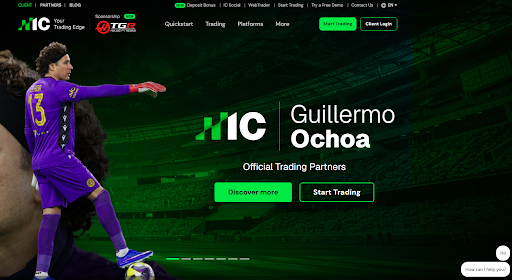
1. IC Markets — Best for Algorithmic & EA Traders
Founded: 2007 (Sydney, Australia)
Best for: Forex traders running Expert Advisors (EAs), algorithmic strategies, or copy trading
Regulation: ASIC (Australia), CySEC (EU), SCB (Bahamas)
Platforms: MT4, MT5, cTrader
AI Tools: Myfxbook AutoTrade, ZuluTrade, IC Social copy trading
IC Markets is the most technically capable broker for algorithmic forex trading available to retail traders in 2026. Its institutional-grade infrastructure — average execution speeds under 40 milliseconds, raw ECN pricing from 0.0 pips on the Raw account, and genuine non-dealing desk execution — provides the foundation that automated strategies require to function as designed.
For AI and algorithmic trading specifically, IC Markets supports full Expert Advisor functionality across MT4 and MT5 with no restrictions on trading frequency, no minimum holding times, and no strategy bans. Scalping, high-frequency strategies, and news trading are all permitted. The broker also supports three copy trading ecosystems: Myfxbook AutoTrade, ZuluTrade, and its own IC Social platform, each with their own signal provider networks and performance history databases.
VPS hosting is available at no charge for qualifying accounts, reducing latency for traders running EAs around the clock. The cTrader platform additionally supports cAlgo, a C#-based algorithmic trading environment for traders who want to build custom strategies beyond the MetaTrader Expert Advisor framework.
Pros
- Ultra-low latency execution — critical for algorithmic and high-frequency forex strategies
- Full EA and algorithmic trading support across MT4, MT5, and cTrader with no strategy restrictions
- Three distinct copy trading ecosystems providing access to a wide range of verified signal providers
- Raw ECN spreads from 0.0 pips with transparent commission structure
- Free VPS hosting for qualifying accounts reduces execution latency
Cons
- No proprietary AI analysis features — AI capability comes entirely through third-party integrations
- MT4/MT5 interface is dated relative to newer platforms like TradingView
- Customer support quality varies by region and time zone
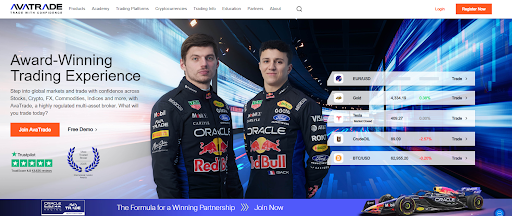
2. AvaTrade — Best for Automated & Copy Trading
Founded: 2006 (Dublin, Ireland)
Best for: Traders who want automated execution through copy trading or MT4/MT5 EAs
Regulation: Central Bank of Ireland, ASIC, FSA Japan, FSCA, ADGM, ISA
Platforms: MT4, MT5, AvaTradeGO, AvaOptions
AI Tools: DupliTrade, AvaSocial, Guardian Angel risk management AI
AvaTrade stands out in 2026 as the most fully-featured broker for traders who want automated execution without building their own systems. Its dual copy trading platforms — DupliTrade for strategy-based automated replication and AvaSocial for community-based copy trading — provide two distinct approaches to automating a trading account without requiring any technical expertise.
DupliTrade is particularly notable as a genuine AI-adjacent feature: it uses performance filtering to match traders with signal providers whose strategies are statistically compatible with their risk profile. Traders can select signal providers by strategy type, drawdown history, and asset class focus, with trades automatically replicated in real time. AvaSocial takes a more community-driven approach, connecting traders to signal providers across the AvaTrade user base.
The Guardian Angel feature is AvaTrade’s proprietary risk management layer — an automated protection system that monitors positions and alerts traders when risk parameters are being approached. It does not constitute AI in a machine-learning sense, but it adds a meaningful automated safety net for traders who use larger position sizes.
AvaTrade is regulated across six jurisdictions, giving it one of the strongest regulatory profiles among brokers with genuine automated trading capability. The Central Bank of Ireland oversight is particularly meaningful for European traders, as it falls under MiFID II protections.
Pros
- DupliTrade and AvaSocial provide two distinct, well-developed automated copy trading options
- Regulated in six jurisdictions including Ireland (Central Bank) and Australia (ASIC)
- Guardian Angel risk protection adds automated position monitoring for safety
- VPS hosting available for EA traders requiring continuous low-latency execution
- Competitive spreads with EUR/USD averaging 0.80 pips on Standard CFD accounts
Cons
- No raw ECN pricing — AvaTrade is a market maker, which creates a potential conflict of interest for high-frequency strategies
- CFD trading not available in Spain where only Futures are offered
- DupliTrade is a separate subscription not included in the standard trading account
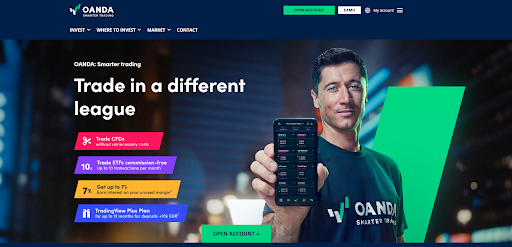
3. OANDA — Best for API-Based Strategy Automation
Founded: 1996 (New York, USA) — now part of FTMO group following 2025 acquisition
Best for: Developers and quantitative traders building custom automated forex strategies
Regulation: FCA (UK), CFTC/NFA (USA), IIROC (Canada), MAS (Singapore), ASIC (Australia)
Platforms: OANDA Trade (web & desktop), MT4, TradingView
AI Tools: OANDA REST API v20, historical data API, TradingView strategy integration, VPS hosting
OANDA occupies a unique position in the 2026 AI trading landscape as the broker most accessible to traders who want to build their own automated systems from scratch. Its REST API v20 provides direct programmatic access to trading, account management, and pricing feeds — making it the go-to choice for developers and quantitative analysts who want to deploy custom strategies without the constraints of MetaTrader’s MQL language.
OANDA also provides one of the most comprehensive historical forex data sets available through a retail broker, dating back to 2005 across major, minor, and exotic pairs. This data depth is critical for backtesting machine learning models, where the volume and quality of historical training data directly determines strategy robustness.
The December 2025 acquisition of OANDA by FTMO adds further institutional credibility to the platform. FTMO’s established payout infrastructure and trader community now operates alongside OANDA’s regulated brokerage network across eight jurisdictions — a combination that strengthens both offerings for algorithmic traders.
OANDA’s TradingView integration allows traders to build and deploy Pine Script strategies directly to live accounts, bringing TradingView’s extensive strategy library into a regulated, multi-jurisdiction broker environment.
Pros
- OANDA REST API v20 provides the most accessible custom automation infrastructure available through a retail forex broker
- Historical data depth from 2005 supports robust ML backtesting and strategy validation
- Regulated across eight jurisdictions including Tier-1 FCA, CFTC/NFA, and MAS oversight
- TradingView integration enables Pine Script strategy deployment directly to live OANDA accounts
- No minimum deposit removes the capital barrier for developers testing automated systems
Cons
- API documentation has a learning curve — not suitable for traders without programming experience
- Spreads are wider than IC Markets on standard accounts — less competitive for high-frequency strategies
- MT4 only (not MT5) limits EA compatibility compared to IC Markets or AvaTrade
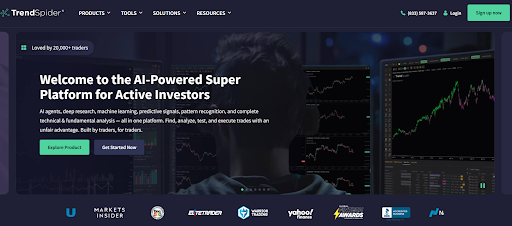
4. TrendSpider — Best AI Analysis Tool for Discretionary Traders
Type: Standalone AI-assisted charting and analysis platform
Best for: Active forex traders who want AI-powered technical analysis without automated execution
Pricing: From $39/month (Essential) to $79/month (Elite)
Broker required: Yes — TrendSpider analyses and alerts; execution through your connected broker
TrendSpider is the most credible AI-assisted charting tool available to retail forex traders in 2026. Unlike most “AI trading platforms” that are rule-based execution engines, TrendSpider applies genuine machine learning to chart pattern recognition, multi-timeframe analysis, and dynamic trendline detection — tasks that are genuinely time-consuming and error-prone when done manually.
Its Raindrop Charts, automated trendline detection, and multi-timeframe analysis tools reduce the hours a discretionary trader would otherwise spend in front of charts scanning for confluences. Backtesting is built directly into the platform with point-and-click strategy testing that does not require coding knowledge, making it accessible to traders at any experience level.
Critically, TrendSpider is honest about what it does: it helps you analyse markets better. It does not claim to trade for you or guarantee results. This intellectual honesty — rare in the AI trading tool space — is one reason its reputation among serious discretionary traders is consistently stronger than the automated bot platforms that promise more but deliver less.
Pros
- Genuine ML-based pattern recognition and automated trendline detection across multiple timeframes
- Built-in backtesting with no coding required — accessible to traders of all experience levels
- Raindrop Charts provide unique volume-at-price visualisation not available on MT4/MT5
- Honest positioning as an analysis aid, not an automated profit generator
Cons
- Does not execute trades — requires a separate broker account for any live trading
- Monthly subscription cost adds to overall trading expenses
- Primarily web-based with limited mobile functionality compared to broker apps
5. Capitalise.ai — Best No-Code Strategy Automation
Type: No-code strategy automation platform
Best for: Forex traders who want to automate rule-based strategies without programming knowledge
Pricing: Free tier available; premium plans for advanced automation
Broker integration: Connects to major forex brokers including OANDA, Pepperstone, and others
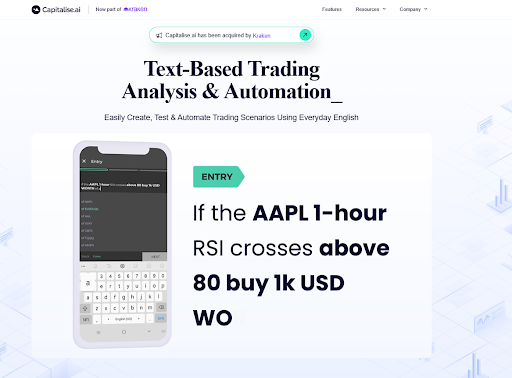
Capitalise.ai solves one of the most common frustrations in retail forex trading: the inability to automate a strategy without learning to code. Its natural language interface allows traders to type conditions in plain English — “Buy EUR/USD when the 50 EMA crosses above the 200 EMA on the 1-hour chart” — and have them executed automatically through a connected broker account.
It is important to be clear about what Capitalise.ai is and is not. It is a powerful, genuinely useful rules automation tool. It is not AI in the machine-learning sense — it executes the rules you define, rather than learning from market conditions to develop its own. For traders who have a clearly defined, rule-based strategy they want automated, it delivers exactly what it promises. For traders who want a system that adapts to changing market conditions, it does not.
The free tier provides meaningful access to the core automation functionality, making it one of the most accessible entry points for non-technical traders wanting to move beyond manual execution.
Pros
- Natural language strategy input removes the coding barrier entirely
- Free tier available with genuine core functionality
- Connects to major regulated brokers rather than requiring a proprietary account
- Transparent about its rules-based nature without false AI claims
Cons
- Not adaptive AI — executes fixed rules, does not learn or adjust to market conditions
- Broker integration list is more limited than direct MT4/MT5 EA deployment
- Strategy logic is constrained by the natural language interface compared to custom-coded EAs
6. TradeZella (Zella AI) — Best AI Trading Agent for Performance Review
Type: AI trade journal and performance analysis agent
Best for: Discretionary traders who want AI-driven analysis of their own trading data
Pricing: From $29/month
Asset classes: Stocks, forex, crypto, futures
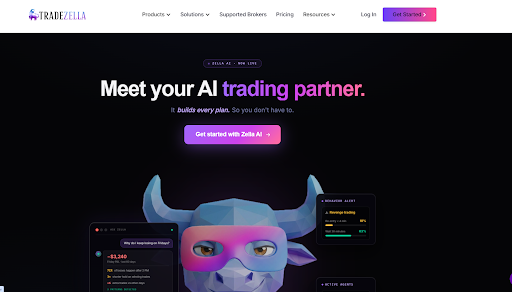
TradeZella represents the most genuine application of conversational AI to retail trading in 2026. Its Zella AI agent does not trade for you — it analyses your trades, identifies patterns in your own performance data, tags sessions by conditions, and answers questions about your trading history with memory that persists across conversations.
For discretionary forex traders, this is the category of AI tool most likely to produce measurable improvement. The bottleneck for most discretionary traders is not execution speed — it is knowing what works and what does not across their specific trading behaviour. Zella AI surfaces those patterns automatically: “Your win rate drops from 58% to 34% when you trade during the first 30 minutes of the London session,” or “73% of your losses come from trades where you entered without a confirmed retracement.”
This is AI doing something genuinely useful — not replacing your judgment, but making your judgment better by revealing the patterns in your own data that are invisible to manual review.
Pros
- Genuine AI analysis applied to your own trading data with memory across sessions
- Identifies specific behavioural patterns in your trading that manual review would miss
- Accessible to any discretionary trader regardless of asset class or broker
- $29/month entry point is low relative to the analytical value provided
Cons
- Does not execute trades — purely an analytical and journaling tool
- Value depends on trading volume — traders with fewer than 30–50 trades per month will see limited pattern data
- Requires consistent trade logging to build the data set the AI analyses
AI Trading Tools vs Brokers: Comparison Table
| Tool / Broker | Type | Best For | AI Features | Platforms | Regulation | Price / Entry |
| IC Markets | Broker | Algo & EA traders | Myfxbook, ZuluTrade, IC Social | MT4, MT5, cTrader | ASIC, CySEC, SCB | From $200 deposit |
| AvaTrade | Broker | Automated & copy trading | DupliTrade, AvaSocial, Guardian Angel | MT4, MT5, AvaTradeGO | Central Bank of Ireland, ASIC, FSA | From $100 deposit |
| OANDA | Broker | Algo traders & API users | OANDA API, VPS, TradingView integration | OANDA Trade, MT4, TradingView | FCA, CFTC, IIROC, MAS | No minimum deposit |
| TrendSpider | AI Analysis Tool | Technical analysis & pattern detection | AI chart scanning, backtesting, multi-timeframe | Web-based | N/A | From $39/month |
| Capitalise.ai | Strategy Builder | No-code strategy automation | Natural language strategy building | Web-based + broker integration | N/A | Free + premium tiers |
| TradeZella (Zella AI) | Trade Journal / Agent | Performance analysis & journaling | AI trade tagging, session review, memory | Web-based | N/A | From $29/month |
How to Choose the Right AI Tool for Your Trading Style
Step 1: Define What Problem You Are Solving
The most common mistake traders make is buying an AI tool because of its marketing rather than because it solves a specific problem. Before evaluating any platform, define the exact bottleneck in your current trading process:
- If your problem is slow manual chart analysis — TrendSpider or a similar AI charting tool addresses this directly.
- If your problem is executing a rule-based strategy inconsistently due to emotion or attention — Capitalise.ai or a broker’s EA environment solves this.
- If your problem is not knowing why your win rate fluctuates — TradeZella’s AI agent is the most relevant tool.
- If your problem is wanting to participate in automated forex trading without building a strategy — copy trading through AvaTrade or IC Markets is the appropriate category.
Step 2: Match the Tool to Your Technical Level
For beginners: AvaTrade’s DupliTrade, Capitalise.ai’s free tier, and TradeZella all require zero coding or technical knowledge. These are the appropriate starting points.
For intermediate traders: TrendSpider and IC Markets’ copy trading ecosystem provide significantly more control and analytical depth without requiring programming.
For advanced traders: OANDA’s REST API and IC Markets’ cAlgo environment on cTrader provide institutional-grade infrastructure for custom strategy deployment.
Step 3: Verify the AI Claim
Before purchasing any tool, ask one simple question: does this system learn and adapt from market data, or does it execute fixed rules? If the vendor cannot answer this question clearly, treat the product as rules-based automation — which may still be useful, but is not AI in any meaningful sense. Tools that genuinely use machine learning will be able to describe their training data, model type, and adaptation mechanism.
Step 4: Start Small and Measure
No AI tool should be allocated significant capital until it has been tested on a demo account for a minimum of 30 to 60 trading sessions across different market conditions. For analysis tools like TrendSpider, paper trade the signals for one full month before using them to inform live entries. For automated tools like Capitalise.ai strategies, backtest across at least 12 months of historical data before live deployment.
What AI Trading Cannot Do: Risks & Limitations
The risks of AI trading tools are real and frequently underrepresented in the marketing materials of platforms that profit from trader adoption. Every forex trader using AI tools in 2026 should understand the following structural limitations:
- AI cannot predict sudden market events. The CFTC’s official position is unambiguous: no AI system can predict the future or sudden market changes. Central bank decisions, geopolitical shocks, and liquidity events occur outside the training data of any model.
- Most retail AI bots fail within 6 months due to overfitting to historical data, strategy decay as market regimes change, and transaction costs eroding edge. A system that worked in backtesting often fails in live conditions.
- Automated trading amplifies bad strategy, not just good. Automating a flawed trading approach does not fix it — it executes the flawed approach faster and at larger scale.
- Leverage in AI-executed accounts is real. Automated systems that manage position sizing inadequately can reach margin limits before a human operator can intervene. Always set maximum position size limits and daily loss limits at the broker level, not just in the strategy.
- Regulatory treatment of AI trading profits varies by jurisdiction. Consult a qualified tax advisor before scaling automated trading income significantly.
How to Get Started with AI-Assisted Forex Trading
- Choose your entry point based on experience level. Beginners should start with a copy trading platform (AvaTrade DupliTrade) or a trade journaling AI (TradeZella) before any automated execution. Do not start with EA automation if you cannot explain the strategy the EA is executing.
- Open a demo account with your chosen broker first. Test the platform’s order execution, charting tools, and any AI integrations in a risk-free environment for a minimum of two to four weeks before depositing real capital.
- Backtest before you automate. Whether using Capitalise.ai, a MetaTrader EA, or OANDA’s API, validate strategy performance across at least 12 months of historical data — including periods of high volatility and regime change — before going live.
- Set hard risk limits at the broker level. Configure daily loss limits, maximum drawdown thresholds, and position size caps within the broker platform, independent of any strategy-level controls. If the strategy malfunctions, broker-level limits are your safety net.
- Review performance weekly, not just equity. AI tools surface patterns in data over time. Weekly review of your journal data, signal performance, and execution quality is how AI-assisted improvements compound into better trading outcomes.
Conclusion
AI trading in 2026 is simultaneously more capable and more overhyped than at any previous point in the industry’s development. The tools that genuinely work — IC Markets for algorithmic execution, AvaTrade for automated copy trading, OANDA for API-driven strategy automation, TrendSpider for AI-assisted analysis, Capitalise.ai for no-code automation, and TradeZella for performance intelligence — share a common characteristic: they are honest about what they do and transparent about their limitations.
The tools that do not work share a different characteristic: they promise returns they cannot deliver, describe rule-based logic as machine learning, and profit primarily from the fees of traders who fail to get the results marketed to them.
The core principle for navigating AI trading in 2026 is straightforward: the best AI tools make you a more disciplined, better-informed trader. They do not replace the need for a genuine edge, sound risk management, or the patience to let a tested strategy play out. Traders who approach AI as a complement to their strategy — rather than a substitute for having one — are the traders who will benefit most from what this technology genuinely offers.
Frequently Asked Questions
1. Are AI forex trading tools legitimate?
Some are; many are not. The most legitimate AI tools in 2026 are transparent about what they actually do — whether that is pattern recognition, rules automation, or performance analysis. The red flags are guaranteed profit claims, vague descriptions of “deep learning” without specifics, and platforms that charge high fees without verifiable track records. The tools and brokers covered in this guide have been selected specifically because they make honest, verifiable claims about their capabilities.
2. Can I make consistent profit with an AI forex trading bot?
The data does not support this as a general statement for retail traders. Well-configured rule-based bots report annualised returns of 12 to 25 percent in favourable conditions, but most retail bots fail to deliver consistent profits due to overfitting and market regime changes. Consistent profitability from automated trading requires a genuinely edge-positive strategy, proper risk management, and ongoing monitoring — the automation executes the strategy; it does not create the edge.
3. What is the difference between an AI trading bot and an AI trading agent?
An AI trading bot executes trades automatically based on coded rules. An AI trading agent analyses your trading data, identifies patterns in your performance, and answers questions about your trading history. Bots replace manual execution; agents improve the human decision-maker. For most discretionary forex traders, the agent model is more likely to produce durable improvement because the human judgment and strategy remain in the loop.
4. Do I need to know how to code to use AI trading tools?
Check the broker’s website for detailed information on spreads and fees. Consider using comparison tools or forums to evaluate multiple brokers at once.
5. What leverage options are available for forex trading in Germany?
No. Tools like Capitalise.ai and AvaTrade’s DupliTrade require zero coding. TradeZella’s Zella AI operates as a conversational interface. TrendSpider’s backtesting is point-and-click. Coding becomes relevant only if you want to build custom strategies through OANDA’s API or IC Markets’ cAlgo environment — both of which are advanced use cases with a genuine learning curve.
6. What is the most regulated AI forex broker in 2026?
OANDA holds the strongest regulatory profile among the brokers reviewed here, operating under FCA (UK), CFTC/NFA (USA), IIROC (Canada), MAS (Singapore), and ASIC (Australia) oversight simultaneously. AvaTrade is regulated across six jurisdictions including the Central Bank of Ireland. IC Markets holds ASIC, CySEC, and SCB regulation. All three are credible choices from a regulatory standpoint.
7. Are AI trading tools suitable for beginners?
Some are specifically designed for beginners and work well in that context — AvaTrade’s DupliTrade, Capitalise.ai’s free tier, and TradeZella’s journaling tools are all accessible without prior trading automation experience. Fully autonomous bot trading is not suitable for beginners because it requires understanding the strategy being automated. Automating a strategy you do not understand is not the same as automating expertise — it is automating ignorance.
8. How much does AI trading software cost in 2026?
Costs vary significantly by category. Broker-level AI tools (copy trading, EA support) are typically included with the trading account at no additional charge. Standalone AI analysis tools like TrendSpider cost from $39/month. AI trading agents like TradeZella start at $29/month. No-code automation platforms like Capitalise.ai offer meaningful free tiers. The key principle: never pay for an AI trading tool before testing it on a demo or free tier for at least one month.