Introduction
If you’re new to forex trading, one of the first concepts you need to understand is currency pairs. Unlike stocks where you buy a single asset, forex always involves trading one currency against another.
In this guide, we’ll break down how currency pairs work, the different types you’ll encounter, and which ones are best suited for beginners. You’ll also get practical tips based on real trading behavior—not just theory.
What Are Currency Pairs in Forex?
A currency pair is a quotation showing how much of one currency is needed to buy another.
Example:
- EUR/USD = 1.10
→ 1 Euro = 1.10 US Dollars
Currencies are always traded in pairs because you’re simultaneously:
- Buying one currency
- Selling another
How to Read Currency Pairs
Base vs Quote Currency
Every pair has two components:
Component | Meaning |
Base Currency | The first currency (EUR in EUR/USD) |
Quote Currency | The second currency (USD in EUR/USD) |
👉 The price tells you how much of the quote currency is needed to buy 1 unit of the base currency.
Real Trade Example
Let’s say:
- EUR/USD = 1.1000
If you buy EUR/USD:
- You’re buying euros and selling dollars
- You expect the euro to rise
If price moves to 1.1050:
- You profit from the increase
Practical Insight
When trading live, even small movements matter. A 50-pip move can be significant depending on your position size—this is why understanding pair behavior is critical.
Types of Currency Pairs
Major Pairs
These include the US dollar and are the most traded globally.
Pair | Description |
EUR/USD | Most liquid pair |
GBP/USD | Known for volatility |
USD/JPY | Stable and trend-driven |
USD/CHF | Safe-haven pair |
Why they matter
- Tight spreads
- High liquidity
- Easier to analyze
Minor Pairs
These pairs don’t include the US dollar.
Pair | Example |
EUR/GBP | Euro vs Pound |
EUR/AUD | Euro vs Australian Dollar |
GBP/JPY | Pound vs Yen |
Characteristics:
- Moderate volatility
- Slightly higher spreads
Exotic Pairs
These involve one major currency and one from an emerging market.
Pair | Example |
USD/TRY | US Dollar vs Turkish Lira |
USD/ZAR | US Dollar vs South African Rand |
Important Note:
- Lower liquidity
- Higher spreads
- More unpredictable movements
Best Currency Pairs to Trade
For beginners, not all pairs are equal. Some are much easier to trade.
Recommended Pairs
Pair | Why It’s Good |
EUR/USD | Most stable and liquid |
GBP/USD | Strong trends |
USD/JPY | Predictable behavior |
AUD/USD | Influenced by commodities |
Real-World Perspective
Many experienced traders stick to just 1–3 pairs. Trying to follow too many markets often leads to confusion and poor decisions.
What Makes a Good Currency Pair
Not all pairs are suitable for every trader. Here’s what to consider:
1. Liquidity
Higher liquidity = smoother price movements
2. Spread
Lower spreads reduce trading costs
3. Volatility
- Low volatility → safer but slower
- High volatility → more opportunities but riskier
4. News Sensitivity
Some pairs react strongly to economic releases (e.g., USD pairs during Fed announcements)
Tips for Trading Currency Pairs
1. Start with Major Pairs
They’re easier to understand and cheaper to trade.
2. Focus on Fewer Pairs
Mastering 1–2 pairs is more effective than watching 10.
3. Understand Market Sessions
Some pairs move more during specific sessions:
- EUR/USD → London session
- USD/JPY → Asian session
4. Follow Economic Calendars
News events can significantly impact prices.
5. Use Risk Management
Always use stop-loss orders and control position size.
Common Mistakes Beginners Make
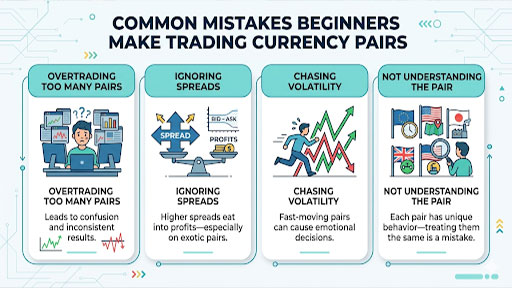
Overtrading Too Many Pairs
Leads to confusion and inconsistent results.
Ignoring Spreads
Higher spreads eat into profits—especially on exotic pairs.
Chasing Volatility
Fast-moving pairs can cause emotional decisions.
Not Understanding the Pair
Each pair has unique behavior—treating them the same is a mistake.
Conclusion
The most important steps for any beginner. Once you learn how to read pairs, interpret price movements, and recognize the differences between majors, minors, and exotics, the market starts to feel far less overwhelming.
What many new traders underestimate is how much pair selection impacts performance. It’s not just about finding opportunities—it’s about choosing markets that match your strategy, personality, and risk tolerance. For example, a highly volatile pair like GBP/JPY might suit experienced traders looking for fast moves, but it can be difficult for beginners to manage emotionally and technically.
In practice, consistency comes from focus and familiarity. Traders who stick to a small number of pairs—like EUR/USD or USD/JPY—often develop a deeper understanding of how those markets behave during different sessions, news events, and economic cycles. This kind of pattern recognition is something you only build over time through observation and experience.
It’s also important to remember that currency pairs don’t move randomly. They reflect real-world economic relationships—interest rate differences, trade balances, and geopolitical developments. The more you connect price movements to these underlying factors, the more confident and informed your decisions will become.
Ultimately, success in forex isn’t about trading more—it’s about trading smarter. Start simple, stay disciplined, and focus on mastering the basics of currency pairs before expanding into more complex strategies or exotic markets.
Looking for a reliable place to start trading? Explore a curated list of trusted and regulated brokers here: