TopBrokers360

What Is Commodity Trading? Beginner Guide (2026)

What Is Commodity Trading?

Commodity trading is the exchange of standardized raw materials and primary goods in financial markets. Unlike trading shares of a specific company, when you trade a commodity — say, crude oil or wheat — you are participating in a global market that directly connects financial speculation with the physical production and consumption of that good.

At its core, commodity trading serves two essential functions in the economy: price discovery (helping markets establish fair prices for physical goods) and risk transfer (allowing producers and consumers to hedge against price volatility). A wheat farmer locking in a price for next season’s harvest and a fuel airline managing its jet fuel costs are both engaging in commodity trading principles — even if they never think of themselves as “traders.”

For individual investors and traders, commodity markets offer exposure to global economic forces, inflation protection, and diversification beyond traditional equities and bonds. But they are also complex, fast-moving, and can carry significant leverage — making education and preparation essential before committing real capital.

A Brief History of Commodity Markets

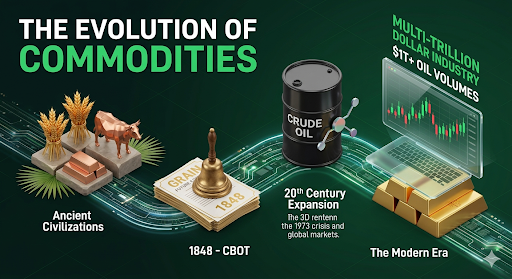
Commodity trading is arguably the oldest form of organized commerce in human history. Ancient civilizations in Mesopotamia, Egypt, and China all developed systems for trading grain, livestock, and metals.

The modern era of organized commodity trading began in 1848 with the founding of the Chicago Board of Trade (CBOT), established to create a centralized marketplace where grain producers and buyers could agree on standardized contracts. This eliminated the chaos of individualized negotiations and introduced the concept of futures contracts — agreements to buy or sell a commodity at a fixed price on a future date.

The 20th century brought the expansion of energy markets (particularly after the 1973 oil crisis), financial commodities, and eventually the rise of electronic trading platforms that opened commodity markets to a global retail audience. Today, commodity trading is a multi-trillion dollar global industry, with daily volumes in crude oil futures alone routinely exceeding $1 trillion in notional value.

Types of Commodities Traded

Commodities are broadly grouped into two categories: hard commodities (extracted or mined) and soft commodities (grown or farmed). Within these, markets are further divided into four main sectors.

Hard Commodities

Hard commodities are natural resources that are mined or extracted from the earth:

CategoryExamples
Precious MetalsGold, Silver, Platinum, Palladium
Industrial MetalsCopper, Aluminum, Nickel, Zinc, Iron Ore
EnergyCrude Oil (WTI & Brent), Natural Gas, Heating Oil, Gasoline, Coal

Gold deserves special mention — it functions simultaneously as a commodity, a store of value, and a financial safe-haven asset, which gives it unique price dynamics compared to other hard commodities.

Soft Commodities

Soft commodities are agricultural products and livestock:

CategoryExamples
Grains & OilseedsWheat, Corn, Soybeans, Rice, Canola
Tropical ProductsCoffee, Cocoa, Sugar, Cotton, Orange Juice
LivestockLive Cattle, Lean Hogs, Feeder Cattle

Soft commodities are particularly sensitive to weather events, crop disease, and seasonal cycles — factors that have no equivalent in stock markets, making them uniquely challenging to analyze and trade.

How Commodity Trading Works

Spot Markets vs. Futures Markets

There are two primary ways commodities change hands:

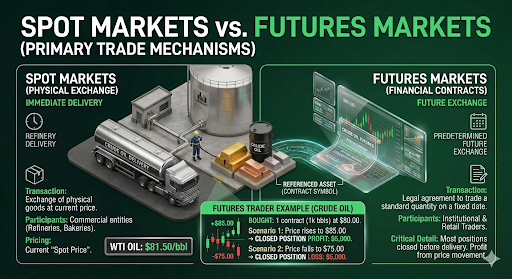
Spot Markets involve the immediate purchase and delivery of a physical commodity at the current market price (the “spot price”). Most spot market transactions are conducted between commercial participants — refineries buying crude oil, bakeries purchasing wheat flour — rather than retail traders.

Futures Markets are where the majority of financial trading activity occurs. A futures contract is a standardized legal agreement to buy or sell a specific quantity of a commodity at a predetermined price on a specified future date. Critically, most futures traders never intend to take physical delivery of the commodity — they close their positions before the delivery date and profit (or lose) based on price movement.

Example: A trader buys one WTI crude oil futures contract (representing 1,000 barrels) at $80 per barrel. If oil rises to $85, they can close the position for a $5,000 profit before the delivery date. If it falls to $75, they incur a $5,000 loss.

Key Trading Instruments

Retail and institutional traders access commodity markets through several instruments:

InstrumentDescriptionBest For
Futures ContractsStandardized exchange-traded agreements on future deliveryActive traders, hedgers
Options on FuturesRight (not obligation) to buy/sell futures at a set priceRisk-limited speculation, hedging
Commodity ETFsExchange-traded funds tracking commodity prices or indexesLong-term investors, passive exposure
CFDs (Contracts for Difference)Derivative tracking commodity price without ownershipShort-term traders (where regulated)
Commodity StocksShares in mining, energy, or agricultural companiesStock investors seeking commodity exposure
Physical OwnershipActual bullion, coins, etc.Long-term gold/silver investors

Each instrument carries a different risk-reward profile. Futures offer the highest leverage and liquidity but require margin management. ETFs are the simplest entry point but may underperform spot prices due to “roll costs” in contango markets.

Major Commodity Exchanges Around the World

Commodity trading is conducted on regulated exchanges that provide transparency, standardization, and counterparty protection. The most important include:

ExchangeLocationKey Commodities
CME Group (CBOT, NYMEX, COMEX)Chicago / New YorkGrains, crude oil, natural gas, gold, copper
ICE (Intercontinental Exchange)Atlanta / LondonBrent crude, sugar, coffee, cocoa, cotton
LME (London Metal Exchange)LondonAluminum, copper, zinc, nickel, lead, tin
SHFE (Shanghai Futures Exchange)ShanghaiCopper, aluminum, gold, rubber, steel
DCE (Dalian Commodity Exchange)DalianIron ore, soybeans, corn, palm oil
MCX (Multi Commodity Exchange)MumbaiGold, silver, crude oil, base metals

The CME Group is the world’s largest derivatives exchange by trading volume. For energy traders, NYMEX (WTI crude oil) and ICE (Brent crude) are the two dominant benchmarks that effectively set global oil prices.

Who Trades Commodities and Why?

Commodity markets attract a diverse ecosystem of participants, each with different motivations:

  1. Hedgers (Commercial Users) These are producers and consumers of physical commodities who use futures to lock in prices and protect business margins. A gold mining company might sell gold futures to guarantee a minimum revenue; an airline buys jet fuel futures to cap its costs. Hedging is not speculation — it is risk management in its purest form.
  2. Speculators Speculators take on price risk in pursuit of profit. They provide essential market liquidity. This group spans everything from individual day traders using CFDs to massive hedge funds running algorithmic strategies across energy and metals markets.
  3. Arbitrageurs These participants exploit price discrepancies between related markets, delivery dates, or geographic locations. Their activity helps keep prices consistent across markets.
  4. Index and Passive Investors Institutional investors — pension funds, sovereign wealth funds — often gain commodity exposure through commodity indexes (like the S&P GSCI or Bloomberg Commodity Index) as a diversification and inflation-hedging tool within a broader portfolio.

What Drives Commodity Prices?

This is where commodity analysis genuinely diverges from stock analysis. Commodity prices are governed by a unique set of fundamental and macro forces:

Supply-Side Factors

  • Production levels: OPEC+ output decisions, mine supply disruptions, crop harvests
  • Inventory/stockpile data: Weekly EIA crude oil inventory reports, for instance, are among the most market-moving data releases in commodities
  • Geopolitical risk: Sanctions, wars, or political instability in producing regions (e.g., Russia-Ukraine conflict and wheat/gas prices in 2022)
  • Weather and climate events: Droughts, floods, and hurricanes can devastate agricultural output or disrupt energy infrastructure

Demand-Side Factors

  • Global economic growth: Commodity demand is closely correlated with industrial output — particularly in China, which is the world’s largest consumer of most major commodities
  • Currency strength: Commodities are priced in USD globally — when the dollar weakens, commodities become cheaper in other currencies, boosting demand and prices
  • Technological change: The EV revolution, for example, is structurally shifting demand from oil toward lithium, cobalt, and copper

Financial/Speculative Factors

  • Interest rate expectations (higher rates strengthen the USD, often pressuring commodity prices)
  • Futures market positioning (extreme speculative positioning can amplify or reverse price trends)
  • Inflation expectations (commodities are widely used as an inflation hedge, so CPI data moves markets)

Commodity Trading vs. Stock Trading

Understanding the key differences helps traders set realistic expectations and choose the right approach:

FactorCommodity TradingStock Trading
Underlying AssetRaw materials, energy, agricultural goodsOwnership stakes in companies
Primary DriversSupply/demand, weather, geopolitics, macroEarnings, management, sector trends
LeverageTypically high (futures require small margin)Lower (standard equity accounts)
Market HoursNear 24-hour trading on most major contractsExchange hours (e.g., 9:30–4:00 ET for NYSE)
Inflation HedgeStrong — commodities often rise with inflationMixed — stocks can struggle in high inflation
Expiry/Roll RiskFutures contracts expire; positions must be rolledNo expiry for stocks
VolatilityGenerally higher, event-drivenVaries; typically lower for large-caps
Entry BarrierModerate-to-high for futures; low for ETFsLow

Neither is inherently superior — the right choice depends on your capital, risk tolerance, time horizon, and market knowledge.

Risks of Commodity Trading

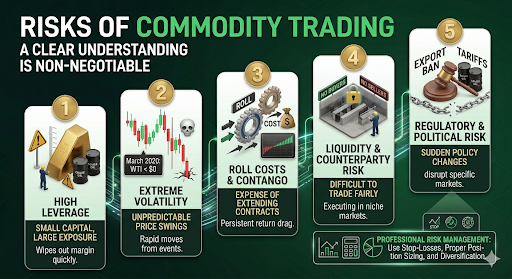
Commodity trading is not suitable for everyone. A clear-eyed understanding of the risks is non-negotiable:

  1. High Leverage Risk Futures contracts control large quantities of commodities for a relatively small margin deposit. A 5% adverse price move on a leveraged position can wipe out 50–100% of deposited margin. This cuts both ways — it is the primary reason commodity trading can be both highly profitable and highly destructive.
  2. Volatility and Event Risk Commodity prices can move dramatically and rapidly in response to unexpected events. The March 2020 oil price crash — when WTI briefly traded at negative prices — is an extreme but real example of how quickly conditions can change.
  3. Roll Costs and Contango ETF investors and traders who hold long-term positions in futures markets face “roll costs” — the expense of rolling from expiring contracts to new ones. In a contango market (where future prices are higher than spot), this creates a persistent drag on returns.
  4. Counterparty and Liquidity Risk In OTC markets and less-traded contracts, finding a buyer or seller at a fair price can be difficult. Exchange-traded contracts on major commodities have strong liquidity, but niche markets can be dangerously illiquid.
  5. Regulatory and Political Risk Export bans, tariffs, sanctions, and changes in environmental regulation can all dramatically affect specific commodity markets with little warning.

Risk management note: Professional commodity traders routinely use stop-loss orders, position sizing rules (risking no more than 1–2% of capital per trade), and diversification across uncorrelated commodities to manage these risks. Retail traders should adopt the same discipline.

How to Start Trading Commodities

Getting started in commodity trading requires a structured approach. Here is a practical roadmap:

Step 1: Educate Yourself Before placing any trade, develop a solid understanding of the specific commodity markets you intend to trade — their fundamental drivers, typical volatility, and key data releases. Treat this phase as mandatory, not optional.

Step 2: Choose Your Instrument

  • Beginners: Start with commodity ETFs (e.g., GLD for gold, USO for oil) through a standard brokerage account — these offer commodity exposure without leverage or expiry complexity.
  • Intermediate traders: Explore commodity CFDs or futures through regulated brokers, starting with highly liquid contracts (gold, crude oil, corn).
  • Advanced traders: Pursue a futures account at a regulated broker (e.g., CME-clearing members), with full access to the futures ecosystem.

Step 3: Select a Regulated Broker Ensure your broker is regulated by a recognized financial authority (FCA, CFTC/NFA, ASIC, CySEC). Verify margin requirements, fees, and available commodity markets before opening an account.

Step 4: Build and Test a Trading Plan Define your entry criteria, exit criteria, position sizing rules, and risk limits before trading. Paper trade (simulated trading) for at least 30–60 days to validate your approach without risking real capital.

Step 5: Start Small and Scale Gradually Begin with minimal position sizes. The objective in early trading is to learn, not to generate maximum returns. Increase position sizes only as your strategy proves consistently profitable.

Commodity Trading Strategies

There is no single “best” strategy — the right approach depends on your time horizon, resources, and analytical edge:

  1. Trend Following The most widely used institutional strategy in commodities. Traders identify sustained directional moves (using moving averages, breakout systems, or momentum indicators) and ride them until reversal signals emerge. Commodities often trend powerfully due to sustained supply/demand imbalances.
  2. Seasonal Trading Many commodities exhibit predictable seasonal price patterns. Natural gas prices historically rise ahead of winter; crop prices often peak during planting uncertainty and soften post-harvest. Seasonal strategies use historical data to identify recurring patterns and position accordingly.
  3. Spread Trading Rather than outright direction, spread traders profit from the price relationship between two related contracts — for example, the crack spread (refiners’ margin between crude oil and gasoline/heating oil) or calendar spreads (price difference between near and far delivery months). Spread trading often carries lower margin requirements and reduced volatility.
  4. Fundamental/Macro Trading Traders analyze supply-demand balances, inventory trends, crop reports, and macroeconomic conditions to take medium-to-long-term positions. This approach requires deep sector knowledge and patience, but can generate outsized returns when a fundamental thesis plays out correctly.
  5. 5. Range/Mean Reversion In sideways markets with well-defined support and resistance, traders buy pullbacks and sell rallies within the established range. This strategy works well in low-volatility consolidation periods but can produce large losses in trending conditions.

Conclusion

Commodity trading is one of the world’s oldest and most economically vital forms of financial activity, connecting the production of physical goods with global financial markets. Whether you are an individual trader seeking to diversify a portfolio, a business hedging against input cost volatility, or simply someone trying to understand why oil prices affect everything from grocery bills to airline tickets — commodity markets sit at the heart of the global economy.

The core principles are straightforward: commodities are real, finite resources whose prices are governed by supply, demand, and the full spectrum of global events.

Trading them requires understanding those fundamentals, choosing the right instruments for your risk tolerance, and maintaining rigorous discipline in risk management.

FAQs

Is commodity trading profitable?

Commodity trading can be profitable, but it demands skill, discipline, and robust risk management. Statistics show that the majority of retail traders who use leverage lose money. Profitability is achievable — but it requires treating trading as a skilled profession, not a shortcut to wealth.

You can start with commodity ETFs through a standard brokerage account with as little as a few hundred dollars. Futures trading requires a funded margin account — minimums vary by broker and contract, but typically range from $1,000 to $10,000 for retail access to major markets.

Historically, yes. Because commodities are the raw materials that feed into the prices of goods and services, they tend to rise during inflationary periods. Gold, energy, and broad commodity baskets have demonstrated meaningful positive correlation with inflation over multi-year periods. However, they can underperform in deflationary or recessionary environments.

Gold is often recommended for beginners — it is highly liquid, well-researched, and its price drivers (USD strength, real interest rates, risk sentiment) are relatively transparent compared to agricultural or energy markets. Crude oil is highly liquid but significantly more volatile and event-driven.

A spot contract involves immediate (or near-immediate) delivery and payment at the current market price. A futures contract fixes a price today for delivery at a specified future date, allowing both parties to plan ahead and manage price risk.

Author

Reach the new peaks of trading with FXNovus

Online broker of a new generation. Creating a new trading reality

Scroll to Top