Introduction
NAGA and AvaTrade both court the same audience: retail traders who want a friendly multi-asset platform with copy trading built in. Underneath the similar pitch, however, sit two very different companies, and in 2026 the gap between them is wider than their marketing suggests.
AvaTrade is the better broker for most people. Founded in Dublin in 2006, it is regulated in nine jurisdictions across six continents, has run for two decades without a material regulatory blemish, and pairs commission-free fixed-spread pricing with genuinely unique features: AvaProtect trade insurance covering losses up to $1 million per position, vanilla FX options through AvaOptions, and exchange-traded futures through AvaFutures with TradingView integration. Its education is among the best in the industry.
NAGA is the more interesting choice for social-first traders and stock investors. The Frankfurt-listed fintech, enlarged by its 2024 merger with CAPEX.com, offers a true social network experience with Autocopy, real stock investing at zero commission, a multi-currency account with its own MasterCard, and 4,000+ instruments. But it carries baggage a trustworthiness-focused comparison cannot ignore: a EUR 150,000 CySEC settlement over 2021 to 2022 compliance breaches, a Trustpilot score currently suspended over review-acquisition practices, wider-than-average spreads on entry accounts, and a punishing $50 per month inactivity fee.
If you want the safest, most rounded package, choose AvaTrade. If the social feed, real shares and fintech extras matter more than razor pricing and a spotless record, NAGA is a legitimate, regulated alternative. The details follow.
Comparison Table
| Feature | NAGA | AvaTrade |
|---|---|---|
| Founded | 2015 | 2006 |
| Headquarters | Germany (group); Cyprus (EU entity) | Dublin, Ireland |
| Regulation | CySEC, FSA Seychelles, FSCA, ADGM | Central Bank of Ireland, ASIC, FSA Japan, FSCA, ADGM/FSRA, ISA, BVI FSC, CIRO and more |
| Publicly Listed | Yes, The NAGA Group AG (Frankfurt) | No (private company) |
| Minimum Deposit | From about $50 (tier dependent) | $100 ($300 Canada; $1,000 AvaOptions) |
| Trading Platforms | NAGA Trader (web/app), MT4, MT5 | MT4, MT5, WebTrader, AvaTradeGO, AvaOptions, AvaFutures |
| Tradable Assets | 4,000+ incl. real stocks | 1,250+ (CFDs, options, futures) |
| Maximum Leverage | 1:30 EU retail; up to 1:1000 offshore | 1:30 EU retail; up to 1:400 international |
| Spreads | From about 1.1 to 1.7 pips (entry tiers) | Fixed, from 0.9 pips EUR/USD |
| Commissions | None on CFDs; $0 real stocks | None (built into fixed spreads) |
| Inactivity Fee | $50 per month | $50 per quarter + $100 annual after 12 months |
| Account Types | Tiered (spread improves with deposit), Islamic, Demo | Retail, Professional, Islamic, Options, Futures, Demo |
| Demo Account | Yes | Yes |
| Islamic Account | Yes | Yes |
| Copy Trading | Yes, NAGA Autocopy (native) | Yes, via AvaSocial, DupliTrade, ZuluTrade |
| Social Trading | Yes, full social network | Partial (community features) |
| Risk Tools | Standard stops | AvaProtect insurance up to $1M per trade |
| Mobile Trading | Yes, NAGA app | Yes, AvaTradeGO (4.6 iOS / 4.4 Android) |
| Desktop/Web Platform | NAGA Trader, MT4/MT5 | MT4/MT5, WebTrader |
| Educational Resources | NAGA Academy, webinars | AvaAcademy, extensive and award-winning |
| Research Tools | Trading Central | Trading Central, Capitalise.ai |
| Customer Support | 24/5 multilingual | 24/5 multilingual, ~3 min response tested |
| Deposit Methods | Cards, wire, e-wallets | Cards, wire, Skrill, Neteller, WebMoney, more |
| Withdrawal Methods | Same; flat fee may apply | Same, no broker fees |
| Processing Time | Instant to 5 business days | Typically 1 to 3 business days |
| Investor Protection | ICF €20k (CySEC entity), negative balance protection | ICCL (Ireland), negative balance protection for all retail clients |
Conditions vary by entity and change often. Confirm current figures on the official NAGA and AvaTrade websites before opening an account.
Company Overview
NAGA
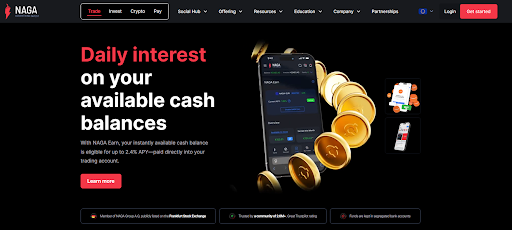
NAGA was founded in Germany in 2015 and staged one of the country’s most successful fintech IPOs in 2017; The NAGA Group AG remains listed on the Frankfurt Stock Exchange, which obliges it to publish audited financial statements, a transparency layer few CFD brokers offer. Its defining idea has never changed: trading as a social network. The NAGA platform combines a feed, leaderboards and its Autocopy system, which automatically mirrors the trades of top-performing members, who in turn earn bonuses when they are copied.
The company transformed in August 2024, when its merger with CAPEX.com (Key Way Group) completed. The combined group, led by CEO Octavian Patrascu, operates around eight licenses, reported EUR 31.7 million in revenue for the first half of 2024, and serves a community exceeding 1.5 million registered users. Product-wise, NAGA is more fintech super-app than pure broker: alongside 4,000+ tradable instruments including real stocks at zero commission, it offers multi-currency accounts (EUR, USD, GBP, PLN and more), the NAGA MasterCard for spending directly from the account, NAGA Pay, and even a Telegram-integrated trading app launched in 2024.
Two trust items belong in any honest overview. In 2024, CySEC concluded a EUR 150,000 settlement with NAGA Markets Europe Ltd over regulatory breaches during 2021 and 2022. And as of mid-2026, Trustpilot has suspended the public display of NAGA’s rating after detecting non-compliant review-acquisition practices, leaving roughly 4,300 reviews with mixed sentiment visible but unscored. Neither event makes NAGA unsafe, but both are facts a prospective client should weigh.
AvaTrade

AvaTrade was founded in Dublin in 2006 and has grown into one of the most broadly regulated retail brokers in existence: licenses from the Central Bank of Ireland, ASIC in Australia, Japan’s FSA, South Africa’s FSCA, Abu Dhabi’s ADGM/FSRA, Israel’s ISA, the BVI FSC and Canada’s CIRO give it authorization on six continents. It serves more than 400,000 clients from 16 offices with a clean two-decade record and a Trustpilot rating around 4.6.
The broker’s model is deliberately old-school in one way and innovative in others. It is a market maker offering commission-free trading on fixed spreads (EUR/USD from 0.9 pips), which sacrifices raw cheapness for cost predictability. Around that core it has built an unusually deep product shell: AvaOptions for vanilla FX options, AvaFutures for exchange-traded futures (expanded in 2025 with CME Micro Grain contracts and TradingView integration), spread betting for UK and Irish clients, and its signature AvaProtect feature, a purchasable insurance that reimburses losses on a protected position, up to $1 million per trade, if it closes negative within the chosen window. No other major broker offers anything comparable. Education through AvaAcademy is consistently rated among the best for beginners, and copy trading runs through AvaSocial, DupliTrade and ZuluTrade.
Regulation & Safety
AvaTrade is the heavyweight here. Nine licenses across tier-1 and tier-2 jurisdictions, Central Bank of Ireland oversight with ICCL investor compensation for eligible clients, segregated client funds, and, unusually, negative balance protection extended to all retail clients worldwide rather than only where regulators force it. Twenty years without a material enforcement action rounds out one of the strongest trust profiles in the CFD industry. The main structural caveat is universal to the sector: clients of non-EU entities fall outside EU compensation schemes.
NAGA operates through NAGA Markets Europe Ltd under CySEC (license 204/13), with ICF compensation up to EUR 20,000 for eligible EU clients, plus NAGA Capital Ltd under the Seychelles FSA for international clients (no compensation scheme), and further coverage via the FSCA and ADGM from the CAPEX side. Funds are segregated at tier-1 banks and negative balance protection applies to retail clients of both main entities. The Frankfurt listing adds audited transparency. Against that stand the CySEC settlement and the Trustpilot suspension described above, and the practical reality that many non-EU clients trade under the lightly regulated Seychelles entity.
Trust verdict: AvaTrade, clearly. NAGA is regulated and transparent as a listed company, but AvaTrade’s breadth of licensing and unblemished record put it in a different tier.
Trading Products
NAGA advertises more than 4,000 instruments: roughly 80 forex pairs, CFDs on indices, commodities, cryptocurrencies, ETFs and futures, plus real stock investing with zero commission, a genuine differentiator against CFD-only rivals. The multi-currency wallet and MasterCard extend the ecosystem beyond trading altogether. Crypto CFD availability varies by entity, and UK-style restrictions apply where relevant.
AvaTrade offers 1,250+ instruments: 50+ forex pairs, 600+ stock CFDs, 58 ETF CFDs, around 30+ index CFDs, commodities, bonds and a large crypto CFD range, and then two categories NAGA lacks entirely: vanilla FX options through AvaOptions (with professional options analytics) and real exchange-traded futures through AvaFutures, including CME micro contracts at $0.75 per trade. What it does not offer is real share ownership; every equity position is a derivative.
Verdict: NAGA for raw instrument count and real shares; AvaTrade for derivatives sophistication (options, listed futures, spread betting). Investors who want to actually own stock lean NAGA; traders who want structured risk products lean AvaTrade.
Trading Platforms
NAGA centers on its proprietary NAGA Trader platform (web, desktop and a highly rated mobile app), where the social feed, leaderboards and Autocopy live, with MT4 and MT5 available for traditionalists and EA users. The experience is closer to a fintech app than a trading terminal: slick, social and mobile-first, with Trading Central research integrated. The Telegram trading integration launched in 2024 is a curiosity few rivals match.
AvaTrade fields one of the widest platform stables in retail trading: MT4 and MT5 (full EA support), the proprietary WebTrader with 90+ indicators, the flagship AvaTradeGO mobile app, AvaOptions for options strategies, AvaFutures (now with TradingView connectivity), AvaSocial for copy trading, DupliTrade and ZuluTrade integrations, and Capitalise.ai for natural-language automation. The main gaps: no cTrader, and TradingView reaches only the futures side for now.
Verdict: NAGA wins for social experience in a single app; AvaTrade wins for breadth, automation options and specialist platforms. MetaTrader users are equally served at both.
Trading Costs
Neither broker competes with ECN houses on raw pricing, but their structures differ meaningfully.
Spreads. NAGA’s entry tiers price EUR/USD from roughly 1.1 pips, with independent testing recording averages around 1.7 pips on the lowest tier; spreads tighten with account level, reaching about 0.7 pips only at deposit tiers most retail traders will never touch. AvaTrade’s fixed spreads start at 0.9 pips on EUR/USD regardless of deposit size, with the fixed structure meaning no widening during normal news volatility, a real benefit for beginners who fear slippage surprises. On typical entry-level accounts, AvaTrade is simply cheaper per trade.
Commissions. Both are commission-free on CFDs. NAGA adds zero-commission real stock investing; AvaTrade charges around 0.13% on stock CFDs via spread and $0.75 to $1.75 per futures contract on AvaFutures.
Non-trading fees. This is where both brokers demand attention, and NAGA more so. NAGA charges a $50 per month inactivity fee, among the most aggressive in the industry, and flat withdrawal fees can apply depending on account type. AvaTrade charges no deposit or withdrawal fees, but applies a $50 per quarter inactivity fee after three months of dormancy plus a $100 annual administration fee after twelve, also steep, though roughly a quarter of NAGA’s dormancy cost over a year. AvaProtect premiums (typically 1 to 3% of position size) are optional and disclosed before purchase. Overnight swaps apply at both; AvaTrade’s were measured as relatively low, and crypto spreads at both brokers run wide.
| Cost Item | NAGA | AvaTrade |
|---|---|---|
| EUR/USD spread (entry account) | From approx. 1.1 pips (approx. 1.7 avg) | Fixed 0.9 pips |
| Spread model | Variable, tier-based | Fixed |
| CFD commissions | None | None |
| Real stocks | $0 commission | Not offered (CFDs only) |
| Futures | CFD futures | Listed futures from $0.75 (micros) |
| Inactivity fee | $50 per month | $50 per quarter + $100/year after 12 months |
| Deposit/withdrawal fees | Withdrawal fee may apply | None |
| Trade insurance | No | AvaProtect (premium 1 to 3%) |
Cost verdict: AvaTrade for active and semi-active CFD traders; NAGA only pulls ahead for commission-free real-stock investing. Dormant accounts bleed at both, but four times faster at NAGA.
Account Types
NAGA runs a tiered account ladder (entry tiers from roughly $50, with names such as Iron ascending to premium levels) where higher balances unlock tighter spreads, and notably, profits count toward upgrades for up to half the required minimum. Islamic swap-free accounts and a full demo are available; there are no ECN, raw-spread or cent accounts. Four of the six tiers let traders reduce effective costs by being copied through Autocopy, turning social performance into a fee discount.
AvaTrade keeps it simpler: one core retail account ($100 minimum; $300 in Canada), a professional account for qualifying experienced clients (higher leverage, fewer protections), Islamic accounts on request, plus the specialist AvaOptions ($1,000 minimum) and AvaFutures accounts. A free demo mirrors live conditions. The single-account structure is beginner-friendly but leaves high-volume traders nothing to negotiate toward, no raw tier exists.
| Account Feature | NAGA | AvaTrade |
|---|---|---|
| Entry minimum | From about $50 | $100 |
| Structure | Tiered, deposit-linked spreads | Single retail account |
| Raw/ECN option | No | No |
| Options account | No | Yes (AvaOptions) |
| Futures account | No (CFDs only) | Yes (AvaFutures) |
| Islamic | Yes | Yes |
| Earn from being copied | Yes (Autocopy bonuses) | No direct equivalent |
Deposits & Withdrawals
NAGA accepts cards, bank transfer and a set of e-wallets into a multi-currency account (EUR, USD, GBP, PLN and others), which elegantly avoids conversion fees, and funds can be spent directly via the NAGA MasterCard. Deposits are free; withdrawals process from instantly up to five business days, and a flat withdrawal fee can apply depending on account tier. Reviewers note the payment-method list is narrower than at global rivals.
AvaTrade accepts cards, wire transfer, Skrill, Neteller, WebMoney and various regional methods, with zero deposit or withdrawal fees and processing typically inside one to three business days. Crypto funding is not supported, and EU/Australian payment options are slimmer than elsewhere. Base currencies are more limited than NAGA’s wallet approach.
| Funding Feature | NAGA | AvaTrade |
|---|---|---|
| Cards / wire | Yes | Yes |
| E-wallets | Yes (selection) | Yes (Skrill, Neteller, more) |
| Multi-currency wallet | Yes, with MasterCard | No |
| Crypto funding | Varies by entity | No |
| Broker withdrawal fee | May apply | None |
| Typical processing | Instant to 5 days | 1 to 3 days |
Research & Education
AvaTrade is the category leader between these two. AvaAcademy delivers structured, jargon-free courses that have won it best-broker-for-beginners recognition, backed by Trading Central research, Capitalise.ai automation, market analysis videos and a genuinely useful in-app education layer inside AvaTradeGO. In-house analysis is lighter than at giants like IG, but the third-party stack fills the gap.
NAGA offers NAGA Academy courses, webinars and Trading Central integration, competent, improving, but thinner and less structured than AvaTrade’s program. Its real educational asset is arguably the social feed itself, where beginners watch real traders’ decisions in real time, for better and worse.
Verdict: AvaTrade by a clear margin for formal education; NAGA for learning-by-watching social dynamics.
Customer Support
| Support Channel | NAGA | AvaTrade |
|---|---|---|
| Live chat | Yes | Yes |
| Phone | Limited | Yes |
| Yes | Yes | |
| Multilingual | Yes | Yes, localized desks |
| Coverage | 24/5 | 24/5 |
Mobile Trading Experience
NAGA’s app is the company’s soul: feed, Autocopy, portfolio, payments and card management in one place, closer to a neobank-meets-social-network than a trading terminal, and very well executed for that audience.
AvaTradeGO is one of the highest-rated broker apps anywhere (4.6 on iOS, 4.4 on Android), with clean charting, market-sentiment insights, price alerts and the exclusive mobile home of AvaProtect, letting you insure a position in two taps. AvaSocial handles the copy side in a separate app, which fragments the experience slightly.
Verdict: both excellent; NAGA for a unified social-fintech app, AvaTrade for trading-first polish plus the AvaProtect edge.
Pros & Cons
NAGA
Pros
- True social trading network with native Autocopy and 1.5M+ community
- Publicly listed on the Frankfurt Stock Exchange with audited accounts
- 4,000+ instruments including real stocks at zero commission
- Multi-currency accounts, NAGA MasterCard and fintech extras
- Copied traders earn bonuses; being copied reduces effective costs
- Low entry from about $50 with a tiered upgrade path
Cons
- EUR 150,000 CySEC settlement over 2021 to 2022 compliance breaches
- Trustpilot rating suspended in 2026 over review-acquisition practices
- Entry-tier spreads (approx. 1.1 to 1.7 pips) are above average; no ECN/raw account
- $50 per month inactivity fee, among the industry’s harshest
- Best pricing locked behind very high deposit tiers
- Many international clients onboard under the Seychelles entity
AvaTrade
Pros
- Nine licenses across six continents with a clean 20-year record
- AvaProtect trade insurance up to $1 million per position, unique in the market
- Fixed spreads from 0.9 pips: predictable costs, no news-spike widening
- AvaOptions (vanilla FX options) and AvaFutures (CME micros, TradingView)
- Award-winning AvaAcademy education and top-rated AvaTradeGO app
- Negative balance protection for all retail clients, free deposits and withdrawals
Cons
- Market maker with no raw/ECN tier; scalpers will pay more than at ECN brokers
- $50 quarterly inactivity fee plus $100 annual administration fee
- No real share ownership; everything is a CFD, option or future
- No cTrader; TradingView limited to futures
- Wide crypto spreads; no crypto funding
- Not available to US residents
Who Should Choose NAGA?
Choose NAGA if the community is the product you actually want. Social-first traders get the most complete feed-and-copy ecosystem outside eToro, aspiring signal providers get paid when others copy them, and long-term investors get real stocks at zero commission inside the same app as their CFD trading, their multi-currency wallet and their payment card. The listed-company transparency partially offsets the trust wobbles, provided you go in with open eyes: trade actively (that monthly inactivity fee punishes dormancy), stay on the CySEC entity if you are eligible, and accept that entry-tier spreads cost more than at execution-focused brokers.Choose eToro if you are investing rather than operating. First-time stock buyers get commission-light real shares in an interface that explains itself; passive investors get CopyTrader and Smart Portfolios to outsource decision-making from $200; crypto-curious users get 100+ coins inside a regulated, insured platform rather than an offshore exchange; and US residents get one of the few social-investing platforms legally open to them. The trade-offs, higher CFD spreads, non-trading fees and limited pro tooling, simply do not bite the buy-and-hold, copy-and-forget audience eToro is built for.
Who Should Choose AvaTrade?
Choose AvaTrade if safety, predictability and product depth top your list. Beginners get the industry’s friendliest education plus fixed spreads that never ambush them during news; risk-averse traders get AvaProtect, effectively a stop-loss with a refund, for their highest-conviction positions; and advancing traders can graduate into vanilla options and real listed futures without changing broker. Swing and position traders benefit from its comparatively low swap rates. Just set a calendar reminder if you ever pause trading: the dormancy fees are real, and the absence of a raw-spread tier means dedicated scalpers should look at ECN brokers instead.
Final Verdict
AvaTrade wins this comparison for the majority of traders. Its regulatory depth is in the industry’s top tier, its record is spotless, its fixed 0.9-pip pricing beats NAGA’s entry tiers, and AvaProtect, AvaOptions and AvaFutures give it product capabilities NAGA cannot answer. It is the safer, cheaper and more complete broker as of 2026.
NAGA remains a defensible pick for a specific trader: one who values the social network, wants commission-free real stocks beside CFDs, and appreciates the fintech wallet-and-card ecosystem, and who is comfortable weighing the CySEC settlement, the Trustpilot suspension and the aggressive inactivity fee against those strengths.
Whichever you choose, verify which entity will hold your account, avoid dormancy at both, and remember the sector-wide truth both brokers disclose: roughly three-quarters of retail CFD accounts lose money. Trade only with capital you can afford to lose.
Frequently Asked Questions
Is NAGA or AvaTrade safer?
AvaTrade has the stronger trust profile: nine licenses (including the Central Bank of Ireland, ASIC and Japan’s FSA), a clean 20-year record and negative balance protection for all retail clients. NAGA is genuinely regulated (CySEC, FSCA, ADGM, Seychelles FSA) and publicly listed, but carries a EUR 150,000 CySEC settlement from 2024 and a suspended Trustpilot rating as of 2026.
Which broker has lower trading costs?
AvaTrade for most traders: fixed EUR/USD spreads from 0.9 pips versus NAGA’s roughly 1.1 to 1.7 pips on entry tiers. NAGA’s spreads only become competitive at high deposit tiers. Neither offers an ECN or raw-spread account, so cost-obsessed scalpers should look elsewhere entirely.
Do both brokers offer copy trading?
Yes, differently. NAGA’s Autocopy is native to its social platform, with copied traders earning bonuses and over a million members to follow. AvaTrade delivers copy trading through AvaSocial, DupliTrade and ZuluTrade, solid, but less integrated than NAGA’s network.
Can I buy real stocks at NAGA or AvaTrade?
Only at NAGA, which offers real stock investing at zero commission alongside its CFDs. At AvaTrade every equity position is a CFD; it compensates with vanilla FX options (AvaOptions) and real exchange-traded futures (AvaFutures), which NAGA lacks.
What is AvaProtect?
AvaProtect is AvaTrade’s proprietary trade insurance. For a premium (typically 1 to 3% of position size, quoted before execution), losses on a protected position are reimbursed in cash if it closes negative within the chosen window (up to $1 million per trade), while profits remain yours. It works in AvaTradeGO and WebTrader on market orders.
What are the inactivity fees?
Both are steep, NAGA more so: $50 per month after dormancy at NAGA, versus $50 per quarter plus a $100 annual administration fee after 12 months at AvaTrade. Casual traders who pause for long stretches should factor this heavily or withdraw idle balances.
What are the minimum deposits?
NAGA starts from around $50 depending on region and tier. AvaTrade requires $100 for standard accounts, $300 for Canadian clients and $1,000 for AvaOptions.
Which platforms do they support?
NAGA: its proprietary NAGA Trader (web, desktop, mobile, plus a Telegram integration) alongside MT4 and MT5. AvaTrade: MT4, MT5, WebTrader, AvaTradeGO, AvaOptions, AvaFutures (with TradingView connectivity), AvaSocial, DupliTrade and Capitalise.ai. Neither offers cTrader.
Is NAGA really publicly listed?
Yes. The NAGA Group AG trades on the Frankfurt Stock Exchange and publishes audited financials; its 2024 merger with CAPEX.com brought new leadership under CEO Octavian Patrascu and reported EUR 31.7 million in H1 2024 revenue. AvaTrade, by contrast, is privately held.
Do these brokers accept US clients?
No. Neither NAGA nor AvaTrade accepts US residents. NAGA also excludes Japan, Canada and Belgium among others, while AvaTrade serves Japan and Canada through locally regulated entities.
Which broker is better for beginners?
AvaTrade, primarily for its AvaAcademy education, fixed spreads (no surprise widening), top-rated app and AvaProtect safety net. NAGA appeals to beginners who prefer learning socially by following and copying live traders, but its costs and fee structure demand more vigilance.
Do NAGA and AvaTrade offer Islamic accounts?
Yes, both provide swap-free Islamic accounts on request, replacing overnight interest with alternative fee structures. Terms vary by instrument and entity, so review the current schedules before converting an account.